




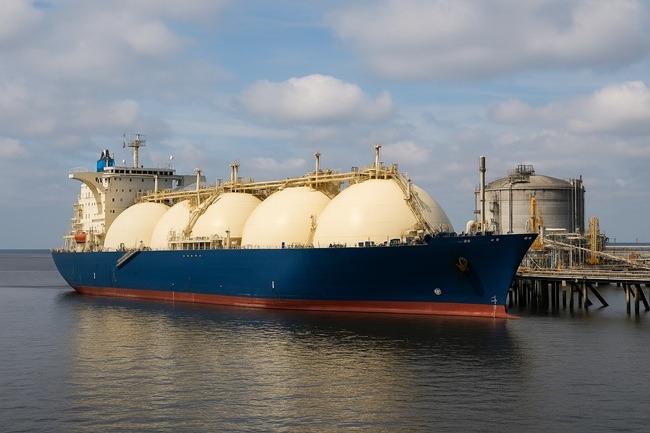
Santos Limited (ASX: STO) has shipped the first liquefied natural gas cargo from the Barossa Gas Project to Japan’s Sakai terminal, marking a pivotal execution milestone for one of Australia’s largest upstream developments in over a decade. The cargo, loaded onto the Kool Blizzard vessel from the Darwin LNG terminal, comes just six months behind the original start target and within the project’s sanctioned budget.
The development transitions Darwin LNG from legacy Bayu-Undan feedstock to a new long-term supply source, positioning Barossa as a key pillar in Santos’ Asia-facing LNG growth strategy. Joint venture partners PRISM Energy International Australia (37.5 percent) and JERA Australia (12.5 percent) join Santos in the 3.4 million tonnes per annum (MTPA) venture.
With regional demand for reliable LNG surging and geopolitical tension forcing energy buyers to re-diversify sourcing, Barossa’s arrival may reshape investment appetites, infrastructure utilization rates, and off-take dynamics in Australia’s Northern Territory and beyond.
How does the first Barossa cargo reshape the LNG narrative in the Northern Territory?
Barossa’s inaugural shipment represents more than just operational success—it resets the LNG narrative in northern Australia. The Bayu-Undan field, which historically underpinned the viability of the Darwin LNG terminal, has now ceased production. In its place, Barossa steps in with a high-CO₂ but economically compelling resource base located offshore, north of Darwin.
Unlike previous LNG projects that leaned heavily on large international operators and EPC contractors, Santos opted for a “self-execution” model, leaning on internal project management and supply chain orchestration. The company claims the project was delivered within budget and without tapping contingency buffers, despite construction challenges spanning the COVID-19 pandemic, legal disputes over approvals, and global logistics bottlenecks.
For the Northern Territory government, Barossa represents the anchor around which future LNG throughput, workforce development, and regional GDP are being forecast. According to the 2025–26 NT Budget, Barossa-driven export volumes are projected to lift Gross State Product by 7.8 percent in FY26, followed by a further 5.9 percent gain in FY27. Approximately 300 permanent positions are expected to be maintained over the project’s 20-year operational horizon.
The project’s infrastructure integration strategy—piping gas from the Barossa field into existing Darwin LNG assets—also sets a precedent for brownfield optimization, limiting upfront capital exposure while maximizing long-term utility.
What is the strategic significance of JERA’s offtake from Barossa for Japan’s energy diversification?
JERA Co., Inc., Japan’s largest power generation company, will offtake around 425,000 tonnes of LNG annually from Barossa, aligned with its 12.5 percent equity stake. For JERA, this cargo is more than a logistics milestone—it reinforces the company’s efforts to deepen upstream participation and hedge against supply volatility across its global LNG portfolio.
The timing is strategic. As Asia’s energy demand rebounds and regional policy shifts begin to re-embrace LNG as a critical “transition fuel,” JERA is repositioning itself as not just a buyer, but a vertically integrated player. Barossa enhances JERA’s ability to control supply-side risk, secure competitive pricing, and backstop fuel availability for Japan’s thermal fleet—still a significant component of its baseload generation.
This comes amid broader geopolitical uncertainty in the LNG market, with ongoing tensions in the Red Sea, U.S. liquefaction delays, and questions around long-term Qatari expansion capacity. For Japan, Australia remains one of the few politically aligned and logistically viable suppliers for secure and sustained LNG flows.
JERA’s Barossa investment also signals institutional confidence in Australian LNG longevity, even as net-zero targets and renewables deployment continue to reshape the region’s energy matrix.
What makes Santos’ execution approach different from past LNG mega-projects?
Santos’ self-execution model at Barossa stands in sharp contrast to earlier LNG megaprojects in Australia, which were often plagued by cost blowouts, delay cycles, and contractor overruns. By internalizing core project controls, Santos insulated itself from the worst of supply chain shocks and regulatory turbulence, enabling Barossa to progress without material delays.
The decision to take final investment decision (FID) in March 2021—at a time when many peers were scaling back capex—was viewed as counter-cyclical. Santos effectively bet that LNG demand would rebound post-COVID, and that integrated execution would offer better capital discipline than traditional outsourcing-heavy models. So far, that bet appears to be paying off.
Key risk mitigation factors included: staged approvals, leaner contractor scopes, and aggressive procurement alignment before major inflationary waves hit global construction costs. The result is a project that Santos says not only delivered within its original budget, but also avoided drawing on its contingency reserve—a rare feat for a greenfield offshore development.
With global capital markets increasingly focused on returns, execution certainty, and ESG compliance, the Barossa model could reframe how mid-cap operators and investors evaluate upstream LNG plays in politically stable jurisdictions.
How are community investment and Indigenous partnerships being structured for long-term impact?
Santos has embedded a unique community investment vehicle into the project design: the Barossa Aboriginal Future Fund. This fund will receive up to AUD 10 million annually to support infrastructure development, employment training, cultural continuity, and environmental stewardship across Aboriginal coastal communities in the Northern Territory.
While resource companies have long made social license investments, the scale and structure of this fund—built on predictable, project-linked contributions rather than discretionary grants—signals a shift toward embedded impact financing in energy projects.
For Aboriginal groups, the fund offers a clearer path to long-term economic participation and cultural autonomy. For Santos and its joint venture partners, it bolsters ESG credibility and preempts future tensions over land use, development approvals, and equity in resource benefit-sharing.
In a post-Voice referendum environment where Indigenous relations remain politically sensitive, Barossa’s proactive structure may emerge as a blueprint for balancing economic utility with social obligations in Australia’s resource sector.
How does the Barossa startup affect broader LNG market positioning for Australia?
The commissioning of Barossa stabilizes Australia’s LNG throughput at a time when other projects—such as Prelude FLNG and Ichthys—have faced intermittent production or operational risk. It also consolidates Darwin’s role as a viable LNG export hub for the Asia-Pacific region, reducing pressure on east coast terminals and reinforcing the country’s energy export reliability credentials.
With its proximity to Southeast Asian markets and existing infrastructure, Barossa reinforces Australia’s competitive advantage as a low-risk, low-lead-time LNG supplier compared to greenfield plays in Africa or North America. That has implications for contract renegotiations, new offtake agreements, and sovereign attractiveness for energy financing.
Barossa also reflects a subtle shift in global LNG dynamics—away from pure volumetric expansion toward optimization of existing infrastructure, joint venture derisking, and socially-integrated development models. As more economies seek LNG security while navigating transition targets, Australia’s model of infrastructure reuse plus regulated impact funding may find wider adoption.
Whether this makes Barossa a template for future projects or a one-off success story will depend on how the asset performs over the next few production years—and how Santos balances export performance with emerging decarbonization pressures on high-CO₂ fields.
What are the key takeaways on what this development means for the company, its competitors, and the industry?
- Santos has successfully loaded and shipped the first LNG cargo from Barossa to Japan, staying within budget and six months of the original target.
- Barossa replaces Bayu-Undan as feedstock for Darwin LNG, ensuring continuity of export operations and regional economic contribution.
- JERA’s offtake strengthens Japan’s LNG security while deepening its upstream exposure in Asia-Pacific energy assets.
- Santos’ self-execution strategy delivered a major upstream project during a volatile supply chain and pandemic era, avoiding cost overruns.
- Northern Territory GDP is projected to benefit significantly, with long-term employment and contract value expected to reach AUD 2.5 billion.
- The Barossa Aboriginal Future Fund introduces a new model for embedded, annualized Indigenous impact financing in LNG projects.
- Barossa reinforces Australia’s strategic LNG positioning in Asia amid growing demand and geopolitical realignments.
- The project’s success supports a shift toward brownfield optimization and asset-led infrastructure reuse over greenfield expansion.
- Santos’ capital discipline and delivery record may enhance investor confidence in mid-cap LNG operators with self-managed project models.
- Execution learnings from Barossa could shape future LNG project design, particularly around ESG integration and regional political alignment.
Discover more from Business-News-Today.com
Subscribe to get the latest posts sent to your email.
