



In the accelerating race to secure rare earth elements (REEs) for the global energy transition, developers and investors are increasingly turning their attention to unconventional extraction methods. One of the most promising is in-situ recovery, or ISR—a technique that offers the potential to unlock high-grade magnet metals without the disruptive environmental footprint of conventional mining.
For Brazilian Critical Minerals Limited (ASX: BCM), a Perth-headquartered explorer operating in Brazil’s Apuí region, ISR is more than just a technical alternative. It forms the backbone of the company’s long-term strategy to commercialize its flagship Ema rare earths project. The breakthrough came in July 2025, when BCM confirmed the successful field recovery of REEs using ISR and magnesium sulfate (MgSO₄) as the leaching agent. That milestone may not only redefine the economics of its own project, but also signal a wider shift toward greener, scalable rare earth extraction practices.
How does in-situ recovery (ISR) for rare earths differ from traditional open-pit or clay mining?
ISR, also known as solution mining, fundamentally reverses the paradigm of mineral extraction. Instead of physically removing and processing ore from the ground, ISR involves injecting a carefully formulated leaching solution directly into the mineralized zone. This solution mobilizes the targeted elements—in this case, rare earth ions—by dissolving them into a liquid state, which is then pumped back to the surface for recovery.
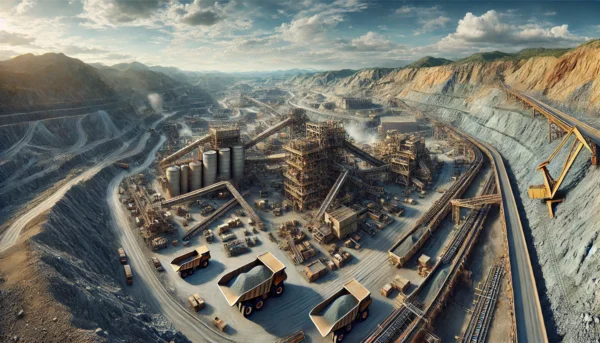
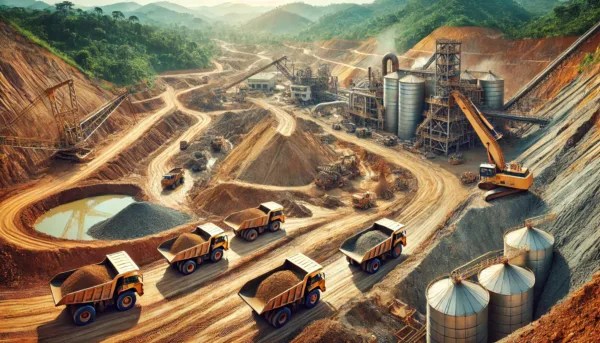
In traditional REE mining, especially in hard-rock deposits such as bastnäsite or monazite, operators must drill, blast, and crush ore, followed by complex beneficiation processes and hazardous chemical separation. The result is a high-energy, capital-intensive process often associated with toxic waste, tailings dams, and significant land disturbance.
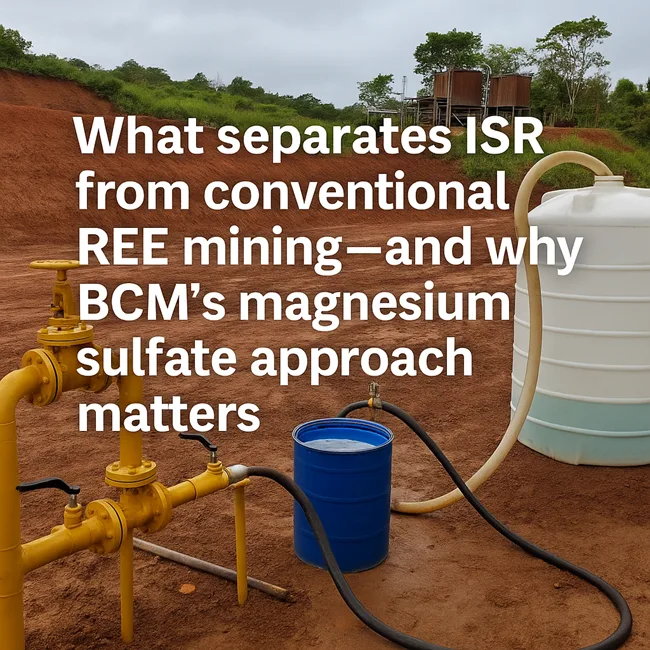
In contrast, ISR operations require minimal surface disruption. There are no pits, trucks, or tailings ponds. Infrastructure is limited to injection and extraction wells, solution tanks, and sometimes surface precipitation units. The entire extraction cycle occurs underground, making ISR more acceptable from a regulatory, social, and environmental standpoint—an increasingly crucial consideration in ESG-sensitive jurisdictions.
While ISR has long been used in uranium and copper mining, its application in rare earths is relatively recent and primarily focused on ionic adsorption clay (IAC) deposits, like those found in southern China. These soft, weathered clays allow for effective ion exchange with the leaching solution, which is essential for ISR to function at economic rates.
Why is magnesium sulfate emerging as a preferred leaching solution for ISR REE projects?
The choice of leaching agent can make or break an ISR project. In southern China, where most IAC REEs are currently produced, the standard leachate has historically been ammonium sulfate—a salt that poses significant environmental risks, particularly groundwater contamination and nitrogen discharge.
Magnesium sulfate, by contrast, is both naturally occurring and widely used in agriculture (as Epsom salt). It offers a non-toxic, biodegradable alternative with strong ion-exchange capability for rare earths. From a chemistry perspective, MgSO₄ effectively displaces REEs that are loosely bound to clay particles without generating harmful byproducts or requiring pH extremes.
Brazilian Critical Minerals’ decision to deploy a low-concentration (0.5M) MgSO₄ solution at the Ema project is particularly noteworthy. Field trials confirmed that magnesium sulfate could rapidly lower pH in the target clay zone, allowing REEs to dissolve into solution via ionic exchange. This was not only safe and effective but also aligned with BCM’s stated goal to be a low-impact producer of critical minerals.
From an operational standpoint, magnesium sulfate is also cost-effective and locally available. Its low corrosiveness extends the lifespan of ISR infrastructure, further reducing operating costs. Taken together, these advantages make MgSO₄ an attractive reagent for ISR-focused rare earth developers.
What did BCM’s pilot trial at Ema reveal about the viability of ISR for rare earth extraction?
BCM’s July 2025 ASX announcement detailed a landmark achievement: the successful field extraction and precipitation of rare earth elements from its Ema deposit using ISR and MgSO₄. This was not merely a lab simulation—it was executed under real geological and hydrological conditions, with solution flow mimicking what would be expected in a scaled operation.
The pilot produced pregnant leach solution (PLS) with total rare earth oxide (TREO) concentrations reaching up to 719 ppm and magnet rare earth oxide (MREO) concentrations of 292 ppm. Magnet elements—neodymium (Nd), praseodymium (Pr), dysprosium (Dy), and terbium (Tb)—accounted for up to 41% of TREO content in the best-performing wells. These elements are critical inputs in high-efficiency electric motors, EVs, wind turbines, and defense systems.
Notably, BCM’s pilot wells demonstrated strong solution permeability, rapid reagent reactivity, and consistent pH progression—all indicators that the ISR process can be controlled and repeated. The impermeable basement rock beneath the mineralized zone helps contain the leaching solution, mitigating risk of groundwater dispersion—a common concern in ISR mining.
The field success supports the economic case put forward in BCM’s February 2025 scoping study, which estimated capex of just US$55 million and opex of US$6.15/kg TREO—among the lowest in the global REE space.
How could ISR adoption shift the rare earth mining landscape beyond Asia?
The implications of ISR success in Brazil extend well beyond BCM. China currently controls over 60% of global rare earth production and more than 85% of downstream refining. Much of this supply comes from IAC deposits in southern China—often operated with low environmental oversight.
BCM’s Ema project, located in a democratic jurisdiction with rising critical mineral demand, offers a blueprint for rare earth production that is not only geopolitically diversified but also ESG-compliant. If ISR can be deployed safely and profitably outside Asia, it may trigger a reconfiguration of supply chains—enabling Western markets to secure rare earths without relying on Chinese feedstock.
Furthermore, ISR lends itself well to modular scaling. Operators can begin with small production zones and expand incrementally as market conditions allow. This flexibility makes ISR particularly appealing in volatile commodity cycles where capital conservation and permitting agility are essential.
For government agencies and clean tech OEMs alike, ISR projects using environmentally friendly reagents like magnesium sulfate could become preferred partners in offtake agreements, especially in jurisdictions that are tightening environmental and traceability standards.
What challenges remain and what should investors or regulators watch for?
While ISR offers immense promise, it is not without challenges. Hydrological modeling must be precise to prevent reagent leakage or contamination. Reagent recovery systems and groundwater monitoring add complexity to permitting and community engagement. Additionally, the chemistry of leaching and precipitation must be tailored to each deposit’s mineralogy.
BCM has indicated that it will now move toward producing a representative mixed rare earth carbonate (MREC) product from its extracted solution, to validate commercial-grade outputs and support downstream offtake discussions. A Bankable Feasibility Study is expected to follow, alongside continued work on permitting and environmental compliance.
For ISR to become a global standard in REE production, more projects will need to demonstrate not just pilot viability, but long-term economic performance, ESG compliance, and scalable processing routes. Brazilian Critical Minerals is now at the forefront of that transition.
Discover more from Business-News-Today.com
Subscribe to get the latest posts sent to your email.