




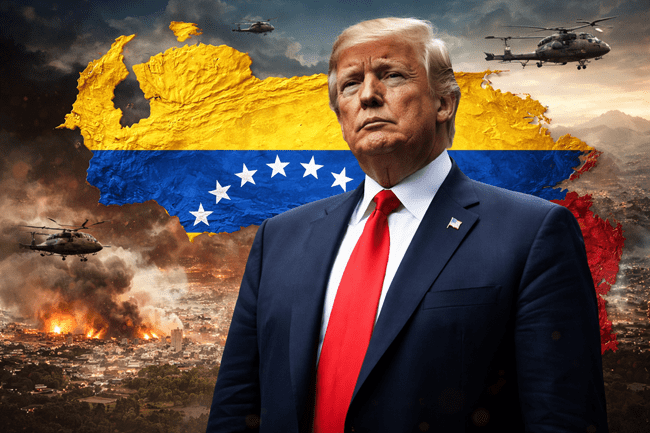
United States President Donald Trump stated on January 24, 2026, that American forces used a classified device referred to as the “discombobulator” during a military raid in Caracas, Venezuela, on January 3, 2026. The operation, which led to the capture of Venezuelan President Nicolás Maduro and his spouse, Cilia Flores, reportedly involved disabling Venezuelan air defense systems. Trump attributed the raid’s success to the deployment of this undisclosed U.S. weapon.
The discombobulator was described by President Trump as a “secret sonic weapon” with the capability to neutralize electronic defense systems. According to his remarks, the Venezuelan military was equipped and prepared to deploy Russian- and Chinese-supplied missile systems against U.S. helicopters entering Venezuelan airspace. Trump stated that these missile systems failed to activate at the critical moment, despite full readiness, due to the effects of the device.
The weapon’s existence was initially revealed in a social media post prior to President Trump’s public confirmation. The post cited an unnamed Venezuelan security official who alleged that radar and defense systems ceased to function suddenly. The account described a strong wave-like force that caused physical disorientation, cranial pressure, and an inability to respond. U.S. officials have not provided additional technical details, and President Trump explicitly stated that he was not authorized to discuss further information about the device or its mechanisms.
How does the alleged use of a disabling weapon fit into recent U.S.–Venezuela dynamics?
The January 2026 raid marks a significant escalation in U.S. actions against the Maduro government. Over the past several years, the United States has imposed a wide range of sanctions targeting Venezuelan oil exports, government officials, and financial institutions. The United States government, alongside allies such as the European Union, has publicly questioned the legitimacy of Nicolás Maduro’s presidency since the disputed 2018 Venezuelan elections.
The use of a disabling or non-kinetic weapon aligns with evolving U.S. military doctrine focused on precision, minimal collateral damage, and systems disruption. Although the discombobulator has not been independently verified or acknowledged by the Department of Defense, the concept is consistent with reported U.S. investments in directed energy, acoustic disruption, and non-lethal tactical technologies. Similar technologies have been studied under programs run by the Defense Advanced Research Projects Agency (DARPA) and the United States Air Force Research Laboratory.
While the device remains classified, the terminology and effects described parallel other publicly known technologies such as the Active Denial System, long-range acoustic devices (LRADs), or directed energy weapons capable of targeting electronics rather than personnel.
What other claims did the United States make about Venezuelan oil assets during this period?
In the same discussion, President Trump claimed that U.S. authorities had seized seven oil tankers linked to Venezuela as part of an ongoing campaign to interdict oil shipments. He said that 50 million barrels of oil had been redirected to U.S. ports and that the crude was being refined at facilities including those in Houston, Texas.
The legal and diplomatic basis for these seizures was not elaborated in the public statement. However, past U.S. enforcement actions targeting Venezuela’s state-owned oil company, Petróleos de Venezuela, S.A. (PDVSA), have relied on executive orders and Treasury Department designations under the Office of Foreign Assets Control (OFAC). Seizures of vessels and cargoes have previously occurred in coordination with international partners or as a result of maritime enforcement measures under extraterritorial sanctions law.
The volume of oil mentioned in President Trump’s statement, 50 million barrels, represents a substantial quantity equivalent to roughly 60 percent of Venezuela’s estimated monthly production as of late 2025, based on International Energy Agency data.
What are the broader implications of deploying undisclosed military technologies in active operations?
The use of a classified disabling device, if confirmed, would represent a significant milestone in the operational deployment of non-lethal technologies by the United States military. While electromagnetic and acoustic weapons have been discussed in open-source defense literature, there is limited precedent for public disclosure of their use in live combat or foreign sovereign territory.
Such deployments raise questions related to sovereignty, international law, and military transparency. Under the United Nations Charter, unauthorized military interventions in sovereign nations may be subject to scrutiny unless justified under self-defense, humanitarian grounds, or Security Council authorization. The Caracas operation was not conducted under a multilateral mandate, and the Venezuelan government has not issued an official response or condemnation at the time of reporting.
In the context of global military norms, the use of advanced disabling technology could influence future doctrine across peer and near-peer competitors. Institutions such as the North Atlantic Treaty Organization (NATO), the Russian Ministry of Defence, and the People’s Liberation Army of China have active research programs in similar domains. Confirmation of effective U.S. deployment could accelerate interest in countermeasures, legal frameworks, and battlefield applications across allied and adversarial forces.
What institutional response has followed Trump’s disclosure of the ‘discombobulator’?
As of January 25, 2026, the United States Department of Defense, the National Security Council, and the Department of State have not issued formal statements confirming or denying the existence or use of a device named the discombobulator. The absence of institutional verification limits independent assessment of the claim’s operational or strategic significance.
In past cases involving classified military systems, formal acknowledgment has typically lagged years behind initial use or development. The revelation of the stealth Black Hawk helicopter used in the 2011 Osama bin Laden raid, for example, occurred only after its visual confirmation during the mission. Whether the discombobulator represents a psychological deterrent, a technological advance, or a rhetorical tactic remains undetermined absent further official documentation.
What are the key takeaways from the alleged use of a classified disabling weapon in Venezuela?
- United States President Donald Trump stated that a classified device known as the discombobulator was used during the January 3, 2026, raid in Caracas, Venezuela.
- The device was described as a sonic or electronic disabling weapon that prevented Venezuelan forces from activating Russian- and Chinese-supplied missile systems.
- Trump also claimed that the United States seized seven oil tankers and 50 million barrels of oil from Venezuela, which are reportedly being processed in American refineries.
- The Department of Defense and other U.S. institutions have not confirmed the existence or deployment of the device, limiting external verification.
- The claims, if validated, could represent a precedent in the operational use of non-kinetic, classified technologies in sovereign foreign territory.
Discover more from Business-News-Today.com
Subscribe to get the latest posts sent to your email.