





Equinor ASA confirmed that artificial intelligence (AI)-driven efficiencies delivered USD 130 million in value creation and cost savings across its operations in 2025. The Norwegian energy major is increasingly embedding AI across its upstream assets, with over 100 industrial use cases now in deployment or development. The latest results underscore how AI tools are reshaping operational planning, seismic data interpretation, and predictive maintenance across the Norwegian continental shelf.
The announcement signals a growing alignment between Equinor’s 2035 production strategy and the use of AI to optimize barrel economics and extend asset life amid capital discipline and decarbonization pressures. A standout USD 12 million saving from a machine-generated well plan at Johan Sverdrup highlights how algorithmic models are not just automating tasks, but also reconfiguring field development logic.
How is Equinor using AI to extend the profitability of mature North Sea assets through 2035?
Artificial intelligence is no longer a side experiment for Equinor. In 2025, it became a quantifiable driver of margin optimization, risk reduction, and data-driven decision-making at industrial scale. The company reported that AI contributed USD 130 million in value last year alone, with more than USD 330 million generated since 2020. This dovetails with Equinor’s goal of maintaining production on the Norwegian continental shelf at 2020 levels—roughly 1.2 million barrels of oil equivalent per day—through 2035.
Much of the 2025 value creation stemmed from predictive maintenance capabilities. Over 700 rotating machines are now monitored in real time by AI models analyzing data from 24,000 sensors. This approach has not only prevented costly unplanned shutdowns but also reduced CO2 emissions from emergency flaring. Since inception, this system alone has unlocked USD 120 million in value.
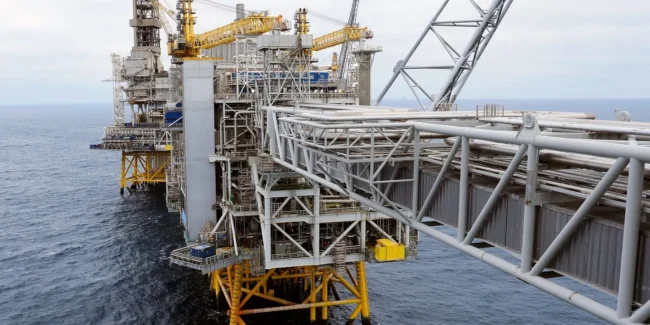
But the more forward-looking application lies in upstream planning. Equinor reported that AI-assisted well planning at Johan Sverdrup Phase 3 surfaced an unconventional development path that experts had not previously considered, leading to an additional USD 12 million in project savings. AI models now generate thousands of field development scenarios, allowing engineers to zero in on optimal solutions faster and more systematically.
Equinor has also expanded AI use in geophysical analysis. In 2025, its AI-powered seismic interpretation engine processed 2 million square kilometers of subsurface data—10 times the capacity of traditional methods—enhancing basin modeling and accelerating prospect maturation. The implication is clear: better geological understanding translates to higher exploration ROI and more informed licensing decisions on the Norwegian shelf.
Why is Equinor scaling traditional machine learning instead of frontier generative AI models?
While much of the AI hype in 2025 centers on generative models and foundation model architecture, Equinor’s results show that conventional machine learning continues to deliver material industrial gains. According to Hege Skryseth, Executive Vice President for Technology, Digital, and Innovation at Equinor, the company primarily relies on supervised learning techniques and operational data pipelines. These allow for more deterministic, auditable models suited for safety-critical environments like offshore platforms.
This choice reflects Equinor’s commitment to both safety and regulatory robustness. Industrial AI use requires explainability, resilience, and tight human–machine collaboration. Tools such as copilots, chatbots, and domain-specific agents are being rolled out not to replace operators but to augment workflows—especially in planning, surveillance, and root-cause diagnostics.
Equinor’s adoption philosophy favors embedded intelligence in critical infrastructure, not centralization in cloud-native environments. That matters for latency-sensitive use cases like rotating equipment monitoring and well control. The company’s data strategy appears to prioritize edge analytics and robust integration with its industrial control systems—an architecture well-suited to North Sea realities.
What does this mean for offshore AI adoption and energy asset optimization strategies globally?
The implications extend far beyond Norway. Equinor’s success strengthens the case for AI as a core lever in extending the economic life of aging offshore assets. As field decline curves steepen and maintenance costs rise, predictive analytics and optimization models offer a viable path to lower lifting costs and emissions intensity.
This is especially relevant for energy companies facing similar offshore legacy infrastructure challenges, such as BP p.l.c., TotalEnergies SE, and Shell plc. While many global players are experimenting with AI pilots, Equinor’s ability to translate those into operational savings and concrete decisions—like an AI-selected field development plan—sets a new benchmark.
At the sector level, Equinor’s results could accelerate AI procurement in offshore operations, particularly for seismic interpretation, flow assurance, and asset integrity management. Specialized vendors in industrial AI for energy—like Cognite, Akselos, and C3.ai—may benefit from increased demand for pre-trained models and integration tooling.
However, this also raises execution risk. Equinor will need to manage organizational change, model governance, and cyber-resilience as more workflows shift to AI dependency. Training engineers to trust, validate, and iterate on machine-generated outputs will be key to unlocking the next layer of value.
Is AI becoming central to Equinor’s decarbonization and energy security narrative?
Yes—and that framing appears intentional. Equinor is tying its AI deployment directly to energy security, operational profitability, and carbon intensity reduction. The ability to avoid shutdowns and flaring, improve energy efficiency, and model lower-emission development paths plays well into both shareholder expectations and government alignment on Norway’s climate targets.
AI may also assist Equinor in balancing its fossil and renewables portfolio. As it pivots to offshore wind, hydrogen, and carbon capture, transferable AI tooling—from asset monitoring to optimization of control systems—could help harmonize operational models across segments.
From a reputational perspective, emphasizing AI-led efficiency allows Equinor to present a forward-thinking digital strategy without compromising its upstream focus. That’s a delicate line, especially as scrutiny grows over long-term oil and gas expansion on the Norwegian shelf.
What are the investor signals and sentiment risks surrounding Equinor’s AI push?
Equinor’s AI productivity results come at a time when oil majors are under pressure to demonstrate both capital discipline and innovation. With Brent crude prices stabilizing in the USD 70–80 range and cost inflation pressuring offshore service rates, the ability to extract efficiency gains from existing assets becomes more valuable.
For institutional investors, Equinor’s AI disclosures provide a rare quantitative look at how digital investments translate into bottom-line outcomes. USD 130 million in 2025 alone is not transformative in isolation, but it signals maturity in internal use case scaling.
However, expectations will now rise. The more Equinor positions AI as critical to its 2035 goals, the more investors will demand proof of continuous gains. Any visible AI project failure, cyber incident, or system breakdown could introduce reputational risk and raise questions about governance. Balancing innovation and accountability will be essential as the program scales.
Key takeaways: What Equinor’s AI value realization in 2025 means for energy, investors, and offshore operations
- Equinor reported USD 130 million in 2025 value creation from AI, highlighting its central role in offshore optimization and operational efficiency.
- Predictive maintenance using 24,000 sensor-fed models across 700 machines has prevented shutdowns and reduced flaring, generating USD 120 million in value since 2020.
- AI-assisted well planning at Johan Sverdrup Phase 3 delivered a previously undiscovered development path, saving USD 12 million.
- AI-based seismic interpretation scaled to 2 million square kilometers in 2025, improving basin modeling and prospect evaluation.
- Equinor’s AI strategy prioritizes explainable, traditional machine learning over generative models, with edge deployment over cloud dependence.
- The company is using AI to meet dual goals of energy security and decarbonization on the Norwegian continental shelf.
- Execution, cyber-resilience, and internal adoption remain key risks as AI use cases scale across mission-critical workflows.
- Peer companies may now face pressure to match Equinor’s AI-driven operational transparency and cost efficiency reporting.
Discover more from Business-News-Today.com
Subscribe to get the latest posts sent to your email.



