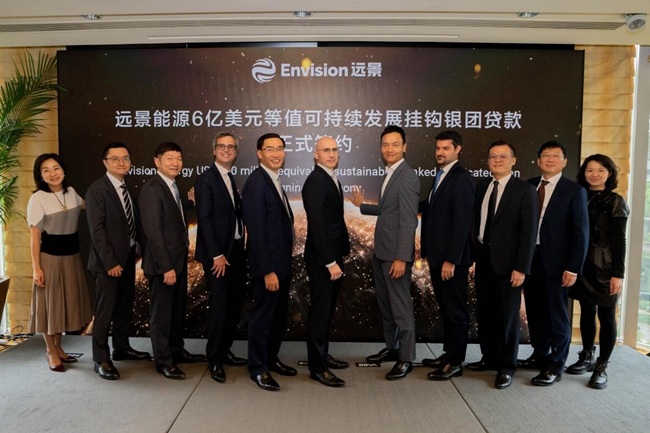
Envision Energy has secured a USD 600 million sustainability-linked syndicated term loan in Hong Kong, marking the largest non-project offshore syndicated financing in the company’s history. The transaction, structured as a sustainability-linked loan tied to environmental performance targets, attracted strong participation from international financial institutions and was oversubscribed during syndication. The deal was jointly arranged by Banco Bilbao Vizcaya Argentaria and Crédit Agricole Corporate and Investment Bank, alongside a consortium of banks from multiple regions. For Envision Energy, the financing represents both a capital milestone and a strategic endorsement of its global clean energy expansion ambitions.
Unlike traditional project financing structures tied to specific infrastructure assets, the syndicated loan provides Envision Energy with broader corporate financial flexibility. This distinction matters because the global renewable energy sector is increasingly capital-intensive not just in project deployment but also in technology development, energy storage integration, and green hydrogen ecosystems. Access to flexible offshore credit markets allows companies like Envision Energy to accelerate innovation and scale new business segments beyond individual wind or solar installations.
Why is Envision Energy using a sustainability-linked syndicated loan instead of traditional project financing structures?
The financing structure itself reveals much about how renewable energy companies are evolving their capital strategies. Sustainability-linked loans differ from green project loans in that they do not restrict funding to a single asset or infrastructure development. Instead, they tie borrowing costs and financial conditions to measurable sustainability targets.
In the case of Envision Energy, those targets include Scope 3 greenhouse gas emission intensity reductions and the annual installation capacity of wind turbines. By linking the loan framework to operational sustainability metrics, lenders effectively align financial incentives with environmental performance outcomes. If the company meets or exceeds these targets, financing conditions can improve, creating a tangible economic reward for environmental progress.
The structure follows the Sustainability-Linked Loan Principles developed by the Loan Market Association, the Asia Pacific Loan Market Association, and the Loan Syndications and Trading Association. Independent verification by DNV Business Assurance Limited provides additional credibility, ensuring that performance metrics are measurable and transparent. For lenders increasingly focused on environmental, social, and governance risk exposure, this type of framework reduces reputational and regulatory uncertainty.
From a corporate finance perspective, sustainability-linked loans also signal a shift toward performance-based ESG financing rather than simple labeling of capital as “green.” Investors and lenders have become increasingly skeptical of superficial sustainability claims. By tying loan terms to quantifiable climate and deployment targets, Envision Energy demonstrates that its sustainability commitments are embedded within operational execution rather than marketing narratives.
How does the $600 million financing strengthen Envision Energy’s global renewable expansion strategy?
The oversubscription of the loan and its increase from an initial USD 500 million target to USD 600 million highlights strong lender confidence in Envision Energy’s long-term growth prospects. Thirteen banks ultimately participated in the syndication, with an additional USD 100 million greenshoe option reflecting the depth of demand.
For Envision Energy, this financing expands its access to diversified international capital markets. Renewable energy companies historically relied heavily on domestic bank lending or government-backed funding programs. By successfully tapping offshore syndicated loan markets, the company positions itself alongside global energy technology firms that increasingly operate across multiple financing ecosystems.
This diversification is strategically important because renewable energy development is becoming increasingly globalized. Wind turbine manufacturing, grid integration software, battery storage systems, and green hydrogen infrastructure now operate within interconnected international supply chains. Access to international financing pools reduces reliance on domestic credit cycles and enables faster deployment of capital into emerging energy markets.
Company executives indicated that the funding will support innovation across renewable energy systems, energy storage technologies, and green hydrogen platforms. These areas represent critical pillars of the broader energy transition. While wind turbines remain a core product segment, the future competitiveness of renewable companies increasingly depends on their ability to integrate generation with storage, digital grid management, and industrial decarbonization technologies.
What does strong bank participation reveal about global confidence in renewable energy financing?
The participation of banks from Europe, Asia, Australia, and the Middle East reflects growing institutional comfort with renewable energy credit exposure. Financial institutions that historically focused on oil and gas project financing are gradually redirecting capital toward energy transition technologies.
For lenders such as Banco Bilbao Vizcaya Argentaria and Crédit Agricole Corporate and Investment Bank, participation in sustainability-linked loans also aligns with broader corporate lending strategies aimed at supporting low-carbon economic transformation. European banks in particular face increasing regulatory pressure to align lending portfolios with climate objectives under evolving sustainable finance frameworks.
The oversubscription of the loan indicates that global banks increasingly view renewable energy companies not merely as technology ventures but as infrastructure-scale industrial players with durable long-term revenue potential. Wind energy equipment manufacturing and integrated energy technology platforms now generate stable cash flows tied to long-duration infrastructure projects and service contracts.
From a risk perspective, diversified renewable energy companies benefit from structural tailwinds created by government decarbonization policies. National commitments to net-zero emissions, expanding renewable electricity mandates, and rising carbon pricing mechanisms collectively provide demand visibility for clean energy technologies.
How does Envision Energy’s ESG performance influence lender confidence and financing conditions?
The company’s environmental, social, and governance track record appears to have played a central role in securing the syndicated loan. Envision Energy reported operational carbon neutrality for four consecutive years and achieved full renewable electricity usage for two consecutive years, fulfilling its RE100 commitment ahead of schedule.
Such achievements strengthen credibility with lenders who increasingly integrate ESG metrics into credit risk assessments. For global banks, financing companies with strong sustainability credentials reduces long-term exposure to climate transition risk.
External recognition also reinforces the company’s ESG positioning. Inclusion in S&P Global Commodity Insights’ Tier 1 Cleantech Companies list for both wind energy and energy storage suggests that the firm has achieved technological maturity and operational scale across multiple energy segments. Additional recognition from EcoVadis and the Carbon Disclosure Project further strengthens its reputation among institutional investors and financial institutions.
These credentials matter because sustainability-linked loans require measurable environmental progress. If companies fail to meet agreed performance targets, loan pricing or covenant conditions may change. As a result, lenders carefully assess whether borrowers possess the operational capabilities and governance structures necessary to meet sustainability commitments.
Could sustainability-linked financing become the dominant funding model for renewable energy companies?
The Envision Energy transaction reflects a broader shift in sustainable finance toward performance-based capital structures. Over the past decade, green bonds dominated climate-aligned financing markets. However, sustainability-linked loans offer several advantages that make them attractive for corporate borrowers.
Unlike green bonds tied to specific environmental projects, sustainability-linked loans can finance general corporate activities while still incentivizing environmental progress. This flexibility allows companies to allocate capital toward research, acquisitions, and operational expansion while maintaining alignment with climate objectives.
For renewable energy companies operating across technology platforms and global markets, such flexibility is essential. The energy transition increasingly requires integrated solutions that combine generation, storage, digital grid management, and industrial electrification. Financing structures tied to narrow project definitions may limit strategic agility.
As sustainability performance metrics become more standardized and independently verified, lenders may expand the use of these instruments across multiple sectors including utilities, industrial manufacturing, and transportation infrastructure.
Key takeaways on what Envision Energy’s financing means for renewable energy markets and global capital flows
- The USD 600 million syndicated loan represents the largest offshore non-project financing raised by Envision Energy, signaling strong lender confidence in its growth trajectory.
- Oversubscription of the loan suggests that global financial institutions increasingly view renewable energy technology companies as stable infrastructure-linked borrowers.
- Sustainability-linked loan structures tie financing conditions to measurable environmental targets, reinforcing accountability in ESG financing frameworks.
- Diversified international bank participation indicates that renewable energy financing is becoming a global capital market rather than a regionally concentrated sector.
- Access to flexible corporate financing allows Envision Energy to invest in emerging technologies such as energy storage systems and green hydrogen infrastructure.
- Independent verification of sustainability targets strengthens credibility with lenders concerned about greenwashing and ESG reporting transparency.
- The transaction highlights the increasing role of performance-based sustainable finance instruments within corporate capital strategies.
- Renewable energy firms with strong ESG track records are likely to secure more favorable financing conditions as banks expand climate-aligned lending portfolios.
- Sustainability-linked loans may gradually replace traditional green project financing as companies seek greater strategic flexibility in funding innovation and expansion.
Discover more from Business-News-Today.com
Subscribe to get the latest posts sent to your email.