



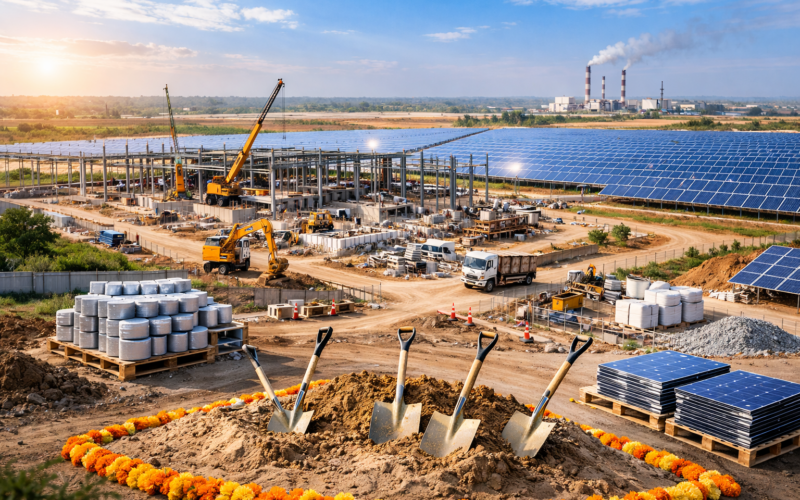
Waaree Energies Limited (NSE: WAAREEENER | BSE: 544277), India’s largest solar photovoltaic module manufacturer by installed capacity, broke ground on March 14, 2026 on a 10 GW integrated solar ingot and wafer manufacturing facility at Butibori, Nagpur, in what the company described as India’s single largest upstream solar manufacturing investment to date. The project, spanning 300 acres and requiring capital expenditure of approximately Rs 6,200 crore, is designed to produce high-purity silicon ingots and wafers, the two most import-dependent stages of the solar photovoltaic value chain. Maharashtra Chief Minister Devendra Fadnavis attended the groundbreaking ceremony alongside Waaree Energies chairman and managing director Hitesh Doshi, signalling strong state-level political backing for the project. The announcement arrives at a moment of acute strategic urgency for India’s solar manufacturing sector, where domestic ingot and wafer capacity remains negligible even as national solar deployment targets surge and import-sourcing from China faces mounting trade, regulatory, and geopolitical pressure.
Why does India’s near-total absence of domestic ingot and wafer capacity represent a structural vulnerability for solar manufacturing ambitions?
India’s solar manufacturing story has a well-documented gap at its upstream end. While the country has aggressively built module and, more recently, cell capacity, it has remained almost entirely dependent on China for the silicon ingots and wafers that feed those downstream stages. As of 2024, China accounted for more than 97 percent of global ingot and wafer production for solar photovoltaic applications, and India had no meaningful commercial output in either category. The practical consequence of this dependency has grown more visible as India’s annual solar additions have accelerated: in the absence of domestic ingot and wafer supply, every additional gigawatt of module capacity installed in India requires a corresponding import bill denominated in Chinese-sourced materials.
Policy signals from New Delhi have sharpened the urgency. India’s Domestic Content Requirement rules, tightened in March 2025, now require that cells used in government-funded projects must be produced using undiffused silicon wafers manufactured domestically. From June 2026, full upstream-to-module local sourcing becomes mandatory across those projects. The Approved List of Models and Manufacturers framework, already enforced for modules, is scheduled to cover cells from July 2026. These deadlines, combined with anti-dumping duties on Chinese cells and modules ranging from 23 percent to 30 percent imposed in September 2025, have created a structural incentive for any company with serious module and cell ambitions to backward-integrate into wafers and ingots as quickly as possible. Waaree Energies, which operates approximately 22.3 GW of global module capacity and 5.4 GW of cell capacity, faces exactly this pressure. The Nagpur facility is, in effect, a compliance necessity dressed as a strategic offensive.
What is the capital intensity and execution risk of the Butibori, Nagpur integrated ingot and wafer project, and how does it compare to global benchmarks?
At Rs 6,200 crore for 10 GW of combined ingot and wafer capacity, the Nagpur project implies a capital cost of approximately Rs 620 crore per GW of each stage, or roughly US$ 75 million per GW at current exchange rates. For reference, global benchmarks for greenfield ingot-wafer plants range from US$ 300 million to US$ 1.2 billion depending on capacity, location, and technology specification, suggesting Waaree Energies is targeting the lower end of that range by leveraging India’s labour cost advantages and, presumably, economies of scale from the 300-acre site footprint. Chinese competitor Trina Solar announced a 25 GW ingot plant at US$ 1.55 billion in 2023, implying a cost of approximately US$ 62 million per GW. The Waaree Energies figure is directionally consistent with that benchmark, though the Indian context involves higher energy costs, a recurring challenge for upstream solar manufacturing where electricity can account for nearly 28 percent of total production costs.
Execution risk in this segment is meaningful. Ingot and wafer manufacturing is significantly more capital-intensive, energy-intensive, and technically complex than module assembly, which has historically been India’s comfort zone. It requires control of crystal growth processes, highly precise thermal management, and specialized slicing equipment that Indian manufacturers have not operated at commercial scale before. The Chinese polysilicon and ingot supply chain has benefited from decades of learning-curve compression and state subsidy; any Indian entrant, however well-capitalised, will need time to close that gap. Waaree Energies has not disclosed a commissioning timeline for the Nagpur facility, which introduces uncertainty about when the strategic rationale will translate into operational revenue. Given the June 2026 ALMM cell deadline, the company will likely need to manage a period of transition using imported wafers or existing upstream relationships before Nagpur comes online.
How does Waaree Energies’ Nagpur investment position the company against Adani Solar and Reliance Industries in the race for integrated solar supply chain control in India?
The competitive dynamics in India’s integrated solar manufacturing race have intensified considerably over the past eighteen months. Reliance Industries is commissioning a 20 GW fully integrated giga-factory covering polysilicon, ingots, wafers, cells, and modules as part of its new energy strategy, with completion targeted by the end of fiscal year 2025-26. Adani Solar is scaling toward 10 GW of integrated capacity, including ingots and wafers, by 2028. Against this backdrop, Waaree Energies’ Nagpur plant represents a necessary rather than pioneering move. The company is not first to announce upstream integration but brings to the table what is, on paper, the largest single-site ingot-wafer capacity commitment in India to date, at 10 GW each for both stages.
The competitive stakes are high because India’s solar deployment ambitions, including an approximate 41.5 GW annual additions target for fiscal year 2026, are growing faster than domestic upstream supply can currently meet. Whichever company achieves commercial-scale ingot and wafer production first will capture a structural cost advantage across its downstream cell and module output, reduce exposure to import price volatility, and benefit from PLI scheme incentives tied to integrated production. Premier Energies has taken a different approach, entering a joint venture with Taiwan’s Sino-American Silicon Products for a 2 GW wafer facility, highlighting that technology partnerships remain an alternative route for companies seeking to accelerate upstream entry without building de novo capability. Waaree Energies appears to be pursuing greenfield development rather than a joint venture route, which places the full technological and execution burden on its own organisation.
What is the regulatory and geopolitical backdrop that makes upstream solar manufacturing in India both strategically urgent and commercially uncertain heading into 2026 and beyond?
India’s solar policy environment in 2026 is simultaneously more supportive and more complex than at any prior point. The Production Linked Incentive scheme, with an allocation of Rs 24,000 crore, has enabled 18.5 GW of module capacity and 9.7 GW of cell capacity under ALMM as of mid-2025, but ingot-wafer capacity enabled through the scheme had reached only around 2.2 GW by that point. The government has announced an ambition to build 40 GW of wafer capacity by 2027, a target that remains substantially unfunded relative to the capital required. The Nagpur project, if commissioned on schedule, would represent a quarter of that target from a single company.
The geopolitical dimension is not abstract. India’s wafer import volumes from China increased from approximately 3.5 million units in 2022 to around 11 million in 2024 and were tracking toward approximately 16 million for 2025. Near-total dependence on China for a critical industrial input, combined with an unresolved border dispute and China’s December 2025 WTO challenge against India’s solar subsidy framework, creates supply chain vulnerability that Indian policymakers have been vocal about addressing. The Waaree Energies Nagpur announcement therefore lands in policy terms as exactly the kind of investment the government needs to demonstrate, and the high-profile groundbreaking with the Maharashtra chief minister in attendance reflects that alignment of interest. Whether the commercial arithmetic is independently sound, absent policy support, is a separate question that Waaree Energies has not yet fully answered publicly.
How has the WAAREEENER stock performed recently, and what does the market’s positioning signal about investor confidence in the company’s capital allocation strategy?
Waaree Energies shares were trading at approximately Rs 2,594 on the BSE on March 14, 2026, up around 7.4 percent on the day, against a 52-week range of Rs 1,863 to Rs 3,865. The stock has declined roughly 16 percent over the past month, a period during which global risk appetite for solar manufacturing equities has been compressed by a combination of US tariff uncertainty redirecting export-oriented module volumes back toward domestic markets and concerns about potential oversupply as India’s cell capacity races toward a projected 100 GW by late 2027 against annual deployment of 45 to 50 GW. The company’s market capitalisation stood at approximately Rs 77,168 crore as of mid-March 2026, implying a price-to-earnings multiple of around 41 times trailing earnings. Analyst price targets span a wide range, from Rs 2,109 to Rs 4,610, reflecting genuine disagreement about how quickly Waaree Energies can monetise its vertical integration investments and whether the Indian domestic market will absorb the capacity additions without significant pricing pressure.
The day’s trading gain, coinciding with the Nagpur groundbreaking announcement, suggests the market received the news positively, though the stock remains more than 30 percent below its September 2025 record high of Rs 3,864. Investors appear to be distinguishing between strategic merit, broadly acknowledged, and near-term execution risk, which the scale and technical novelty of the Nagpur project amplifies. The Rs 6,200 crore capital commitment will weigh on free cash flow during the construction phase, and a lack of publicly disclosed commissioning timelines makes financial modelling difficult. That uncertainty, set against a backdrop of strong revenue growth, with second-quarter fiscal year 2026 revenue at Rs 60.66 billion and net income at Rs 8.43 billion, positions Waaree Energies as a growth story with execution risk rather than a mature, de-risked industrial play.
Why did Waaree Energies choose Butibori in Nagpur for its 300-acre integrated ingot and wafer facility, and what does this reveal about India’s evolving industrial geography for solar manufacturing?
Butibori is Maharashtra’s largest industrial zone and one of the more established heavy industrial clusters in central India. Its selection reflects a combination of land availability at the scale required for a 300-acre integrated facility, transport connectivity, an existing industrial ecosystem that can supply ancillary services and skilled labour, and the proximity to the Maharashtra government’s administrative support. Nagpur’s central location also gives the facility reasonable logistics reach to both northern and southern module assembly hubs, reducing inter-facility transport costs once the ingots and wafers produced there feed Waaree Energies’ downstream cell and module operations. The endorsement from Chief Minister Devendra Fadnavis at the groundbreaking is consistent with Maharashtra’s recent track record of using high-profile industrial announcements as a signal of investment-friendly governance, and implies that Waaree Energies may have secured material state-level incentives, the details of which have not been publicly disclosed.
The broader implication for India’s solar geography is notable. Waaree Energies’ existing module and cell facilities are concentrated in Gujarat. The Nagpur investment begins to distribute the company’s manufacturing footprint across Maharashtra as well, reducing concentration risk and potentially qualifying for additional state incentives tied to Maharashtra’s own industrial development agenda. As India’s solar manufacturing cluster builds out beyond its traditional Gujarat-Rajasthan axis, Nagpur’s emergence as a solar upstream hub alongside Butibori would represent a meaningful diversification of the country’s industrial renewable energy base. That is a medium-term outcome contingent on the Nagpur project being commissioned successfully, but the strategic geography makes sense.
Key takeaways: What Waaree Energies’ 10 GW Nagpur ingot and wafer plant means for the company, its competitors, and India’s upstream solar manufacturing strategy
- Waaree Energies has broken ground on India’s single largest upstream solar manufacturing commitment, a 10 GW ingot and 10 GW wafer integrated plant at Butibori, Nagpur, requiring Rs 6,200 crore in capital expenditure and covering 300 acres of industrial land.
- The project targets the most import-dependent stage of India’s solar supply chain. As of 2024, China supplied more than 97 percent of global ingot and wafer volumes, and India had no meaningful commercial production in either category.
- Regulatory pressure is a key driver. India’s DCR and ALMM frameworks mandate domestic cell and upstream sourcing from June-July 2026, creating an urgent need for companies like Waaree Energies with large cell manufacturing ambitions to secure domestic wafer supply or face compliance gaps.
- Capital cost benchmarks are plausible but the execution challenge is significant. Ingot and wafer manufacturing is more technically demanding than module assembly, and Waaree Energies will need to ramp up capabilities it has not operated at scale before.
- Competitive positioning: Reliance Industries and Adani Solar are pursuing parallel integration strategies. Waaree Energies’ 10 GW single-site commitment is the largest announced in India to date but the company is not first to move and faces well-capitalised rivals.
- WAAREEENER shares closed around Rs 2,594 on the announcement day, approximately 33 percent below the 52-week high of Rs 3,865, as the market weighs strategic merit against near-term free cash flow impact of the Rs 6,200 crore spend and an undisclosed commissioning timeline.
- The facility is projected to generate over 8,000 direct and indirect employment opportunities in Maharashtra, adding a regional economic development dimension that aligns with state government objectives and likely secured favourable site and incentive terms.
- India’s government has set a 40 GW domestic wafer capacity target by 2027. If Nagpur is commissioned on schedule, Waaree Energies’ 10 GW would represent a quarter of that national objective from a single facility, making this project a test case for the entire upstream integration agenda.
- The Nagpur facility complements Waaree Energies’ existing Gujarat manufacturing base, beginning a geographic diversification across Maharashtra that reduces single-state concentration risk and taps Maharashtra’s industrial infrastructure at Butibori.
- The strategic logic is clear but the financial outcome depends on commissioning speed, energy cost management, Chinese supply disruption dynamics, and whether India’s ALMM enforcement holds. The groundbreaking is a milestone; the commissioning date is what investors will be watching.
Discover more from Business-News-Today.com
Subscribe to get the latest posts sent to your email.