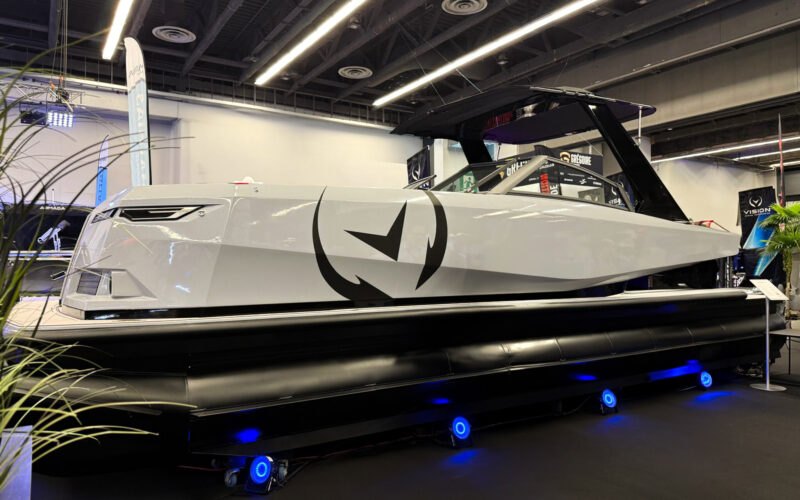
Vision Marine Technologies Inc. (NASDAQ: VMAR) has outlined a strategic push to accelerate electric boat adoption by concentrating on the North American pontoon segment while unveiling its new SPECTR 26 flagship electric tritoon platform. The Montreal-based marine electrification company said its strategy pairs its high-power E-Motion 180E electric outboard propulsion system with one of the highest-volume categories in recreational boating. Management believes the pontoon category provides one of the most realistic entry points for scaling electric propulsion adoption due to its predictable operating patterns, structural stability, and strong existing consumer demand. The launch of the SPECTR 26 platform therefore represents not only a product debut but also a broader positioning move within the evolving electric marine propulsion market.
The company’s strategy reflects a practical approach to marine electrification. Rather than attempting to electrify multiple boat categories simultaneously, Vision Marine Technologies is concentrating on segments where the physics of the vessel, real-world usage patterns, and charging convenience align naturally with electric propulsion. This targeted approach mirrors early adoption strategies seen in other electrified transportation sectors, where adoption began in segments with the most favorable operating profiles.
Why is the pontoon boat segment emerging as a scalable entry point for electric marine propulsion adoption?
The pontoon category has quietly become one of the most commercially important segments in North American recreational boating. Industry reporting based on National Marine Manufacturers Association data indicates that pontoon boats accounted for roughly 52,000 to 55,000 new unit sales in the United States in 2024, underscoring the scale of the segment within the broader marine market. The same data suggests that pontoons represent the largest share of new outboard-powered boat sales, accounting for more than one third of all outboard units sold.
For companies attempting to introduce electric propulsion into recreational boating, this scale is critical. High-volume segments provide the market foundation required to justify investments in propulsion development, battery integration, and manufacturing capacity. A niche vessel category might allow for technological experimentation, but it rarely provides the scale necessary for sustainable commercial adoption.
Pontoon boats also possess operational characteristics that align particularly well with electric propulsion. Recreational pontoon use often involves moderate cruising speeds, relatively predictable trip distances, and frequent returns to a fixed dock location. These behavioral patterns significantly reduce the range anxiety and infrastructure challenges that can complicate electric propulsion adoption in other marine segments.
The structural architecture of pontoon vessels also supports electrification. Pontoon platforms distribute weight across wide aluminum tubes and large deck surfaces, allowing designers to integrate battery systems without drastically altering hull balance or performance characteristics. This stability provides engineers greater flexibility when designing electric propulsion systems that require heavier energy storage components than conventional gasoline engines.

How does the SPECTR 26 platform demonstrate Vision Marine’s electric boating strategy?
Vision Marine Technologies introduced the SPECTR 26 as its flagship electric pontoon platform, designed specifically around the company’s 180 horsepower E-Motion 180E electric outboard propulsion system. The vessel measures approximately 26 feet 6 inches in length and incorporates a proprietary tritoon hull architecture that aims to balance stability, performance, and passenger capacity within the pontoon category.
The platform integrates a reinforced fiberglass deck with three 25-inch aluminum pontoons, a configuration commonly referred to as a tritoon design. Tritoon vessels have become increasingly popular in the premium pontoon segment because the third tube improves buoyancy, handling, and stability when operating at higher speeds or carrying larger passenger loads. By combining this configuration with electric propulsion, Vision Marine Technologies appears to be targeting boaters who expect both comfort and performance from their recreational vessels.
The SPECTR 26 also incorporates hydrodynamic enhancements intended to optimize efficiency and handling. Integrated lifting foils and hydrofin-assisted hull optimization are designed to improve stability, reduce drag, and support smoother planning performance during acceleration. These features attempt to offset some of the efficiency challenges that electric propulsion systems may face when powering heavier vessels.
Another key element of the platform is its compatibility with shore power charging infrastructure. Dockside charging allows boat owners to recharge the vessel while moored at marinas or private docks, reducing the need for specialized fueling infrastructure. This feature aligns closely with typical pontoon ownership patterns, where vessels are often stored at fixed waterfront locations rather than transported between marinas.
What strategic advantages does Vision Marine gain from focusing on a high-volume recreational category?
Concentrating on a high-volume recreational category offers Vision Marine Technologies several strategic advantages beyond engineering compatibility. By targeting the pontoon market, the company positions its propulsion technology within a segment where consumer demand already exists at scale. Rather than attempting to create entirely new demand for electric boats, the company is effectively attempting to convert existing recreational boat buyers to electric propulsion systems.
This approach also aligns with Vision Marine Technologies’ broader integrated business model. In addition to developing electric propulsion systems, the company operates a multi-location boat retail and service network through its ownership of Nautical Ventures, a Florida-based dealership group. This combination of propulsion technology and retail distribution provides direct access to consumers while also enabling the company to manage service, maintenance, and technical support for its electric propulsion systems.
Such integration could prove important during the early stages of electric marine adoption. Electric propulsion systems introduce new maintenance requirements, battery management considerations, and diagnostic needs that traditional boat dealerships may not yet be equipped to support. By controlling both the propulsion technology and the dealership network, Vision Marine Technologies may be able to accelerate consumer confidence in the reliability and serviceability of electric boats.
Another strategic benefit of focusing on pontoons lies in their usage patterns. Pontoon boats are commonly used for short recreational outings on lakes and inland waterways, environments where range requirements are relatively limited and charging infrastructure is easier to manage. These characteristics reduce some of the practical barriers that have historically slowed adoption of electric propulsion in the marine industry.
How does the SPECTR 26 launch reflect broader electrification trends across recreational boating?
The introduction of the SPECTR 26 reflects broader changes occurring within the marine industry as manufacturers explore electrification pathways similar to those already seen in the automotive sector. Electric propulsion in recreational boating has historically struggled to gain traction due to limitations in battery density, range, and cost. High-speed marine vessels require substantial power output, and marine environments place unique durability and cooling demands on propulsion systems.
However, improvements in battery technology, power electronics, and electric motor design are gradually expanding the range of applications where electric propulsion can compete with traditional internal combustion engines. Recreational vessels with predictable usage patterns and moderate speed requirements are emerging as the most practical early candidates for electrification.
Pontoon boats, lake cruisers, and short-range recreational craft therefore represent the first logical testing ground for electric marine propulsion systems. The adoption trajectory in marine transportation may ultimately mirror the pattern seen in electric vehicles, where early adoption began in segments such as urban commuting and commercial fleets before expanding into broader consumer markets.
Environmental and regulatory pressures may also play a role in shaping future adoption. Some freshwater lakes and environmentally sensitive waterways have already implemented restrictions on gasoline-powered engines. As sustainability concerns increase within recreational industries, electric propulsion may gain additional attention as a quieter and potentially lower-emission alternative.
What execution risks could affect Vision Marine’s electric boating strategy?
Despite the strategic logic behind focusing on the pontoon market, several challenges remain for companies attempting to scale electric propulsion in recreational boating. Battery costs continue to represent one of the most significant barriers to widespread adoption. Marine propulsion systems require large battery packs capable of delivering sustained power output, and these packs often represent a substantial portion of the vessel’s overall cost.
Charging infrastructure also remains uneven across marinas and recreational boating destinations. While private dock owners may have the ability to install charging systems relatively easily, public marinas may require substantial electrical upgrades to support large numbers of electric boats. The pace of infrastructure development could therefore influence how quickly electric boating adoption expands.
Consumer perception presents another challenge. Recreational boaters often prioritize reliability, range, and simplicity when choosing propulsion systems. Convincing traditional boat buyers to transition from gasoline outboards to electric propulsion will require consistent demonstration that electric systems can deliver comparable performance and durability.
Competition from established marine engine manufacturers may also intensify. Major propulsion companies with extensive dealer networks and engineering resources are actively exploring hybrid and electric propulsion technologies. As electrification technology matures, these incumbents could become more aggressive participants in the emerging electric marine market.
Key takeaways on why Vision Marine is focusing on pontoons to scale electric boating adoption
- Vision Marine Technologies is prioritizing the pontoon segment because it represents one of the largest volume categories in recreational boating.
- The SPECTR 26 electric tritoon platform showcases the company’s E-Motion 180E electric propulsion system.
- Pontoon boat stability and predictable cruising patterns align well with current electric propulsion capabilities.
- Industry data indicates that pontoons account for more than one third of new outboard-powered boat sales in the United States.
- Vision Marine Technologies’ ownership of Nautical Ventures provides direct consumer distribution and service support.
- Dockside charging compatibility could simplify ownership for electric pontoon boat buyers.
- Marine electrification is likely to begin in recreational categories with moderate speed and predictable usage patterns.
- Battery costs and marina charging infrastructure remain key barriers to broader electric boating adoption.
- Traditional marine engine manufacturers may increase competition as electric propulsion technology matures.
- If successful, the pontoon category could become the initial proving ground for large-scale electric propulsion in recreational boating.
Discover more from Business-News-Today.com
Subscribe to get the latest posts sent to your email.