Why is Vertiv acquiring Great Lakes Data Racks & Cabinets and how will this $200 million deal reshape high-density AI infrastructure markets?
Vertiv Holdings Co (NYSE: VRT), a global provider of critical digital infrastructure solutions, has signed an agreement to acquire the Great Lakes Data Racks & Cabinets family of companies for $200 million. Announced on July 17, 2025, the transaction is structured to expand Vertiv’s capabilities in delivering pre-engineered, AI-ready infrastructure solutions for enterprise, edge, colocation, and hyperscale computing environments.
The deal, expected to close in the third quarter of 2025 subject to regulatory approvals, places Great Lakes at a valuation of approximately 11.5 times its projected 2026 earnings before interest, taxes, depreciation, and amortization (EBITDA). Vertiv has framed the acquisition as a strategic milestone, citing increasing demand for high-density rack solutions and integrated infrastructure as artificial intelligence (AI) workloads continue to drive next-generation data center designs.
Vertiv, headquartered in Westerville, Ohio, operates across more than 130 countries and specializes in power, cooling, and IT infrastructure systems. With the acquisition, Vertiv expects to broaden its portfolio to include a wider array of customized racks and enclosures designed for both retrofit and new-build data center projects.
What is the historical significance of Great Lakes in the global data racks and cabinets industry?
Great Lakes Data Racks & Cabinets, established in 1985 and headquartered in Edinboro, Pennsylvania, has developed a reputation as a specialized manufacturer of innovative and highly customizable data rack solutions. Its product portfolio spans standard and custom racks, seismic cabinets designed for regions with specific building code requirements, and advanced cable management systems that allow greater flexibility for both retrofit and greenfield applications.

The company operates manufacturing and assembly facilities in both the United States and Europe, giving it a transatlantic operational footprint that is advantageous for servicing hyperscale and enterprise clients. Over the past decade, Great Lakes has become known for its ability to rapidly engineer bespoke enclosures, meeting the evolving density requirements of cloud service providers and enterprise IT operators.
Historically, the market for data racks and cabinets has been highly fragmented, with most manufacturers serving regional customers. Great Lakes carved a niche by emphasizing highly engineered solutions rather than commodity-based manufacturing, aligning its expertise with a growing demand for differentiated, high-performance infrastructure.
How are analysts and institutional investors interpreting Vertiv’s strategic move into integrated AI-ready infrastructure solutions?
Institutional investors and analysts view the acquisition as a calculated step for Vertiv to reinforce its presence in the critical white space infrastructure market, where rack integration, power management, and advanced cooling are increasingly interdependent. The high-density computing environment driven by AI model training and inference workloads requires integrated solutions that reduce power and cooling inefficiencies.
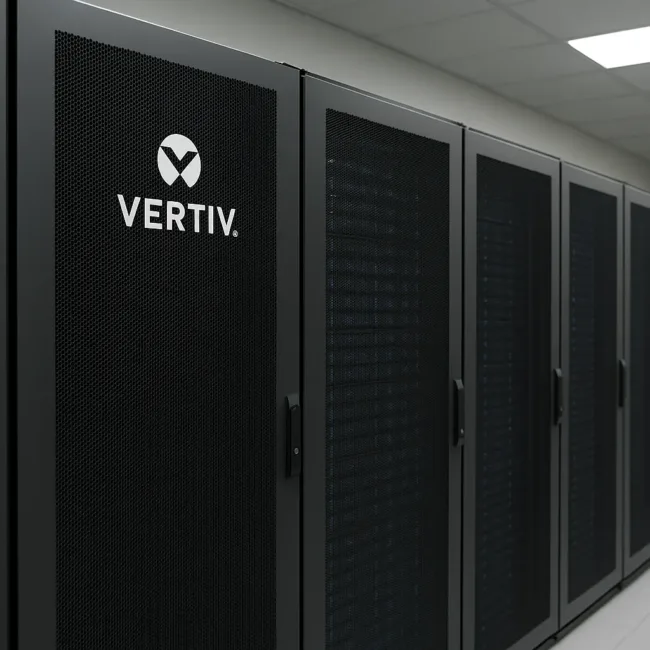
Analysts suggest that Vertiv’s strategy to integrate Great Lakes’ rack manufacturing capabilities could allow the company to deliver factory-assembled, fully engineered infrastructure packages. This shift toward pre-engineered solutions is expected to shorten deployment timelines and enhance scalability, a critical factor for hyperscale and edge computing operators.
Market observers note that Vertiv’s track record in power and thermal management provides a natural synergy with Great Lakes’ enclosure expertise. Institutional sentiment is cautiously optimistic, as integration success will depend on how well Vertiv can align Great Lakes’ engineering processes with its global distribution and service network.
What financial and operational synergies are expected from Vertiv’s acquisition of Great Lakes?
The $200 million acquisition, priced at roughly 11.5x expected 2026 EBITDA, is expected to generate financial and operational synergies through cost optimization, cross-selling, and streamlined infrastructure sourcing. Vertiv anticipates significant benefits from factory-level integration of its power and cooling systems with Great Lakes’ customized rack enclosures, reducing deployment timelines for customers with complex infrastructure needs.
Operationally, Vertiv expects the acquisition to enhance scalability for high-density AI and edge workloads. Customers seeking AI-optimized computing environments often require pre-certified, factory-integrated racks that can handle high power density while maintaining thermal stability. By leveraging Great Lakes’ custom engineering, Vertiv can differentiate itself in an increasingly competitive market where speed to deployment and operational efficiency are critical success factors.
The cross-selling potential is also significant, as Vertiv can bundle Great Lakes’ rack products into its global sales channels, extending their reach to enterprise customers and hyperscale operators in emerging AI markets across Asia-Pacific and Europe.
What regulatory and closing conditions could influence the acquisition timeline?
The transaction is subject to customary closing conditions, including clearance under the Hart-Scott-Rodino Antitrust Improvements Act of 1976. While forward-looking statements from Vertiv acknowledge potential risks—including regulatory delays, integration challenges, or possible disruptions to customer relationships—the complementary nature of the two companies’ portfolios is expected to smooth the regulatory process.
Vertiv anticipates closing the acquisition in the third quarter of 2025. Analysts note that because the deal involves adjacent rather than directly competing infrastructure solutions, regulatory concerns are likely to be minimal, with most scrutiny focusing on standard antitrust compliance.
How does this acquisition strengthen Vertiv’s competitive position in the global AI-driven data infrastructure market?
The acquisition positions Vertiv as a more comprehensive solutions provider in the evolving AI-driven data infrastructure market. High-density computing environments, driven by large language models and other compute-intensive AI applications, demand integrated power, cooling, and rack solutions optimized for both energy efficiency and rapid deployment.
By combining its expertise in power and thermal management with Great Lakes’ custom rack manufacturing, Vertiv is expected to deliver differentiated offerings for hyperscale cloud operators and enterprise data centers transitioning to AI-optimized infrastructure. Analysts believe this move places Vertiv in a stronger position to compete against global players such as Schneider Electric and Eaton, which are also expanding their integrated infrastructure portfolios.
Institutional sentiment remains positive, with investors expecting Vertiv to leverage its global service network to scale Great Lakes’ products internationally. Over the long term, analysts anticipate that Vertiv will further invest in AI-specific infrastructure designs, including liquid cooling integration with high-density racks.
What are the future growth prospects for Vertiv following this strategic acquisition?
Looking ahead, Vertiv is expected to focus on accelerating cross-selling opportunities and expanding Great Lakes’ manufacturing capacity to meet global demand for AI-ready infrastructure. Analysts project that if integration is executed successfully, Vertiv could achieve incremental revenue growth through bundled infrastructure sales and expanded service contracts tied to the new rack solutions.
The broader market outlook supports this growth trajectory. Industry estimates indicate that AI workloads could increase data center power density requirements by 30–50 percent over the next five years, driving demand for custom-engineered rack and cooling solutions. Vertiv, with its expanded portfolio, is positioned to benefit from this trend as data center operators seek turnkey, pre-engineered systems to reduce deployment timelines and operating costs.
While the acquisition marks a major milestone, analysts caution that execution risks remain, particularly around aligning manufacturing processes and maintaining Great Lakes’ reputation for engineering flexibility within Vertiv’s larger corporate structure.
Discover more from Business-News-Today.com
Subscribe to get the latest posts sent to your email.