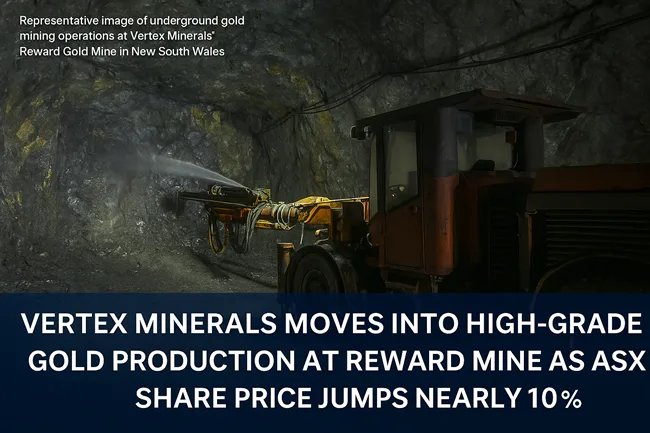
Vertex Minerals Limited (ASX: VTX) has commenced underground production at its 100%-owned Reward Gold Mine in New South Wales’ historic Hill End district, marking a key transition from low-grade stockpile processing to high-grade gold ore production. The announcement, made on 11 August 2025, sent Vertex shares up 9.76% to A$0.225, valuing the basic materials company at approximately A$51.02 million.
The move into high-grade output is seen by market watchers as a significant operational inflection point for the Australian gold exploration and development company, which is advancing both the Reward and Hargraves gold projects in the Eastern Lachlan Fold Belt.
What are the key operational milestones achieved at the Reward Gold Mine ahead of high-grade output?
Vertex Minerals reported that first blasting of gold-bearing ore on the Lady Belmore Reef was completed over the weekend, with this material now being fed to its Gekko gravity processing plant alongside low-grade stockpiles. The company remains on track to begin processing high-grade stope ore from the underground mine in the coming weeks, once all mining fronts are enabled.
The installation and powering of the Reward Underground transformer substation, along with cabling to the primary ventilation fan, has been completed. Access drives to two starter stopes have been cleaned, ready for drilling by the Epiroc production rig. Additionally, the Mica Vein decline — a gold-bearing structure — has been fully dewatered and is ready for flatback mining.
Vertex aims to have at least four active mining fronts supplying continuous feed to the gravity plant, with mining methods tailored to specific ore zones. The current mine plan includes extracting 2,075 tonnes at 17.8 grams per tonne gold from a developed airleg stope block, while bringing forward a very high-grade long hole stope for immediate extraction in August.
How does the Reward Gold Mine fit into Vertex Minerals’ broader resource portfolio?
The Reward Gold Mine has a JORC-compliant mineral resource estimate (MRE) of 419,000 tonnes grading 16.72 g/t gold for 225,200 ounces. This sits within Vertex’s larger Hill End and Hargraves project portfolio, which together host a total of 4.21 million tonnes grading 8.7 g/t gold for 482,000 ounces.
The Hill End district itself has a rich mining history, with the historic Hawkins Hill mine located above Reward producing 435,000 ounces at an extraordinary 309 g/t gold in the past. Vertex inherited A$25 million worth of underground development at Reward, providing a head start on accelerating production timelines.
What is the financial and market context behind Vertex Minerals’ latest move?
Vertex Minerals’ share price surge on the production update extends a strong 12-month run, with the stock posting a 167.86% one-year return. At A$0.225 per share, the company’s market capitalisation now stands at roughly A$51 million, with 226.74 million ordinary shares on issue. Trading volume on the day of the announcement exceeded 1.22 million shares, reflecting heightened investor interest.
Institutional sentiment appears cautiously optimistic, with the commencement of high-grade production viewed as a potential revenue inflection point. However, investors are also expected to track operational execution closely, particularly the timely ramp-up of multiple mining fronts and sustaining high recovery rates.
Why is the start of high-grade production at Reward considered a turning point for Vertex Minerals?
The transition from low-grade stockpile processing to high-grade stope ore production typically delivers a step-change in gold output and project cash flow. Vertex’s gravity plant, capable of recovering up to 95% of contained gold without the need for cyanide leaching, offers a cost-effective pathway to monetising its ore.
The company’s debt-free and unhedged position also gives it flexibility in capturing spot gold price upside. In addition, the high-grade nature of the Reward orebody — averaging over 16 g/t gold — places it among Australia’s richer gold projects currently in development or production.
What do analysts and industry observers expect next from Vertex Minerals’ operations?
Analysts following the junior gold sector have indicated that maintaining consistent high-grade throughput will be critical for sustaining market momentum. The decision to bring forward a high-grade long hole stope into the August mining schedule is expected to accelerate early cash flow generation.
Over the medium term, the integration of output from Reward with Vertex’s Hargraves and Red Hill projects could create a multi-asset production base in the region. Further exploration along the 25 km+ strike length of the Hill End gold system may also offer upside beyond current resource estimates.
How does Vertex Minerals position itself in Australia’s competitive gold sector?
With high-grade underground production now underway at the Reward Gold Mine, Vertex Minerals Limited is transitioning from the development phase into the ranks of Australia’s small-cap gold producers — a step that shifts how it is evaluated by both institutional and retail investors. The Australian gold sector is home to dozens of junior mining companies, but only a fraction manage to make the leap from exploration to sustained production. This is where Vertex’s combination of geological advantage, modern processing infrastructure, and inherited underground development gives it a distinctive competitive edge.
One of the most important differentiators is the ore quality at Reward. At an average grade of 16.72 grams per tonne, the deposit sits well above the grades typically reported by mid-tier and junior peers operating in Western Australia, Victoria, and Queensland, where open-pit operations often work with grades under 3 g/t. In underground mining economics, higher grades generally translate to lower cost per ounce, allowing miners to weather gold price volatility more effectively. This positions Vertex among a select group of Australian gold companies capable of generating robust margins even in a softer commodity price environment.
Vertex’s gravity-based processing route also stands out in a cost-conscious market. The Gekko gravity gold plant installed at Reward is capable of recovering up to 95% of contained gold without the need for chemical-intensive cyanidation, a factor that not only lowers operating costs but also reduces environmental footprint. For investors focused on environmental, social, and governance (ESG) performance, this processing choice aligns with a growing preference for cleaner, lower-impact mining practices.
A further advantage comes from the AU$25 million worth of underground development inherited when Vertex acquired Reward. This includes declines, ventilation systems, and access drives that significantly shorten the development timeline for new stopes. In an industry where capital cost overruns can derail project economics, the ability to expand production without major new capital outlay is a critical risk mitigator. It also means the company can direct more resources toward exploration drilling and resource expansion at both the Hill End and Hargraves projects.
Financially, Vertex maintains a debt-free and unhedged position, giving it maximum leverage to the spot gold price. While this increases exposure to price swings, it also ensures that any upside in the bullion market flows directly to the bottom line. For gold-focused funds and traders seeking higher operational torque, this capital structure can be attractive.
Geographically, operating within New South Wales’ Eastern Lachlan Fold Belt — a region with more than a century of gold mining history — provides both geological pedigree and infrastructure advantages. The area benefits from established supply chains, skilled labour availability, and proximity to existing processing and transport infrastructure, reducing logistical bottlenecks that can hamper operations in more remote Australian mining districts.
When benchmarked against other junior producers in Australia, Vertex’s combination of a high-grade orebody, modern gravity processing, significant inherited development, and favourable jurisdiction places it in a unique bracket. Many exploration-stage peers are still working to prove up resources through drilling campaigns, with production years away and dependent on raising significant development capital. Vertex, by contrast, is already generating gold from both stockpiles and underground stopes, with the potential to scale output quickly as more mining fronts come online.
Looking ahead, the company’s competitive position will hinge on its ability to sustain high-grade throughput, expand its resource base, and maintain low unit costs. If it succeeds, Vertex could emerge as a case study in how a junior miner can leverage strategic assets and disciplined capital management to achieve early production and carve out a durable position in Australia’s gold mining landscape.
Discover more from Business-News-Today.com
Subscribe to get the latest posts sent to your email.