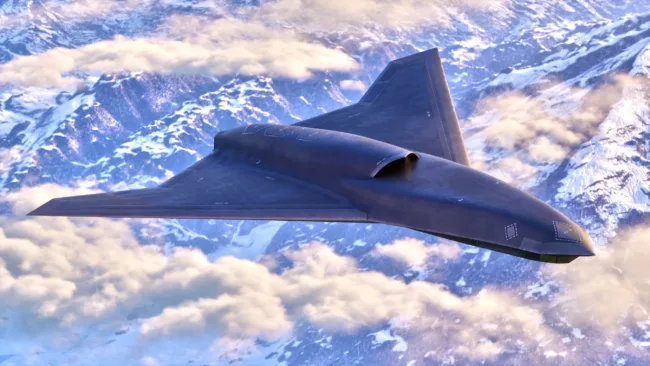
Lockheed Martin Corporation (NYSE: LMT) used the Air, Space and Cyber Conference in Maryland to reveal Vectis, its new Group 5 collaborative combat aircraft (CCA). Developed by its famed Skunk Works division, the system is positioned as a survivable, affordable, and multi-mission drone platform designed to complement fifth-generation fighters and set the benchmark for next-generation air dominance.
The unveiling underscores Lockheed Martin’s long-term strategy to dominate the growing CCA market, which is increasingly seen as central to U.S. and allied airpower concepts in contested theaters such as the Indo-Pacific. It also signals Skunk Works’ intent to merge stealth pedigree with modular, open-system architecture at a price point aimed at rapid scaling.
Why is Lockheed Martin betting on Vectis as the future of collaborative combat aircraft?
The defense contractor is framing Vectis not as a single platform but as an agile, customizable framework built around survivability, affordability, and interoperability. OJ Sanchez, vice president and general manager of Skunk Works, said the program is the culmination of decades of fighter integration, autonomy development, and systems engineering expertise. His comments highlighted the ambition to create a “new paradigm” for air power rather than simply introduce another drone.
Vectis integrates seamlessly with fifth-generation fighters such as the F-35 Lightning II and is designed to evolve alongside sixth-generation programs like Next Generation Air Dominance (NGAD). It supports precision strike, intelligence, surveillance and reconnaissance (ISR), electronic warfare, and both offensive and defensive counter-air missions. The platform also emphasizes multi-domain connectivity, ensuring it can operate independently or as part of a crewed-uncrewed team.
Lockheed Martin has confirmed endurance ranges compatible with Indo-Pacific, European, and Central Command theaters, reinforcing its alignment with U.S. Department of Defense (DoD) strategic priorities.
How does Vectis compare with other CCA programs from Boeing, Northrop Grumman, and Anduril?
The CCA race has heated up in recent years. Boeing’s MQ-28 Ghost Bat, originally developed with the Royal Australian Air Force, has become a reference point for allied drone collaboration. Northrop Grumman has invested heavily in stealthy unmanned systems through its RQ-180 program, while Anduril has introduced low-cost, attritable drone swarms built around AI autonomy.
Vectis appears to position itself at the premium survivability end of the market, leveraging Lockheed Martin’s decades of stealth expertise from the F-117, F-22, and F-35 programs. The company stressed that survivability would be “best in class” for CCAs, an area where low-cost drones may compromise.
By emphasizing open mission architecture and government reference alignment, Lockheed Martin also seeks to avoid “vendor lock-in,” a common criticism in the defense ecosystem. That move could appeal to Pentagon planners who want CCAs to plug into multiple command-and-control frameworks rather than being locked into proprietary systems.
What makes the Skunk Works pedigree central to the credibility of Vectis?
Skunk Works has built its reputation on solving “impossible” problems at speed — from the U-2 spy plane in the 1950s to the stealth breakthroughs of the F-117 Nighthawk. Its name carries weight with both Pentagon buyers and Wall Street investors because it has repeatedly delivered disruptive capabilities under aggressive timelines.
The Vectis program draws on this legacy of rapid prototyping and digital engineering, using lessons from the F-35 program’s advanced manufacturing techniques. Lockheed Martin has publicly committed to design, build, and fly Vectis within two years, a timeline that reflects both urgency and confidence in its agile development pipeline.
How affordable is Lockheed Martin’s Vectis in a defense budget under strain?
Affordability is becoming a critical factor as the U.S. military looks to balance great-power competition with fiscal constraints. The Pentagon’s CCA program of record is seeking a mix of survivable, attritable, and low-cost systems to expand capacity without escalating budgets to unsustainable levels.
Lockheed Martin has stated that Vectis will be offered at a competitive CCA price point, though specific figures were not disclosed. Analysts expect pricing to fall below the $20–25 million range often cited for stealthy, advanced CCAs, but above the $5–10 million attritable drone range targeted by firms like Kratos Defense & Security Solutions.
By blending affordability with survivability, Vectis could appeal to planners seeking a middle ground — high enough survivability to penetrate contested airspace, but low enough cost to procure at scale.
How does this launch align with U.S. and allied defense strategies in the Indo-Pacific?
The Indo-Pacific is widely regarded as the most demanding theater for air dominance. The distances, anti-access/area denial (A2/AD) systems, and sheer scale of Chinese military modernization mean the U.S. and its allies require endurance, survivability, and autonomous teaming.
Vectis’ advertised range profiles fit directly into these requirements. By integrating with both current fighters like the F-35 and emerging NGAD platforms, Lockheed Martin is making the case that its CCA will become the connective tissue in a Family of Systems approach.
Allied militaries such as Japan and Australia, both F-35 operators, may also become prospective customers, expanding the export potential beyond U.S. procurement.
What does Lockheed Martin’s stock performance and investor sentiment suggest about this announcement?
Lockheed Martin’s shares (NYSE: LMT) have been relatively resilient in 2025, trading in the $450–$480 range amid broader volatility in defense stocks. The company has benefited from strong F-35 deliveries, steady missile defense contracts, and heightened demand for munitions tied to European and Indo-Pacific geopolitical tensions.
Analysts have noted that new program announcements like Vectis typically do not move the stock in the short term, since revenues materialize years later. However, they reinforce long-term growth narratives. Institutional flows into Lockheed Martin have remained steady, with pension funds and defense-focused ETFs maintaining overweight positions.
FII/DII activity in recent months suggests a “hold” consensus among investors. Analysts tracking defense equities see limited near-term upside given valuation multiples, but programs like Vectis strengthen Lockheed Martin’s long-term competitive moat against peers.
What are the next milestones for Vectis and why do they matter for defense buyers and investors?
Lockheed Martin has confirmed that parts are already ordered and development teams are actively executing. The company aims to have a flying prototype within two years, a milestone that will be closely watched by both defense buyers and investors.
The program’s success will be measured not only by technical performance but also by how effectively it can integrate into the DoD’s tri-service architecture. Future global requirements will demand CCAs that can work across air, naval, and joint command systems.
Analysts expect that a successful early flight demonstration could position Lockheed Martin to win significant contracts under the U.S. Air Force’s CCA program of record, which is expected to procure hundreds of aircraft in the 2030s.
What are the final takeaways on whether Lockheed Martin’s Vectis can truly redefine the future of collaborative combat aircraft and air dominance?
Lockheed Martin’s unveiling of Vectis represents more than just another Skunk Works prototype. It highlights the defense giant’s strategy to dominate the high-end CCA category by offering a survivable, interoperable, and relatively affordable platform at scale.
The move also fits broader sectoral trends: great-power competition driving demand for autonomous systems, fiscal pressures demanding affordability, and a Pentagon push for open architectures. While Vectis will not affect Lockheed Martin’s near-term financials, it reinforces its long-term competitive position in a market likely to be worth tens of billions of dollars by the next decade.
For investors, the stock remains a long-term hold rather than a short-term trade. But for policymakers and defense planners, the real question is whether Vectis can deliver on its ambitious promise to be the benchmark for survivable CCAs. If it can, Lockheed Martin may once again shape the future of air power just as it did with the U-2, F-117, and F-35.
Discover more from Business-News-Today.com
Subscribe to get the latest posts sent to your email.