



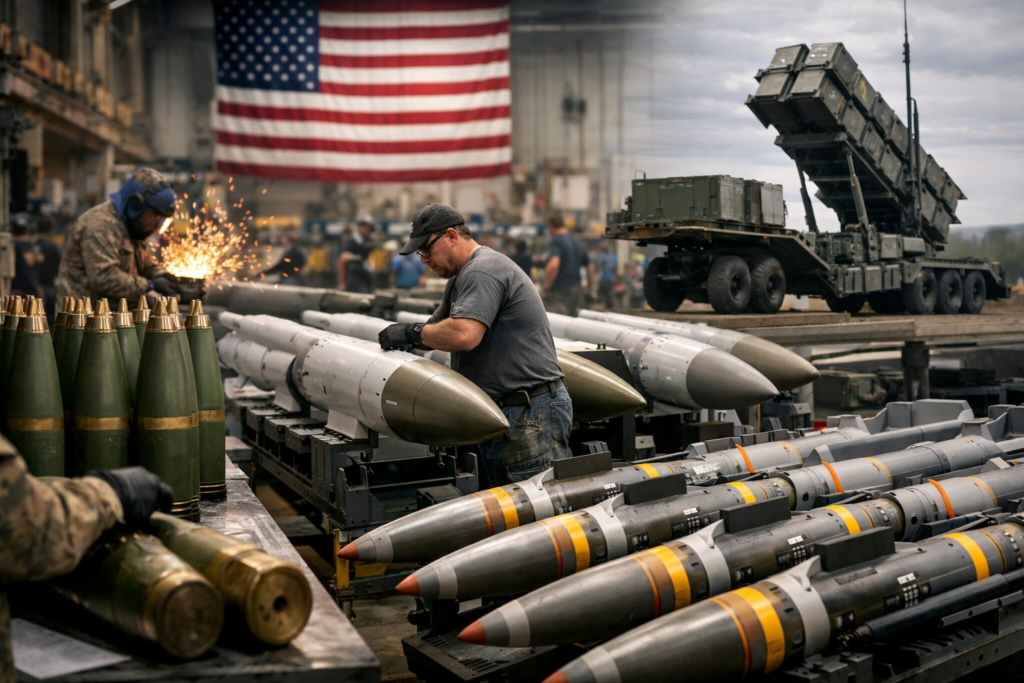
The United States Department of Defense announced on Wednesday, 25 March 2026, that it had concluded separate framework agreements with BAE Systems, Lockheed Martin, and Honeywell Aerospace to substantially expand production of critical munitions components and missile defence systems. The Pentagon described the agreements as a direct outcome of Secretary of Defense Pete Hegseth’s mandate to move faster, place the American defence industrial base on a wartime footing, and build what the Trump administration calls the Arsenal of Freedom.
What are the specific weapons systems covered by the Pentagon’s 25 March 2026 framework agreements with BAE Systems, Lockheed Martin and Honeywell Aerospace?
Three distinct production priorities are addressed under the agreements announced on 25 March 2026. The first involves Lockheed Martin committing to invest in advanced tooling, facility modernisation, and critical testing equipment to reduce production lead times for the Precision Strike Missile, designated PrSM Increment 1. The PrSM Increment 1 is designed to strike targets at distances of 60 to more than 499 kilometres and can be launched from both the M142 High Mobility Artillery Rocket System and the M270A2 Multiple Launch Rocket System. The Department of Defense confirmed that the PrSM agreement also establishes the basis for a potential multi-year procurement contract of up to seven years, subject to congressional authorisation. The PrSM is already in active combat use, having been deployed for the first time in United States military operations against Iran.
The second agreement involves Lockheed Martin and BAE Systems jointly committing to quadruple production of seekers for the Terminal High Altitude Area Defense, or THAAD, interceptor. BAE Systems manufactures the seekers at facilities in Nashua, New Hampshire, and Endicott, New York. Michael Duffey, the Under Secretary of Defense for Acquisition and Sustainment, said the BAE Systems agreement sends a clear, stable, long-term demand signal and provides certainty for industry partners to invest, expand, and hire. BAE Systems President and Chief Executive Tom Arseneault described the multi-year deal as providing the long-term demand signal the company needs to expand seeker production capacity at its manufacturing sites.
The third agreement commits Honeywell Aerospace to a $500 million multi-year investment of the company’s own funds to expand and modernise manufacturing of navigation systems, missile steering actuators, and electronic warfare products used across United States military platforms. Honeywell Aerospace Chief Executive Jim Currier confirmed that Honeywell is prepared to help meet the urgent demand for these components. Duffey described the commitment as evidence that the Pentagon’s strategy of providing long-term demand signals to unlock private investment is succeeding.
Why has the United States Department of Defense launched a series of munitions production deals with major defence contractors in early 2026 and what drove stockpile depletion?
The framework agreements are a direct response to a combination of factors that have collectively depleted United States weapons stockpiles to levels that Pentagon officials describe as insufficient relative to current and anticipated operational demands. The United States began drawing down weapons inventories significantly in 2022 following Russia’s full-scale invasion of Ukraine, supplying allied forces with artillery systems, ammunition, and anti-tank missiles. Further stockpile reductions followed during Israel’s military operations in Gaza. Most recently, the United States and Israel launched military operations against Iran in late February 2026, with the Department of Defense confirming that more than 9,000 targets inside Iran have been struck in the weeks that followed.
In January 2026, President Donald Trump signed an executive order directing Pentagon officials to identify defence contractors deemed to be underperforming on government contracts while continuing to return profits to shareholders through stock buybacks and dividend payments. The order stated that such practices threaten national security and that production has not met the needs of the United States military and its allies. Separately, the Department of Defense submitted an emergency supplemental budget request under the Middle East Security Emergency Act of 2026, seeking $50 billion to replenish depleted weapons stockpiles.
How does the Munitions Acceleration Council and the Department of War’s Acquisition Transformation Strategy shape the Pentagon’s industrial base agreements with defence contractors in 2026?
The framework agreements announced on 25 March 2026 are institutionally embedded within two overlapping policy frameworks. The first is the Department of War’s Acquisition Transformation Strategy, a formal policy document directing the entire Pentagon acquisition system to operate on a wartime footing, with greater tolerance for risk, a shift from a culture of compliance to one of speed and execution, and a mandate to deliver wartime surge capacity for key weapons and munitions. The strategy is anchored in President Trump’s Executive Order 14265, Modernising Defense Acquisitions and Spurring Innovation in the Defense Industrial Base, and in Defense Secretary Hegseth’s Transforming the Warfighting Acquisition System overhaul plan.
The second institutional mechanism is the Munitions Acceleration Council, which focuses specifically on expanding munitions production and procurement while identifying and eliminating bottlenecks across the supply chain. Pentagon officials have emphasised that the strategy is deliberately structured to benefit not only prime contractors but also the smaller subcontractors and component suppliers that underpin the broader defence industrial ecosystem. By issuing multi-year demand signals through framework agreements, the Department of Defense intends to give smaller firms the long-term visibility needed to justify investing in their own facilities and workforces. Hegseth has separately announced the creation of a Wartime Production Unit, redesigned from the former Joint Production Acceleration Cell, to centralise deal-making and enforce delivery commitments.
What is the broader timeline of Pentagon framework agreements with United States defence contractors since January 2026 aimed at rebuilding weapons stockpiles and expanding munitions output?
The 25 March 2026 agreements are the latest in a sequence of production acceleration deals the Department of Defense has concluded since the beginning of 2026. In January 2026, the Pentagon and Lockheed Martin announced plans to triple production of the Patriot Advanced Capability-3 missile. A separate January 2026 agreement committed Lockheed Martin to quadrupling THAAD interceptor production from 96 missiles to 400 per year over a seven-year period.
In February 2026, RTX, the parent company of Raytheon’s weapons division, announced five framework agreements with the Pentagon, committing to raise annual production of the Tomahawk cruise missile to more than 1,000, the Advanced Medium Range Air-to-Air Missile to at least 1,900, and the Standard Missile-6 to more than 500. Production increases for the Standard Missile-3 Block IIA and Standard Missile-3 Block IB interceptors were also confirmed. RTX disclosed it was raising capital expenditure from $2.6 billion to $3.1 billion in 2026 to fund the required manufacturing expansion. The RTX agreements were characterised as the first framework deals between Raytheon and the Trump administration, following President Trump’s public criticism of RTX as the least responsive major contractor to Pentagon production requirements.
In early March 2026, President Trump met at the White House with the chief executives of seven major defence contractors, including RTX, Lockheed Martin, Boeing, Northrop Grumman, BAE Systems, L3Harris Technologies, and Honeywell Aerospace. Following that meeting, President Trump stated publicly that the companies had agreed to quadruple production of exquisite-class weaponry and that plant expansion was already underway across multiple systems.
How does United States congressional appropriations for fiscal year 2026 munitions funding relate to the Pentagon’s framework agreements with defence industry for production acceleration?
Congressional appropriations have provided a parallel foundation for the industrial expansion now being pursued through framework agreements. The fiscal year 2026 National Defense Authorization Act authorised more than $25 billion to rebuild the United States munitions arsenal, including procurement funding for the PrSM, Joint Air-to-Ground Missile, Naval Strike Missile, Javelin, Stinger, GMLRS, Advanced Medium Range Air-to-Air Missile, Sidewinder, Long Range Anti-Ship Missile, and Tomahawk, among other systems. The legislation also granted multiyear procurement authority for a range of key missile systems, a provision the defence industry had sought for years as a mechanism to reduce per-unit costs and incentivise capital investment.
A reconciliation bill passed in the summer of 2025 had separately allocated an additional $25 billion for munitions and supply-chain support, including $500 million for solid rocket motor industrial base expansion and workforce development. The Trump administration requested a further increase of $28.8 billion in munitions spending in December 2025, though Congress added just under $2 billion for certain critical munitions in the final spending bill. Defence industry executives described the combined congressional funding as broadly consistent with expectations and sufficient, alongside the framework agreements, to justify sustained private investment in manufacturing capacity.
Key takeaways on what the Pentagon’s munitions framework agreements mean for the United States defence industrial base, missile production capacity and global security posture
- The United States Department of Defense announced three framework agreements on 25 March 2026 with Lockheed Martin, BAE Systems, and Honeywell Aerospace to accelerate production of the Precision Strike Missile, Terminal High Altitude Area Defense seekers, and critical munitions components including navigation systems and electronic warfare products, in direct response to weapons stockpile depletion from operations in Ukraine, Gaza, and against Iran.
- Honeywell Aerospace has committed $500 million of its own capital for manufacturing expansion, with the Pentagon characterising this as validation of a strategy designed to send long-term demand signals that unlock private sector investment across the defence supply chain, including among smaller subcontractors and component manufacturers.
- The 25 March 2026 agreements are part of a broader series of production acceleration deals concluded since January 2026, including agreements with Lockheed Martin for the Patriot Advanced Capability-3 and THAAD interceptors and with RTX for the Tomahawk, Advanced Medium Range Air-to-Air Missile, and Standard Missile-6, establishing a pattern of multi-year framework contracts intended to institutionalise wartime-level production rates.
- The Trump administration’s January 2026 executive order barring stock buybacks and dividend payments by underperforming contractors, the creation of the Munitions Acceleration Council, and the Acquisition Transformation Strategy collectively represent a structural shift in how the United States Department of Defense manages its relationship with the defence industrial base, prioritising speed and production volume over traditional procurement processes.
- The fiscal year 2026 National Defense Authorization Act authorised more than $25 billion for munitions procurement, and Congress separately allocated $25 billion through reconciliation for supply-chain support, providing legislative backing for the industrial base expansion; the Pentagon has also submitted an emergency $50 billion supplemental request under the Middle East Security Emergency Act of 2026 to accelerate stockpile replenishment following operations against Iran.
Discover more from Business-News-Today.com
Subscribe to get the latest posts sent to your email.