


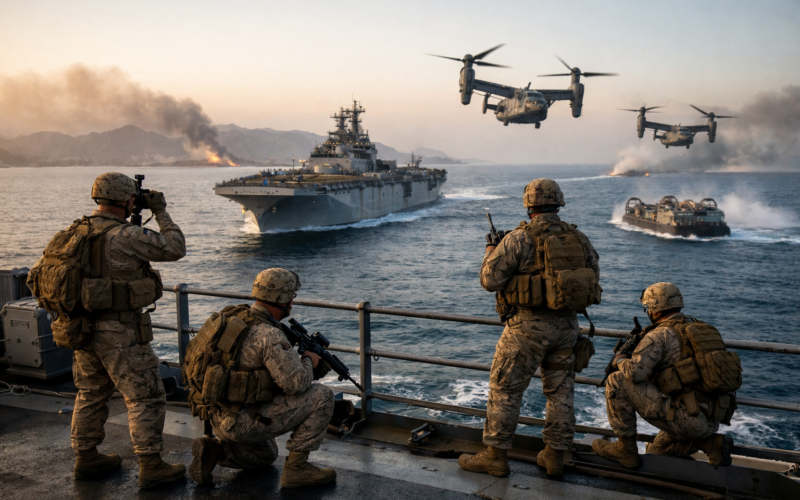
The United States military is deploying two Marine Expeditionary Units and multiple amphibious assault ships to the Persian Gulf region as Iran continues to restrict commercial shipping through the Strait of Hormuz, officials confirmed on 20 March 2026. The deployments follow three weeks of sustained United States and Israeli military operations against Iran under Operation Epic Fury and represent the most significant forward positioning of American ground-capable forces in the Middle East in over a decade.
Defense Secretary Pete Hegseth approved requests from United States Central Command for the deployment of an Amphibious Ready Group and attached Marine Expeditionary Unit following a formal request from Central Command leadership. The America-class amphibious assault ship USS Tripoli, homeported in Sasebo, Japan, departed the Philippine Sea carrying elements of the 31st Marine Expeditionary Unit based in Okinawa. Satellite imagery confirmed USS Tripoli, accompanied by two escort ships, transiting south of Taiwan through the Luzon Strait toward the United States Fifth Fleet area of operations in Bahrain.
A second Marine expeditionary deployment was confirmed within days. The 11th Marine Expeditionary Unit, comprising at least 2,200 Marines, departed San Diego aboard the amphibious assault ship USS Boxer approximately three weeks ahead of its originally scheduled departure. Reuters reported that USS Boxer’s accelerated deployment reflected the urgency of the operational requirement generated by ongoing Iranian attacks on shipping in the Strait of Hormuz. A Pentagon official, citing operational security protocols, declined to confirm specific movements or future force posture decisions.
The combined Marine expeditionary force amounts to approximately 4,400 Marines in addition to sailors crew aboard the amphibious vessels of both groups. A senior United States official confirmed that United States Central Command sought the Marine force to expand available options for military operations against Iran, noting that the Marine Expeditionary Units would be capable of conducting ground operations if ordered. The official declined to comment on the probability of any specific mission.
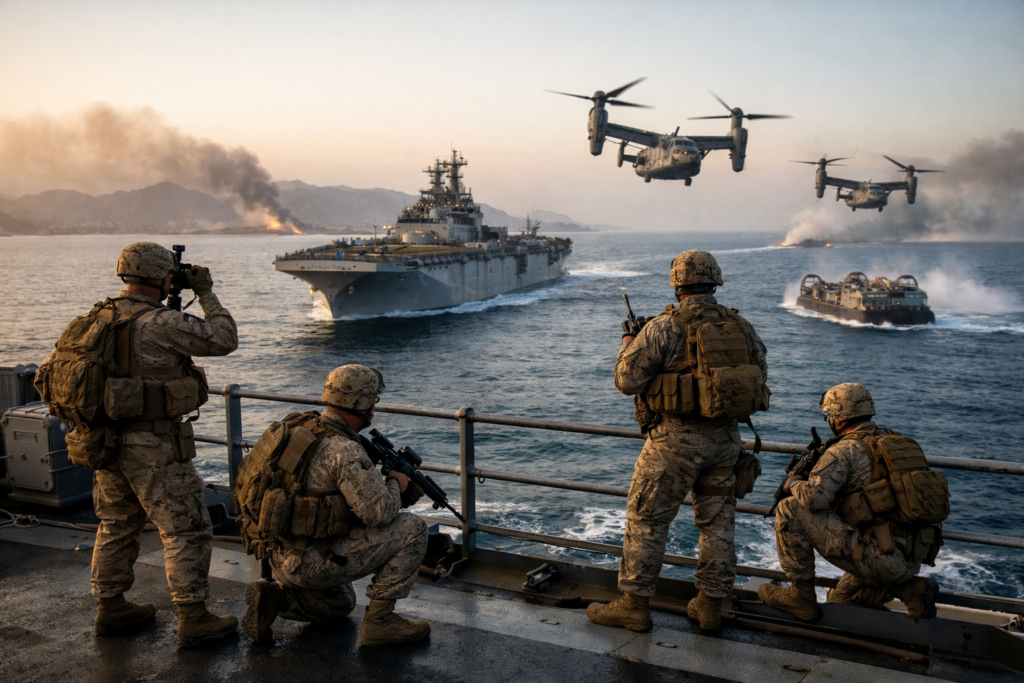
What amphibious capabilities does the 31st Marine Expeditionary Unit bring to the Strait of Hormuz operation?
Marine Expeditionary Units operate under the Marine Air-Ground Task Force concept, a doctrine integrating an air combat element, a ground combat element, a logistics element, and supporting capabilities into a unified self-sustaining force deployable from ship to shore. The 31st Marine Expeditionary Unit is the only permanently forward-deployed Marine Expeditionary Unit in the United States military. It is specifically designed to conduct ship-to-shore operations with units of up to a 550-personnel battalion landing team supported by helicopter, tiltrotor, and fixed-wing aviation assets.
USS Tripoli, the America-class amphibious assault ship carrying the 31st Marine Expeditionary Unit, is capable of embarking F-35B Joint Strike Fighter short takeoff and vertical landing aircraft. The ship previously tested the United States Navy’s lightning carrier concept, embarking up to 19 F-35B aircraft simultaneously. The addition of this aviation complement substantially expands the air power available to United States Central Command beyond the capability already provided by the USS Gerald R. Ford and USS Abraham Lincoln carrier strike groups already operating in the region.
Military analysts cited in reporting by multiple outlets have noted that the 31st Marine Expeditionary Unit’s specific configuration is consistent with operational scenarios involving the seizure of small islands in the vicinity of the Strait of Hormuz, the establishment of air defence and counter-drone positions to protect commercial shipping lanes, or raids on Iranian maritime assets. Iran has historically used islands near the strait to stage drone and missile attacks on commercial vessels. United States officials did not publicly confirm any specific mission for the Marine force currently transiting toward the region.
How has Iran’s closure of the Strait of Hormuz since March 2026 disrupted global oil supply and shipping?
The Strait of Hormuz is the narrow waterway separating the Sultanate of Oman from the Iranian coast and measures approximately 34 kilometres at its narrowest navigable point. The waterway serves as the primary export corridor for Persian Gulf crude oil and liquefied natural gas and carries approximately 20 percent of global daily oil supply and a comparable share of global liquefied natural gas trade. The Islamic Revolutionary Guard Corps of Iran officially declared the strait closed on 2 March 2026, four days after Operation Epic Fury commenced, and Iranian forces have since conducted more than 21 confirmed attacks on merchant vessels attempting transit.
Multiple independent assessments have described the closure as the largest disruption to the global oil market in the recorded history of that market, exceeding in scale the supply shocks of the 1970s energy crisis. Brent crude oil prices breached 100 United States dollars per barrel on 8 March 2026 for the first time in four years and reached a peak of approximately 126 United States dollars per barrel before settling at 112.19 United States dollars per barrel on 20 March 2026. Goldman Sachs warned that elevated energy prices could persist through 2027. Commercial tanker traffic through the strait dropped by approximately 70 percent at the height of the disruption, with more than 150 vessels anchoring outside the waterway to avoid attack.
Major global shipping companies including Maersk, MSC, and Hapag-Lloyd suspended all vessel transit through the Strait of Hormuz indefinitely following the outbreak of hostilities. Alternative routing options have proven both costly and logistically constrained. Saudi Arabia has partially diverted crude oil flows through the East-West Crude Oil Pipeline to the Red Sea port of Yanbu, while the United Arab Emirates has redirected volumes through the Abu Dhabi Crude Oil Pipeline to the Arabian Sea port of Fujairah. The combined throughput capacity of these inland pipeline systems is estimated at between 3.5 million and 5.5 million barrels per day, a fraction of the approximately 20 million barrels per day that ordinarily transit the Strait of Hormuz under normal conditions.
The International Energy Agency coordinated the release of 400 million barrels from emergency strategic petroleum reserves held by its 32 member countries to moderate the supply shock. The United States Treasury Department announced on 20 March 2026 that it was temporarily lifting sanctions on approximately 140 million barrels of Iranian crude oil already loaded aboard vessels at sea, in an effort to ease domestic and global fuel prices. United States Ambassador to the United Nations Mike Waltz described the measure as temporary and said it was intended to prevent Iran from achieving its stated strategy of using the Strait of Hormuz closure to force global energy prices higher.
Why are NATO member states refusing to join the United States in reopening the Strait of Hormuz in March 2026?
President Donald Trump has repeatedly demanded that North Atlantic Treaty Organisation member states and allied nations contribute warships to a multinational naval coalition to reopen and police the Strait of Hormuz. On 20 March 2026, Trump posted on his Truth Social platform characterising NATO member states as cowards and describing the North Atlantic Treaty Organisation without American participation as a paper tiger. Trump argued that the military task of reopening the strait was straightforward and involved very little risk, characterising the United States as having effectively dismantled Iran’s naval and air capabilities through Operation Epic Fury.
NATO allies have broadly refused the demand, citing the fundamental circumstance that they were neither consulted on nor notified of the decision to launch Operation Epic Fury before strikes commenced on 28 February 2026. German Defense Minister Boris Pistorius stated on 16 March 2026 that Germany had not started the conflict and questioned what a small number of European frigates could achieve in the Strait of Hormuz that the considerably larger United States Navy could not. French President Emmanuel Macron stated that France would not participate in operations to open or police the Strait of Hormuz in the current operational context. Germany’s Foreign Minister Johann Wadephul stated that the North Atlantic Treaty Organisation had made no decision on assuming responsibility for the strait and that European security priorities remained centred on Ukraine, noting that rising oil prices were contributing to Russian wartime revenue.
Despite the broad refusal, six NATO member states and Japan issued a joint statement on 19 March 2026 expressing conditional readiness to contribute to appropriate efforts to ensure safe passage through the Strait of Hormuz, while making that readiness contingent upon an end to active hostilities between the United States, Israel, and Iran. The signatories to the joint statement were Germany, the United Kingdom, France, Italy, the Netherlands, Canada, and Japan. The United Kingdom separately advanced its position on 20 March 2026, when Prime Minister Keir Starmer’s office confirmed that existing agreements permitting United States forces to use British military installations had been extended to include United States defensive operations intended to degrade Iranian missile sites and capabilities being used to attack commercial shipping in the Strait of Hormuz. In brief public remarks following the announcement, Trump said the United Kingdom should have acted faster.
Trump reversed his earlier position on 18 March 2026, telling reporters during an Oval Office meeting that the United States did not need any outside help reopening the Strait of Hormuz. Republican Senator Lindsey Graham of South Carolina stated publicly that he had spoken to Trump and had not heard the president so angry over the NATO response, warning of wide and deep repercussions for European governments that provided little support during the crisis.
What has Operation Epic Fury achieved militarily against Iran after three weeks of strikes in February and March 2026?
Operation Epic Fury is the designation for the joint United States and Israeli military campaign against Iran that commenced on 28 February 2026. The operation targeted Iranian command and control infrastructure, Islamic Revolutionary Guard Corps headquarters, ballistic missile production facilities and storage sites, naval vessels, anti-ship missile installations, air defence systems, and military airfields across multiple Iranian provinces. United States Central Command Commander Admiral Brad Cooper reported by 3 March 2026 that no Iranian naval vessel remained active in the Arabian Gulf, the Strait of Hormuz, or the Gulf of Oman. By 13 March 2026, United States forces had conducted more than 6,000 combat flights and destroyed more than 100 Iranian naval vessels since the campaign commenced.
United States and Israeli forces conducted strikes on more than 90 military targets on Kharg Island on 13 March 2026. The targets included naval mine storage facilities, missile storage bunkers, air defences, radar installations, and Kharg Airport. Kharg Island handles approximately 90 percent of Iran’s crude oil exports and serves as the primary loading platform for oil supertankers bound for Asian and European markets. The strikes deliberately avoided oil export infrastructure on the island. Iran retaliated on 15 March 2026 with drone and missile strikes against United States and allied positions in Iraq, Saudi Arabia, and the United Arab Emirates, describing the wave as a decisive phase response to losses at Kharg Island.
Iran’s Supreme Leader Ayatollah Ali Khamenei was reported killed on 28 February 2026, the first day of Operation Epic Fury. Mojtaba Khamenei was subsequently designated as Iran’s new supreme leader. Defense Secretary Hegseth stated on 20 March 2026 that Mojtaba Khamenei had been wounded and likely disfigured in the ongoing campaign, noting the absence of audio or video in a written statement issued by the new supreme leader. Director of National Intelligence Tulsi Gabbard testified before Congress on 18 March 2026 that the Iranian regime appeared intact but largely degraded by Operation Epic Fury. The United States has suffered at least 13 service member deaths since the campaign began, according to reporting by the Jewish Institute for National Security of America.
President Trump, speaking on 20 March 2026, stated that United States forces were getting very close to meeting their objectives and that Washington was considering winding down military operations. He enumerated objectives as preventing Iran from approaching nuclear weapons capability, completely degrading Iran’s ballistic missile systems, and eliminating Iran’s navy and air force. Trump told reporters that large portions of Iran’s government and military leadership had been killed and that finding Iranian officials to conduct any negotiations with had become difficult. The Pentagon submitted a request for 200 billion United States dollars in supplemental congressional funding to support the ongoing campaign.
What does the United States Marine deployment to the Persian Gulf mean for the countries, institutions, and global context involved?
- The United States has deployed the 31st Marine Expeditionary Unit aboard USS Tripoli and the 11th Marine Expeditionary Unit aboard USS Boxer to the Middle East, placing approximately 4,400 Marines within operational range of the Strait of Hormuz for the first time since Operation Epic Fury commenced on 28 February 2026.
- Iran’s closure of the Strait of Hormuz since 2 March 2026 has disrupted approximately 20 percent of global daily oil supply, pushed Brent crude to 112 United States dollars per barrel, and prompted the International Energy Agency to authorise the release of 400 million barrels from emergency strategic reserves in its largest coordinated drawdown in the agency’s history.
- NATO member states including Germany, France, and Italy have refused to join the United States in reopening the Strait of Hormuz, citing that the conflict was initiated without allied consultation, while six NATO nations and Japan issued a conditional joint statement on 19 March 2026 expressing readiness to contribute to safe passage efforts contingent upon a ceasefire.
- The United Kingdom announced on 20 March 2026 that it had extended existing basing agreements to permit United States forces to use British military installations to conduct defensive operations against Iranian missile capabilities targeting shipping in the Strait of Hormuz, marking the most direct allied contribution to Operation Epic Fury to date.
- The United States Treasury Department temporarily lifted sanctions on approximately 140 million barrels of Iranian oil at sea on 20 March 2026, acknowledging the severity of the global energy supply shock even as military operations against Iran continued, with Goldman Sachs warning that elevated oil prices could persist through 2027.
Discover more from Business-News-Today.com
Subscribe to get the latest posts sent to your email.