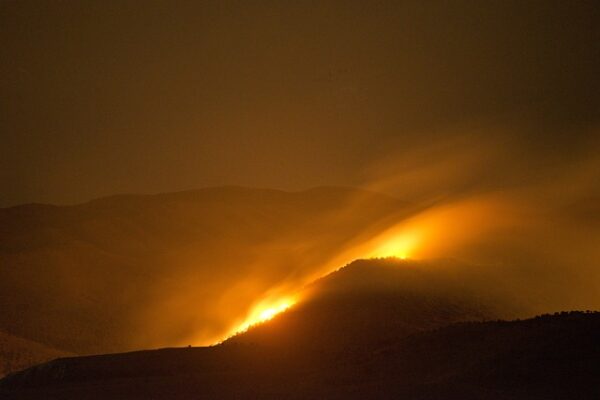

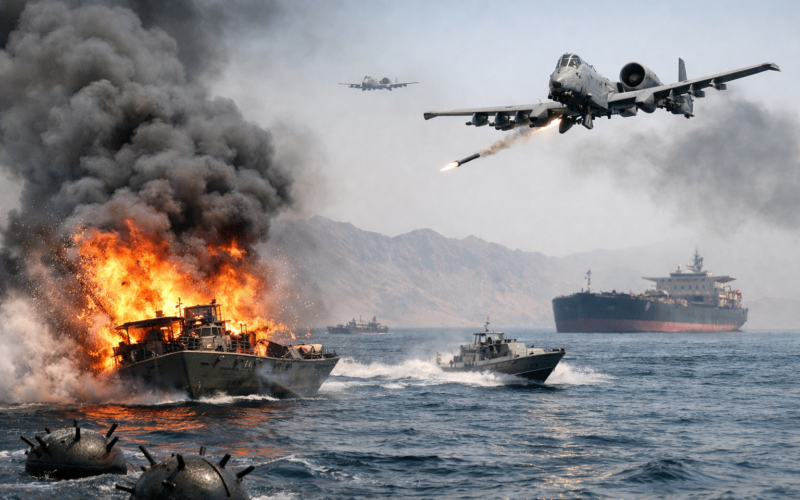
United States military forces have destroyed 44 Iranian mine-laying vessels near the Strait of Hormuz in an escalating campaign to neutralise Tehran’s capacity to block the world’s most critical energy passage, the chairman of the Joint Chiefs of Staff confirmed on 19 March 2026. General Dan Caine told reporters at the Pentagon that Air Force A-10 Warthog attack aircraft are now actively hunting the fast boats that Iran could deploy to seed the narrow waterway with naval mines, describing the operational environment as tactically complex and warning that significant threats to commercial and military shipping persist.
The announcement marks a significant expansion of United States anti-mine operations in the Persian Gulf. The first major strike occurred on 10 March 2026, when United States Central Command announced the destruction of 16 Iranian mine-laying vessels in a preemptive action described by a senior United States official as the result of intelligence on Iran’s operational mine-laying plans. President Donald Trump initially announced that ten vessels had been destroyed, with Central Command subsequently confirming the total at 16. By 19 March 2026, the cumulative figure had risen to 44 minelayers eliminated.
Iran’s Islamic Revolutionary Guard Corps declared the Strait of Hormuz closed to vessels linked to the United States, Israel, and their allies on 2 March 2026, four days after the United States and Israel launched military operations against Iran beginning on 28 February 2026. Senior Islamic Revolutionary Guard Corps adviser Ebrahim Jabari stated that any vessel attempting to transit the waterway would be set ablaze by Revolutionary Guard and Iranian Navy forces. The declaration triggered an immediate surge in global oil prices, which had stood at approximately 65 United States dollars per barrel prior to the conflict.
How Iran’s mine threat has paralysed Strait of Hormuz oil traffic and global energy supply chains
The Strait of Hormuz, located at the mouth of the Persian Gulf between Iran to the north and Oman and the United Arab Emirates to the south, is the world’s single most critical energy chokepoint. The waterway is approximately 21 miles wide at its narrowest point and facilitates two unidirectional sea lanes through which approximately 20 million barrels of oil per day transited in 2025, representing roughly 20 percent of global oil consumption and over a quarter of all seaborne crude trade. Qatar’s liquefied natural gas exports, which supply approximately one-fifth of global liquefied natural gas demand and between 12 and 14 percent of Europe’s liquefied natural gas supply, also transit the Strait. In addition to petroleum and natural gas, the waterway carries helium, fertilisers, and a range of industrial commodities essential to global manufacturing supply chains.
Brent crude oil surpassed 100 United States dollars per barrel on 8 March 2026 for the first time in four years, reaching a peak of 126 United States dollars per barrel as fears of a prolonged supply interruption intensified. The International Energy Agency responded by approving the coordinated release of 400 million barrels of oil from emergency strategic reserves held by its member countries. Analysts at the energy consultancy Kpler noted that even this release volume is equivalent to roughly 20 days of normal Strait of Hormuz flows, and that emergency reserves can temporarily calm market panic but cannot substitute for the restored functioning of the passage itself.
Commercial shipping traffic through the Strait has fallen to a near standstill. Kpler vessel tracking data shows that only Iranian and Chinese-flagged vessels continued to transit the passage in significant numbers in the initial weeks of the crisis, with major commercial operators, international oil companies, and maritime insurers having effectively withdrawn. Major marine war risk providers, including NorthStandard, the London Protection and Indemnity Club, and the American Club, announced suspension of coverage for vessels operating in Iranian territorial waters and parts of the Persian Gulf, citing unacceptably elevated risk from attacks and potential mine encounters. War risk premiums for Strait of Hormuz transits rose from 0.125 percent to between 0.2 and 0.4 percent of insured vessel value per transit.
What is Iran’s mine-laying capability in the Strait of Hormuz and why is it so difficult to counter
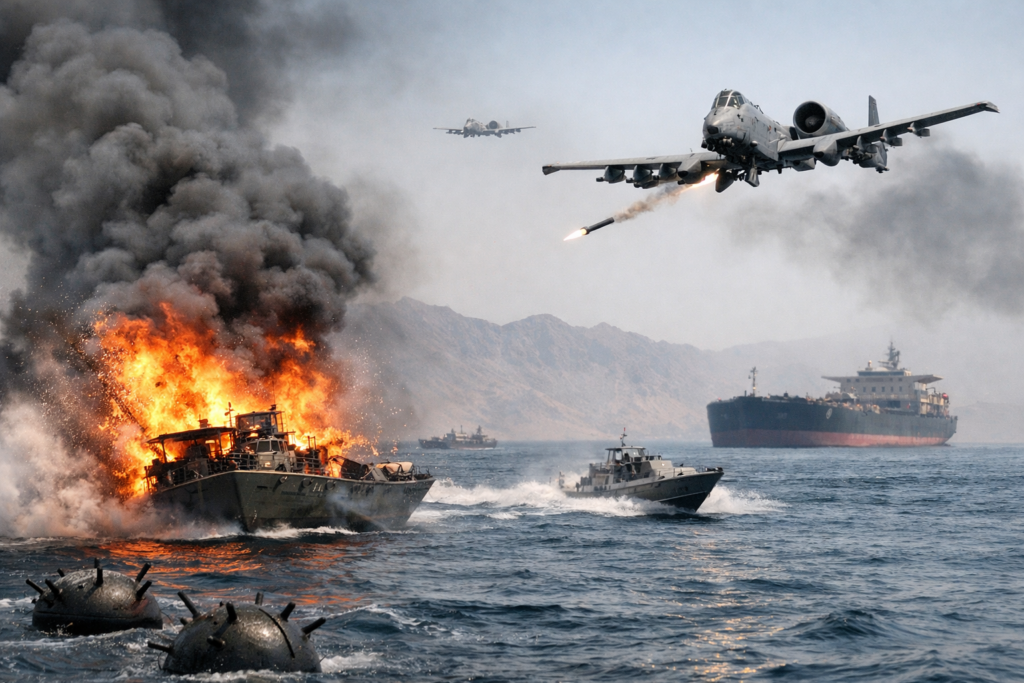
Iran possesses an estimated stock of between 2,000 and 6,000 naval mines, sourced domestically, from China, and from Russia, according to assessments cited by United States officials speaking to CBS News. Initial reporting indicated that Iran had laid fewer than 10 mines in the Strait as of 9 March 2026, with CNN subsequently reporting on 11 March that the number had risen to a few dozen, laid using smaller fast craft capable of carrying two to three mines each. United States officials described the mine-laying activity to that point as not extensive, but noted that Iran retained more than 80 percent of its mine-laying vessels and possessed the capability to lay hundreds of additional mines rapidly.
The asymmetric character of naval mines as a weapon presents acute difficulties for even the most capable military forces. Retired United States Admiral James Foggo, former commander of the United States Navy’s Sixth Fleet, noted that mines are a low-cost weapon that can be deployed by any vessel, including craft disguised as fishing boats. The United States Navy decommissioned its four ships exclusively designed for mine hunting and sweeping in September 2025. As of 19 March 2026, two of the Navy’s three remaining warships with counter-mine capabilities stationed in the Middle East, the USS Tulsa and the USS Santa Barbara, were undergoing scheduled maintenance in Singapore. The Pentagon had not disclosed the location of the third counter-mine capable vessel, the USS Canberra. General Caine acknowledged publicly that de-mining operations are labour-intensive and require the suppression of Iran’s ability to attack with missiles, drones, and fast boats before mine-sweeping can safely proceed.
Iran has built extensive tunnel networks and coastal infrastructure to protect and launch mine-laying vessels, midget submarines, and other submersibles surreptitiously, adding to the complexity of neutralising the threat. Anti-ship cruise missiles can be fired from coastal positions at short range, providing limited time for defensive response. Iran also retains stocks of Shahed aerial drones, which have longer range and can be launched from inland positions, and has deployed underwater and surface drones against commercial vessels off Iraq’s coastline. United States Navy officials told the Wall Street Journal that the Strait of Hormuz currently functions as an Iranian kill box, making the deployment of escort convoys for commercial shipping operationally hazardous until Iran’s broader area denial capabilities are further degraded.
How the United States military campaign is targeting Iranian mine-laying vessels and coastal infrastructure
United States Central Command has employed bunker-busting munitions against Iranian coastal infrastructure and anti-ship missile launch positions in addition to the direct strikes on mine-laying vessels. General Caine confirmed on 19 March that Air Force A-10 Warthog ground attack aircraft, which carry a 30mm automatic cannon capable of firing up to 4,200 rounds per minute, have been deployed specifically to hunt the small and fast boats Iran uses for mine-laying operations. The Pentagon has also discussed the potential deployment of United States Marines for short ground raids targeting missile and drone storage facilities along Iran’s coastlines.
President Trump warned Iran in a series of Truth Social posts that military consequences for continued mine-laying operations would be at a level never seen before. Trump separately threatened to target Iran’s oil export infrastructure at Kharg Island, Iran’s primary crude export terminal, stating that United States forces had struck more than 90 Iranian military targets on Kharg Island while preserving oil infrastructure, and that this restraint would be reconsidered if Iran continued to disrupt the Strait. Trump also directed the United States Development Finance Corporation to provide political risk insurance and guarantees for maritime trade transiting the Persian Gulf, and raised the prospect of United States Navy convoy escort operations once mine and missile threats are sufficiently reduced.
Which countries are allowing ships to pass through the Strait of Hormuz and what exemptions has Iran granted
Iran announced on 5 March 2026 that the Strait of Hormuz would remain closed only to vessels associated with the United States, Israel, and their Western allies, a position reaffirmed on 8 March. Several countries pursued bilateral negotiations with Tehran for safe passage exemptions. Iran granted passage to Indian-flagged tankers carrying liquefied petroleum gas, confirmed by India’s Ministry of Ports, Shipping and Waterways on 16 March. A Pakistani-flagged Aframax tanker named Karachi, carrying Abu Dhabi crude, became the first non-Iranian cargo vessel to transit the Strait while broadcasting its automatic identification system signal, according to MarineTraffic data reported on 16 March. Turkey confirmed that a Turkish-owned vessel received permission from Iranian authorities to transit the passage. Iraq’s oil minister stated on 17 March that Iraq is in contact with Iran to negotiate arrangements for Iraqi-flagged or Iraqi-destined oil shipments.
China, which sources approximately 45 percent of its total oil imports through the Strait of Hormuz, engaged in diplomatic discussions with Iran to secure safe passage for Chinese crude and liquefied natural gas carriers. Reuters reported on 5 March, citing three diplomatic sources, that China had made clear to Tehran that it was unhappy with the blockade’s impact on its energy supply and was pressing for exemptions. Iran’s Foreign Minister Abbas Araghchi confirmed that Iran had been approached by a number of countries seeking passage arrangements, stating that ultimate decisions rested with the Iranian military.
What is the international diplomatic response to Iran’s Strait of Hormuz blockade and the oil crisis
The European Union condemned Iran’s disruption of navigation in the Strait and called for a diplomatic solution. European Union foreign policy chief Kaja Kallas said the European Union was exploring expanding the scope of its existing naval missions, Aspides and Atalanta, or establishing a framework for the Strait modelled on the Black Sea Grain Initiative. European Union foreign ministers debated expanding the Aspides mission at a Brussels meeting but decided against it. Germany, Italy, Luxembourg, Romania, Spain, and the United Kingdom all ruled out military involvement. France said a naval escort mission would only take place after the conclusion of active hostilities, while expressing that Greece, Italy, and the Netherlands had shown interest in such an eventual mission.
Japan, which sources approximately 70 percent of its oil imports through the Strait of Hormuz, released emergency oil reserves beginning 17 March 2026. Japanese Prime Minister Sanae Takaichi met President Trump at the White House on 19 March 2026, describing the safety of the Strait of Hormuz as of the utmost importance to Tokyo but declining to commit to specific military assistance, citing constraints under Japanese law. Trump praised Japan’s response while taking a critical tone toward North Atlantic Treaty Organization allies, stating it was appropriate for other countries to step up to assist in reopening the Strait. Saudi Arabia, which intercepted dozens of Iranian drones and ballistic missiles targeting its territory and the Prince Sultan Air Base hosting United States troops, and Kuwait, which downed eight Iranian drones on 11 March, coordinated air defence responses with United States forces.
Iran’s newly installed Supreme Leader Mojtaba Khamenei, who succeeded his father following the latter’s death during United States-Israeli strikes, stated in his first public address that the Strait of Hormuz should remain closed and that Iran would continue attacks on Persian Gulf neighbours. The Islamic Revolutionary Guard Corps’ Khatam al-Anbiya Headquarters warned that any vessel linked to the United States, Israel, or their allies would be treated as a legitimate target, and forecast oil prices rising to 200 United States dollars per barrel if military pressure on Iran’s territory continued.
Why the Strait of Hormuz crisis represents the largest energy supply disruption since the 1970s oil shock
The disruption of the Strait of Hormuz in March 2026 has been described by analysts as the largest single interruption to global energy supply since the 1970s energy crisis. The closure cuts off oil and gas flows from Saudi Arabia, Iraq, the United Arab Emirates, Kuwait, and Qatar from reaching European, Asian, and global markets through the most direct maritime route. Saudi Arabia’s East-West Pipeline, with a capacity of 7 million barrels per day, and the United Arab Emirates’ Fujairah pipeline offer partial overland alternatives, but terminal infrastructure constraints at Jeddah limit combined throughput. These routes cannot offset a full Strait closure.
The closure has accelerated a structural shift in Asian energy procurement. India, which faces acute near-term crude supply exposure, has moved to increase purchases of Russian crude, while China is expected to reduce the constraints it had recently placed on Russian oil imports if the disruption extends beyond several weeks. The conflict has also materially improved Russia’s competitive position in global crude markets at a moment of otherwise elevated Western pressure on Russian energy revenues. The International Energy Agency warned that more than 3 million barrels per day of regional refining capacity has already been shut due to attacks and the absence of viable export outlets.
Iran’s alternative ports of Duqm, Salalah, and Sohar in Oman, located on the Arabian Sea outside the Strait and theoretically usable to bypass the chokepoint, have also come under pressure. Iranian drones struck Duqm and Salalah in March 2026, damaging at least one fuel storage tank at Duqm. Sohar was classified within insurers’ war risk zones, raising charter and insurance costs for vessels attempting the bypass route. The legal dimension of the crisis was also raised, with analysts noting that Iran’s closure of the Strait may constitute a violation of the United Nations Convention on the Law of the Sea, which guarantees transit passage rights through international straits.
What are the key takeaways on what this development means for the countries, institutions, and global context involved
- United States Central Command destroyed 44 Iranian mine-laying vessels by 19 March 2026, employing A-10 Warthog aircraft in active hunting operations against small fast boats that Iran uses to deploy naval mines in the Strait of Hormuz.
- The Strait of Hormuz has been effectively closed to Western commercial shipping since 4 March 2026, representing the largest disruption to global energy supply since the 1970s, with Brent crude reaching a peak of 126 United States dollars per barrel.
- Iran granted selective passage exemptions to vessels from India, Pakistan, and Turkey through bilateral negotiations, while maintaining the blockade against United States, Israeli, and allied shipping.
- The United States Navy faces acute mine countermeasure constraints after decommissioning its four dedicated mine-hunting ships in September 2025; two of three remaining counter-mine capable vessels were in Singapore for maintenance as of 19 March 2026.
- The European Union, Japan, and Gulf states have condemned the blockade but most governments have declined military involvement, leaving the United States as the primary military actor seeking to restore freedom of navigation in the Strait.
Discover more from Business-News-Today.com
Subscribe to get the latest posts sent to your email.