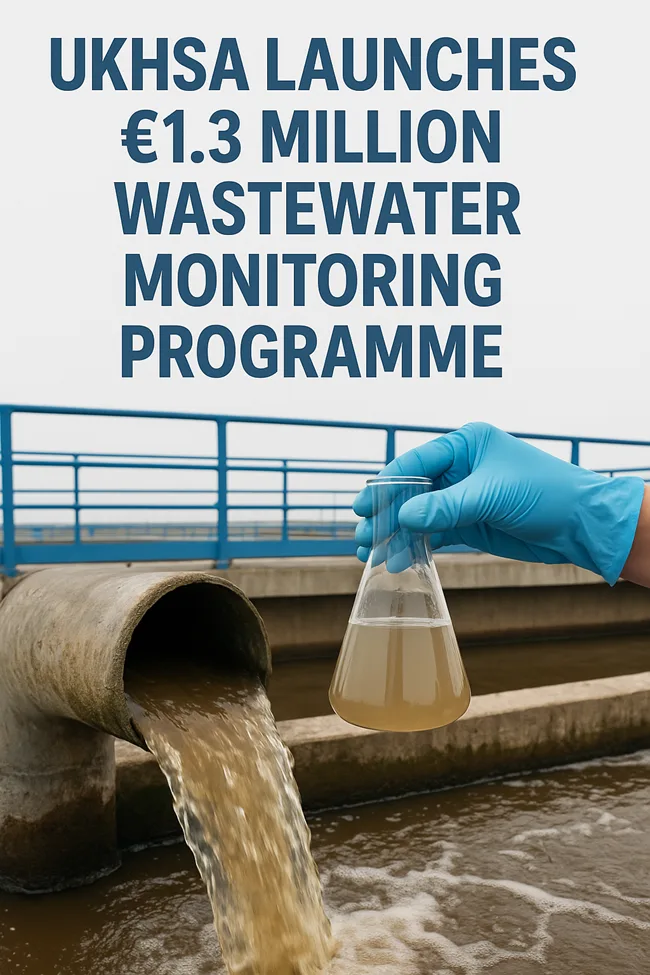
The United Kingdom Health Security Agency (UKHSA) has unveiled a new £1.3 million initiative that seeks to transform wastewater surveillance into a frontline defense against future pandemics. Backed by funding from the UK Integrated Security Fund (ISF), the project will test how cutting-edge genomic technologies can detect the presence of multiple dangerous pathogens in sewage systems.
The investment comes at a time when the UK is reassessing its preparedness for biological threats in light of the COVID-19 pandemic. Wastewater analysis was instrumental in tracking SARS-CoV-2 transmission patterns during the crisis, and public health experts believe that expanding the approach could offer a cost-effective and rapid means of detecting emerging threats.
UKHSA confirmed that its laboratories will conduct evaluations over the coming months, focusing on how viral genetic material behaves in wastewater and how its concentration changes over time. The overarching goal is to build an early warning system capable of alerting authorities to outbreaks before clinical data shows a rise in infections.
What pathogens beyond polio could wastewater surveillance detect under this new UKHSA programme?
The UK already has experience in wastewater testing through its surveillance system for poliovirus, but the new programme significantly widens the scope. According to UKHSA, one of the first pathogens under review will be Crimean-Congo haemorrhagic fever, a severe viral disease spread by ticks that is endemic to Africa, the Balkans, the Middle East, and parts of Asia. Until now, the disease has never been targeted through wastewater surveillance in the UK.
In addition, the programme will explore whether sewage analysis could detect pathogens such as Mpox, West Nile virus, and Lassa fever. Each of these diseases carries unique transmission risks and could pose public health challenges if introduced into the UK. By developing testing frameworks now, UKHSA aims to reduce the lag time between pathogen arrival and official response.
The agency also noted that the technology may be capable of identifying an even wider set of viruses and bacterial threats in the long term, depending on how genetic material persists in wastewater environments.
Why are UK security and health officials linking wastewater testing to national security priorities?
Government officials described the project as a strategic component of Britain’s broader biosecurity framework. Pat McFadden, Chancellor of the Duchy of Lancaster, stated that health security was integral to the UK’s national security strategy, noting that the new project would strengthen the ability to prevent outbreaks before they cause widespread disruption.
He explained that the UK’s updated Biological Security Strategy and Resilience Action Plan both place emphasis on proactive detection and preparedness, rather than relying solely on clinical surveillance systems. Wastewater monitoring, he added, could become a permanent fixture in the UK’s health security “armoury” as a tool to rapidly identify threats.
This perspective highlights the growing recognition that pandemics and biological events are not only public health crises but also threats to economic stability, supply chains, and national resilience.
How does wastewater monitoring complement traditional public health surveillance systems?
Professor Steven Riley, Chief Data Officer at UKHSA, said the project underlines how environmental surveillance can complement more traditional forms of testing and contact tracing. He stressed that wastewater monitoring offers a cost-effective method of detecting a range of pathogens simultaneously without relying on symptomatic individuals seeking medical care.
Riley also underscored the diversity of biological threats facing the world today. With globalization, climate change, and urbanization accelerating the spread of infectious diseases, technologies that can identify novel threats before they reach hospitals are seen as vital. He described the UKHSA initiative as both “exciting” and “crucial” for staying at the cutting edge of pathogen detection.
What role does the UK Integrated Security Fund play in financing biosecurity projects?
The wastewater monitoring project is being funded as part of the UK Integrated Security Fund’s (UKISF) Biosecurity Portfolio, which was launched earlier in 2025 by the Cabinet Office. The fund was designed to support projects that enhance the UK’s ability to prevent, detect, and respond to biosecurity threats.
By financing initiatives such as this one, UKISF aims to integrate scientific innovation with national preparedness. Analysts following the announcement observed that the government is aligning its biosecurity investments with the lessons learned from COVID-19, when reactive measures proved costlier than proactive detection.
For UKHSA, securing a portion of this funding highlights the agency’s central role in executing the UK’s biosecurity agenda, while also expanding the technical capacity of its laboratories to test for a wider range of viral and bacterial pathogens.
How are institutional stakeholders and analysts reacting to the UKHSA’s expanded wastewater strategy?
While the programme is still at an early stage, institutional sentiment towards UKHSA’s announcement has been largely supportive. Analysts pointed out that environmental surveillance is increasingly being recognized as a valuable tool for public health systems worldwide. The approach has already proven successful in tracking SARS-CoV-2 variants in Europe and North America, offering data even in areas where clinical testing declined.
Investors with interests in biotech and genomic testing companies are watching the programme closely, since any long-term rollout could lead to commercial contracts with private-sector partners providing sequencing technology, reagents, and data analytics.
Institutional observers also noted that embedding wastewater monitoring into the UK’s national health framework could help the government demonstrate leadership in global pandemic preparedness efforts, which remain a top priority for multilateral institutions.
What future impact could the UKHSA wastewater project have on pandemic preparedness and public health resilience?
If successful, the project could establish the foundation for a permanent, nationwide wastewater surveillance network in the UK. Such a system would complement hospital reporting and laboratory testing, creating a layered approach to pathogen detection.
Future expansions could also see the UK sharing methodologies with international partners, enabling cross-border detection of outbreaks that might otherwise be missed until infections spread widely. By providing a relatively low-cost, scalable, and non-intrusive way of tracking pathogens, the system could help the UK move towards a model of continuous monitoring rather than crisis-driven interventions.
Public health experts caution, however, that technical challenges remain. Wastewater contains a complex mixture of contaminants, and distinguishing low levels of genetic material from background noise requires advanced sequencing and bioinformatics. The UKHSA’s investment will therefore test both feasibility and accuracy before any long-term deployment decisions are made.
Still, the momentum reflects a broader global trend: countries are increasingly using wastewater not only to monitor polio or COVID-19, but also to track antimicrobial resistance, norovirus, influenza, and other pathogens.
Discover more from Business-News-Today.com
Subscribe to get the latest posts sent to your email.