

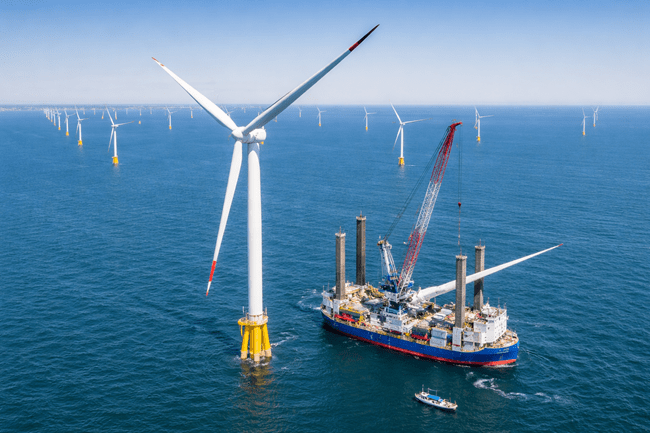
The UK government has committed up to £64 million in grant funding to Associated British Ports (ABP) to develop Port Talbot in South Wales into the first dedicated floating offshore wind port in the Celtic Sea. The investment, announced on 26 March 2026 by the Department for Energy Security and Net Zero, will fund the design and engineering work required to build the infrastructure needed to deploy floating turbines at commercial scale. The announcement positions Port Talbot as the industrial anchor of a 4.5 gigawatt offshore wind pipeline that could power approximately 6.5 million homes and is expected to catalyse over £500 million in additional private investment in the town. For the UK Labour government, the project serves a dual purpose: advancing its clean power mission while extending an industrial lifeline to a community already navigating the painful transition away from conventional steelmaking.
Why is Port Talbot strategically positioned to lead floating offshore wind development in the Celtic Sea?
The Celtic Sea is widely regarded as one of the best locations in Europe for floating offshore wind, owing to its deep waters and consistently strong wind speeds. Unlike traditional fixed-bottom offshore wind farms, which require seabed depths of up to around 60 metres, floating turbines are anchored to the seabed by mooring cables and can operate in water depths exceeding 100 metres. This characteristic makes the Celtic Sea unsuitable for conventional foundations but exceptionally well-suited to floating technology, which can unlock stronger and more consistent wind resources further offshore. Port Talbot sits at the eastern edge of the Celtic Sea and already benefits from established deep-water port infrastructure, road and rail connectivity, and a workforce with industrial and engineering heritage from the steelmaking era. ABP, which operates the port, has been developing plans for a floating wind hub for several years, and the Crown Estate’s Offshore Wind Leasing Round 5 gave those plans concrete commercial purpose by awarding 4.5 gigawatts of seabed rights to three developers across three separate 1.5 gigawatt sites.
What does the £64 million government grant actually fund and what does ABP still need to deliver?
The £64 million is a design and engineering grant, not a construction payment. It covers the preparatory work ABP requires before any turbine components arrive at the quayside. This includes detailed site surveys, structural engineering assessments, quay reinforcement planning, heavy-lift infrastructure design, and port layout reconfiguration to accommodate the assembly and marshalling of floating platform structures, which are considerably larger and heavier than fixed-bottom foundations. ABP has described this phase as essential to unlocking further private investment commitments. The company expects the completed port development to attract over £500 million in private capital and to support thousands of jobs across the project lifecycle. Grant terms have been agreed, but the funding remains subject to completion of the mandatory Subsidy Advice Unit referral and final government approvals, which introduces some residual regulatory timing risk. The Competition and Markets Authority must also clear the arrangement. Until both processes conclude, the grant is confirmed in principle but not yet legally disbursed.
Who are the developers already holding Celtic Sea seabed leases and how does port infrastructure affect their timelines?
Three developers now hold agreements for lease across the 4.5 gigawatt Round 5 portfolio. Norwegian energy major Equinor and the Gwynt Glas joint venture between EDF Power Solutions and ESB formalised their lease agreements in October 2025, each covering a 1.5 gigawatt project site off the coasts of South Wales and South West England. Ocean Winds, the floating wind specialist behind the world’s first commercial semi-submersible wind farm off Portugal, entered its agreement for lease in March 2026, completing the Round 5 framework. All three projects are at early development stage, with environmental impact assessments, consenting processes, and engineering surveys still to be completed. Operational dates are not expected before the mid-2030s. The availability of purpose-built port infrastructure at Port Talbot is, however, directly relevant to developer planning decisions. Without a functioning assembly and marshalling base within practical proximity to the project areas, developers face either significant additional transport costs or the risk that no suitable port exists in time for their construction programmes.
How does the Port Talbot floating wind investment fit within the broader industrial transformation programme for the town?
The floating wind announcement is the latest layer in a multi-strand industrial policy intervention that the UK government has been assembling around Port Talbot since Tata Steel announced in 2023 that it would close its two blast furnaces at the site. Those closures resulted in thousands of redundancies and removed the primary economic anchor for a community in South Wales that had been built around heavy industry for more than a century. The government responded with a £500 million commitment to support construction of a new Electric Arc Furnace at the site, which will allow Tata Steel to continue producing steel using a less carbon-intensive process. It also allocated £122 million through the Port Talbot Transition Board to fund training, business support, and supply chain resilience for workers and companies affected by the blast furnace transition. Separately, Port Talbot was designated the home of the Celtic Freeport, which offers tax and customs incentives designed to attract new investment into the area. The floating wind hub grant sits atop this policy stack. Together, the interventions amount to a deliberate attempt to replace the economic output of the old steelworks with a portfolio of lower-carbon industries, each of which depends on a different but overlapping skills and infrastructure base.
What are the execution risks that could slow or derail the Port Talbot floating wind port development?
The principal near-term risk is regulatory. The Subsidy Advice Unit referral and Competition and Markets Authority review are standard processes for public funding of this scale, but they introduce timing uncertainty. If either review raises material concerns, the grant timetable could shift, delaying ABP’s ability to proceed to detailed design. Beyond regulatory process, the floating offshore wind industry itself remains at an early stage of commercial scale-up. The three Celtic Sea projects are among the largest floating wind assignments ever attempted, and the supply chain for floating platforms, mooring systems, and subsea infrastructure does not yet exist at the volumes needed. Port Talbot can serve as a marshalling and assembly hub only if the components actually arrive, which depends on investment decisions by turbine manufacturers, platform fabricators, and cable suppliers that are still being made. There is also the question of where the high-value design and engineering work funded by the £64 million grant will be located. Critics have noted that ABP’s engineering advisers are based outside Port Talbot, raising the concern that the planning-phase jobs may not materialise in the town itself even as public money is committed. ABP and the government have pointed to the downstream construction and operational employment as the primary economic benefit, but the sequencing means the jobs are years away and dependent on final investment decisions that have not yet been taken.
How does the UK government’s Celtic Sea strategy compare to floating wind investment decisions in competing European markets?
The UK’s approach in the Celtic Sea is distinctive in combining a dedicated seabed leasing round with port infrastructure co-investment and a freeport incentive zone in the same location. Norway, the Netherlands, and Portugal have each taken steps to develop floating wind capability, but none has yet assembled a comparable policy package around a single port and a defined seabed lease portfolio. RenewableUK has estimated that floating wind in the Celtic Sea alone could deliver up to £32 billion in economic value and a £4.8 billion opportunity for Welsh businesses over the coming decades. At scale, the UK’s floating wind industry could employ around 97,000 people by 2050 according to trade body projections, with floating turbines potentially providing a third of total offshore wind capacity. Whether Port Talbot captures a meaningful share of that opportunity depends on how quickly ABP can complete the port development, how effectively the supply chain develops domestically, and whether the Celtic Sea developers ultimately reach final investment decision on their respective projects. The involvement of Equinor, a company with deep experience in North Sea infrastructure and a long record of delivering large-scale offshore projects, adds credibility to the Round 5 developer lineup. Ocean Winds, which built WindFloat Atlantic in Portugal, brings the most direct floating wind operating experience. Both represent strong industrial partners for a nascent UK supply chain to develop alongside.
What does the Port Talbot floating wind hub mean for Associated British Ports and its long-term port investment strategy?
For Associated British Ports, Port Talbot represents a strategic repositioning of an asset that has faced declining traditional cargo volumes as the steelmaking complex at the town contracted. ABP operates 21 ports across Britain and has been actively seeking to capture offshore wind-related revenue across several of its facilities. The floating wind hub grant removes a significant capital risk from ABP’s investment case by funding the design and engineering phase before ABP commits to full construction expenditure. If the port development proceeds to construction and the Celtic Sea projects reach final investment decision, Port Talbot would become one of ABP’s most strategically important assets, generating revenues from vessel berthing, component storage, assembly activity, and ongoing operations and maintenance logistics over a multi-decade project lifecycle. The chief executive Henrik L. Pedersen has described the government grant as a critical step toward further ABP investment at the site, indicating that the company’s own capital commitment is contingent on the public funding rather than running in parallel with it. This sequencing is commercially rational given the scale and novelty of the infrastructure involved, but it does mean that the port development timeline is tied to the regulatory approval process rather than purely to ABP’s own planning schedule.
Key takeaways on what the Port Talbot floating wind hub grant means for UK energy, industry, and investors
- The UK government has committed up to £64 million in grant funding to Associated British Ports to develop Port Talbot as the first dedicated floating offshore wind port in the Celtic Sea, covering design and engineering work ahead of full construction.
- The port is intended to support the 4.5 gigawatts of floating wind capacity awarded by The Crown Estate under Leasing Round 5, now held by Equinor, the Gwynt Glas joint venture of EDF and ESB, and Ocean Winds, with first power expected in the mid-2030s.
- The £64 million is a design-phase grant, not a construction payment. ABP’s own full capital commitment and the £500 million-plus in projected downstream private investment remain contingent on the regulatory approval process and developer final investment decisions.
- The grant is subject to Subsidy Advice Unit referral and Competition and Markets Authority clearance, introducing near-term timing risk to ABP’s development schedule.
- Port Talbot’s floating wind designation sits alongside the £500 million Electric Arc Furnace commitment to Tata Steel, the £122 million Transition Board programme, and the Celtic Freeport designation, forming an integrated industrial policy package for the town.
- The floating offshore wind supply chain in the UK remains underdeveloped relative to the ambition of the Celtic Sea pipeline, and the port’s ultimate economic contribution depends on how quickly platform fabricators, mooring specialists, and turbine manufacturers scale domestically.
- RenewableUK has estimated that floating wind in the Celtic Sea could deliver £32 billion in economic value and a £4.8 billion opportunity for Welsh businesses, with the UK industry potentially employing 97,000 people by 2050.
- Critics have raised questions about where the high-value engineering roles funded by the grant will be located, given ABP’s reliance on external consultants, with the headline employment projections for Port Talbot dependent on construction and operations phases still years away.
- For ABP, the grant de-risks the front-end investment case and positions Port Talbot as a long-term revenue-generating asset across vessel servicing, component logistics, and operations and maintenance if the Celtic Sea projects proceed as planned.
- The UK’s combined approach of seabed leasing, port co-investment, and freeport incentives around a single cluster represents a more integrated industrial policy framework for floating wind than has yet been deployed in competing European markets.
Discover more from Business-News-Today.com
Subscribe to get the latest posts sent to your email.