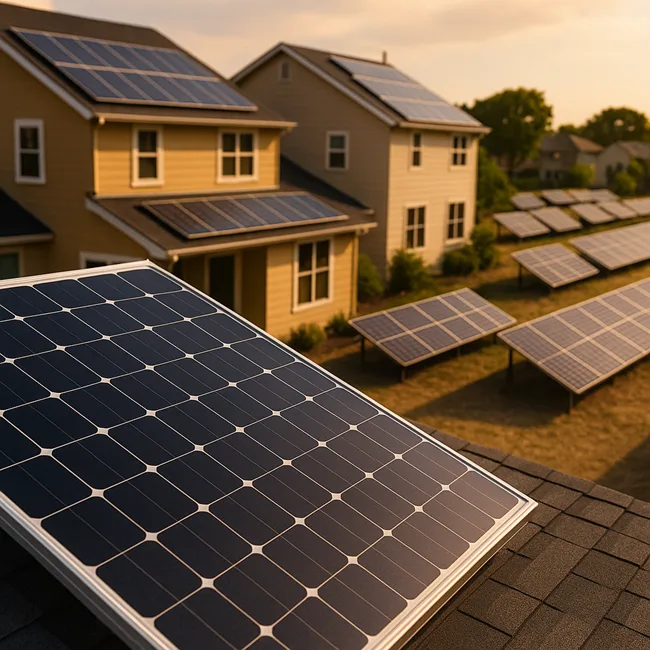
Why did the EPA terminate the $7 billion Solar for All program and what legal basis is being cited?
The United States Environmental Protection Agency (EPA) confirmed on August 7, 2025, that it has formally ended the $7 billion Solar for All grant program. Administrator Lee Zeldin announced the decision in a post on X, stating that the agency “no longer has the authority to administer the program or the appropriated funds” following the enactment of the One Big Beautiful Bill Act (OBBBA) on July 4, 2025. Signed into law by President Donald Trump, the legislation eliminated the Greenhouse Gas Reduction Fund (GGRF), a $20 billion pool established under the Inflation Reduction Act (IRA) that had allocated $7 billion specifically for Solar for All.
The move marks a major reversal of one of the Biden administration’s flagship clean energy initiatives, which had been intended to support nearly 1 million low- and moderate-income households with rooftop and community solar access. Without the GGRF, the EPA says it lacks statutory authority to disburse the funds or continue program oversight.
What was the original goal of Solar for All and which communities had already secured funding?
Launched in 2022 under the IRA, Solar for All was designed to accelerate equitable access to renewable energy while reducing household energy costs and lowering greenhouse gas emissions. The EPA awarded grants to 60 recipients, including state governments, tribal entities, and nonprofit organizations. Collectively, these grants were expected to serve close to 1 million households across the United States.
The program targeted communities traditionally excluded from renewable energy investments, with many grants earmarked for rural, tribal, and underserved urban areas. The expected benefits extended beyond energy cost savings, with additional aims including job creation, improved grid resilience, and measurable reductions in carbon emissions.
Which states and organizations will be most affected by the program’s cancellation?
The abrupt termination has disrupted major projects in multiple states. In the U.S. South, nonprofit organization Groundswell had secured $156 million to deliver solar solutions to more than 17,000 rural households across eight states. That funding stream has now been cut off.
Texas faced the loss of more than $400 million in planned investments, including $250 million earmarked for Harris County. These grants were intended to finance community solar arrays, battery storage systems, and energy efficiency upgrades for residents in economically disadvantaged neighborhoods. In Connecticut, the $62.45 million Project SunBridge initiative—aimed at expanding solar access, strengthening grid resilience, and lowering electricity costs—has been halted. State officials have already signaled their intent to mount legal challenges.
California, despite being in the early stages of implementing its Solar for All allocation, had planned to expand community solar projects for renters and low-income residents. The funding cancellation removes a key capital source before ground-level deployment could begin.
How has the political and institutional community responded to the repeal of Solar for All funding?
Political opposition to the decision has been swift and pointed. Senator Bernie Sanders described the move as “illegal” and an attack on working families and climate action. Clean energy advocacy groups, including the Southern Environmental Law Center, have argued that rescinding already obligated federal funds may violate existing contracts and statutory provisions.
The Environmental Protection Network criticized the repeal for undermining both renewable energy adoption and environmental justice objectives. Industry trade groups, such as the Solar Energy Industries Association, have similarly stated that the EPA lacks the legal authority to cancel grants that have been contractually committed, warning of reputational and operational risks to U.S. solar deployment if the decision stands.
What provisions in the One Big Beautiful Bill Act impact broader clean energy development in the U.S.?
The OBBBA is a sweeping legislative package that not only eliminated the GGRF but also rolled back multiple clean energy incentives established under the Inflation Reduction Act. These include the phased elimination of tax credits for solar, wind, electric vehicle adoption, and battery manufacturing.
For the renewable energy sector, analysts say this signals a significant policy pivot away from federally backed clean energy acceleration toward a more market-driven, state-led framework. Institutional investors tracking the solar and energy storage sectors have already flagged increased policy risk premiums, which could raise the cost of capital for future projects.
What are the projected impacts on household energy burdens and climate goals?
Solar for All had been projected to lower energy bills by as much as 20% for participating households. The loss of funding is expected to keep many low-income families locked into higher-cost, less sustainable energy sources.
According to program documentation, the initiative was projected to support approximately 200,000 jobs and cut 30 million metric tons of carbon dioxide emissions over its operating term. These benefits will now be unrealized unless alternative funding mechanisms are identified.
Connecticut officials, among others, emphasized that beyond household energy savings, the program promised secondary benefits such as improved public health through air quality gains and increased climate resilience through distributed generation and storage.
What legal challenges are being considered and could they reverse the EPA’s decision?
Multiple grant recipients and advocacy organizations are preparing legal challenges. Earlier in 2025, federal courts had blocked attempts to freeze certain clean energy funds, suggesting judicial skepticism toward retroactive cancellations. Legal experts believe plaintiffs may argue that the EPA’s action violates both administrative law and constitutional protections for contract obligations.
Given that much of the Solar for All funding had already been awarded and contractually obligated, legal analysts expect that any litigation will center on whether the repeal can override existing agreements. A protracted legal battle could create uncertainty for grantees, contractors, and communities, potentially delaying even state- or privately funded clean energy projects.
How might the cancellation reshape the trajectory of U.S. solar and energy equity programs?
The demise of Solar for All highlights the fragility of policy-driven climate initiatives in the face of shifting political majorities. Without federal grant support, states, municipalities, and nonprofits may need to pursue alternative financing models such as green bonds, public-private partnerships, and utility-driven community solar programs.
Institutional observers note that while U.S. solar deployment has been robust in recent years, its growth has been heavily supported by federal incentives. The cancellation may disproportionately affect emerging markets for solar—especially in low-income and multifamily housing segments—where upfront cost barriers remain a primary obstacle.
How does the termination of Solar for All highlight the vulnerability of U.S. clean energy programs to political shifts?
The termination of Solar for All represents a high-profile setback for equitable clean energy access in the United States. While supporters of the repeal argue it aligns federal spending with new legislative priorities, opponents view it as a direct blow to climate progress and energy justice. With lawsuits pending and policy uncertainty growing, the outcome will shape not only the future of this specific program but also the broader credibility of federal renewable energy commitments.
Discover more from Business-News-Today.com
Subscribe to get the latest posts sent to your email.