


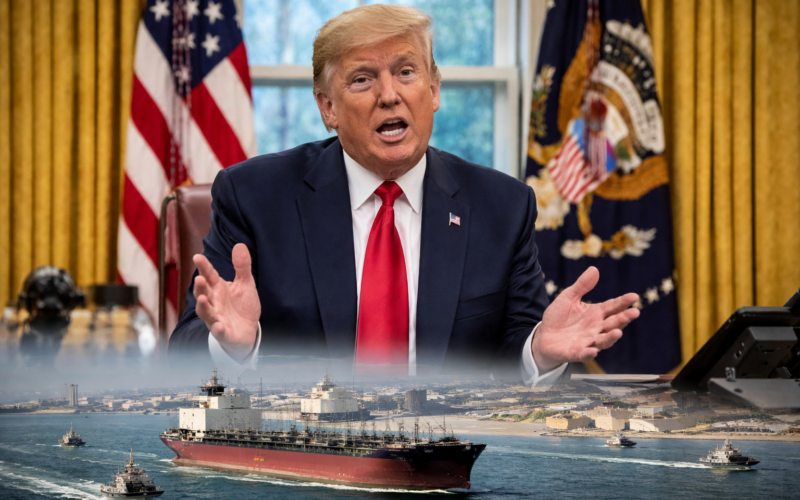
United States President Donald Trump declared on Tuesday, 24 March 2026, that Iran had delivered an undisclosed oil and gas-related concession he described as a “very big present worth a tremendous amount of money,” offering the development as evidence that Washington and Tehran were engaged in active negotiations to end a conflict now entering its 25th day. The announcement came as military operations continued on both sides and as Iran’s parliament speaker publicly denied that any negotiations were taking place, producing a stark and unresolved public contradiction between the two governments.
Speaking to reporters in the Oval Office during a ceremony for the swearing-in of newly appointed Secretary of the Department of Homeland Security Markwayne Mullin, Trump said the concession had been delivered the previous day and arrived in Washington on Tuesday morning. When pressed on its nature, the president confirmed it was “oil- and gas-related” and linked it specifically to transit flow through the Strait of Hormuz. He declined to provide further details, but said the development gave him confidence that the United States was “dealing with the right people” in Tehran. The White House did not respond to requests for elaboration on the specific nature of the concession.
Bloomberg reported that a Thai-flagged vessel had passed through the Strait of Hormuz on Tuesday, according to Iran’s Tasnim news agency, a development observers interpreted as potentially connected to the energy-related concession Trump had referenced. The passage of a vessel through the strait under non-hostile conditions would represent a notable shift from the near-total blockade that has been in effect since the conflict began.
What is the Strait of Hormuz and why has its closure since February 2026 triggered a global energy emergency?
The Strait of Hormuz is a narrow body of water approximately 33 kilometres wide at its narrowest point, situated between Iran to the north and Oman and the United Arab Emirates to the south. It is the world’s most consequential oil transit chokepoint. Under normal conditions, approximately 20 percent of the global daily oil supply and a comparable share of liquefied natural gas exports from Gulf producers including Qatar, Saudi Arabia, Kuwait, the United Arab Emirates, and Iraq pass through the strait. More than 80 percent of that cargo is destined for Asian economies, making countries such as Japan, South Korea, India, China, and Pakistan especially vulnerable to any sustained disruption.
The current crisis began on 28 February 2026, when the United States and Israel launched coordinated airstrikes on Iran under Operation Epic Fury, targeting military facilities, nuclear sites, and leadership, resulting in the death of Supreme Leader Ali Khamenei. Iran responded with missile and drone attacks on Israeli cities, United States military bases throughout the Gulf region, and energy infrastructure across Gulf states. The Islamic Revolutionary Guard Corps subsequently issued warnings prohibiting vessel passage through the strait, triggering a near-total collapse of tanker traffic. Tanker transits fell by approximately 70 percent within days of the closure, and more than 150 vessels anchored outside the strait to avoid the risk of attack. Iran made 21 confirmed attacks on merchant ships by 12 March 2026.
The International Energy Agency head Fatih Birol characterised the disruption as representing a worse impact on oil markets than the combined oil shocks of 1973 and 1979, and a more severe blow to gas markets than the disruption caused by the Russia-Ukraine war. The agency was preparing for what would have been the largest strategic petroleum reserve release in history if conditions deteriorated further.
How Iran shifted from blocking the strait entirely to operating a selective toll access system for approved vessels
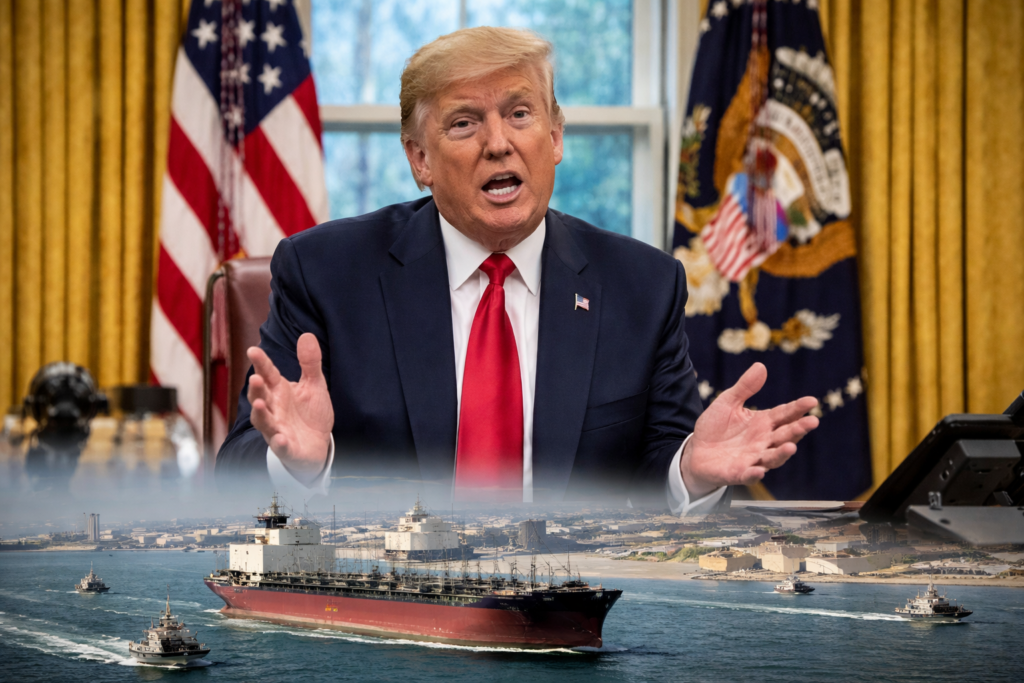
Rather than maintaining a complete closure, Iran moved toward a system of selective access that allowed approved vessels to transit through Iranian territorial waters for substantial payments. Multiple reports from maritime news service Lloyd’s List and subsequently from Bloomberg confirmed that Iran had established a fee-based corridor, with tankers paying reported fees of up to two million United States dollars per transit. At least 20 ships had transited the corridor as of 23 March 2026, accounting for between 10 and 20 percent of all traffic through the strait since the conflict began. Iran’s Islamic Revolutionary Guard Corps was simultaneously developing a formal vetting and registration system requiring vessels to provide extensive details about ownership and cargo destinations before receiving approval to transit.
Iran’s Foreign Minister Abbas Araghchi stated that Tehran had received approaches from multiple countries seeking safe passage for their vessels and that transit decisions rested with the Iranian military. India, China, Pakistan, Turkey, Malaysia, and Iraq were among the governments that engaged directly with Tehran over corridor access. The emergence of the fee system introduced a significant revenue stream for Iran at a time when the country’s economy was under severe pressure from military operations, sanctions, and the broader disruption caused by the conflict.
What diplomatic steps preceded Trump’s decision to suspend the ultimatum against Iranian power plants on Monday, 23 March 2026?
On 21 March 2026, Trump issued an ultimatum to Iran demanding it fully reopen the Strait of Hormuz without conditions within 48 hours, threatening to strike Iranian power plants if the demand was not met. Iran responded by threatening to completely close the strait and to strike energy and desalination infrastructure across the Gulf region. The confrontation represented the sharpest public escalation since the outbreak of hostilities on 28 February 2026.
Despite the public confrontation, behind-the-scenes diplomatic activity had been accumulating for several days. Pakistan, Turkey, Egypt, and Oman were all involved in parallel mediation efforts aimed at establishing conditions for both a ceasefire and a resolution of Strait of Hormuz access. The United States shared a 15-point framework of expectations with Iran via Pakistan, though it remained unclear whether Tehran had agreed to any of the terms. One regional source described several of the conditions as “next to impossible” for Iran to accept in their current form.
An Israeli official confirmed to Axios that United States envoys Steve Witkoff and Jared Kushner had been in contact with Iranian parliament speaker Mohammad Bagher Ghalibaf, a former general in the Islamic Revolutionary Guard Corps, a former mayor of Tehran, and a close associate of newly appointed Supreme Leader Mojtaba Khamenei. Trump declined to name the Iranian interlocutor publicly, citing concern for his safety, but described him as the most respected figure the United States had engaged with, adding that Supreme Leader Mojtaba Khamenei had not been directly contacted.
Trump’s announcement of productive talks on Monday arrived two hours before the opening of United States equity markets, resulting in a rally of more than 1,000 points in the Dow Jones Industrial Average and a sharp decline in the price of Brent crude oil. The timing drew scrutiny over potential market manipulation, given an unusual spike in oil futures trading recorded in the minutes immediately before Trump’s Truth Social post. Those questions remained unresolved as of Tuesday.
Why Iran denied negotiations even as indirect diplomatic channels remained active across multiple countries
Iran’s simultaneous public denial of negotiations while engaging through indirect channels reflects constraints that are simultaneously domestic and strategic. Iranian officials face significant pressure from hardline factions and a domestic audience that views negotiation under military bombardment as capitulation. Parliament speaker Mohammad Bagher Ghalibaf denied that any negotiations had taken place and described United States claims as an effort to manipulate markets and help Washington “escape the quagmire in which the United States and Israel are trapped.” Iran’s Foreign Ministry separately stated that “there is no dialogue between Tehran and Washington.”
United States officials acknowledged internally that Iran’s government was in a state of disorder following the death of Supreme Leader Ali Khamenei and the installation of his successor, Mojtaba Khamenei. Confusion about which Iranian officials held decision-making authority complicated both the United States assessment of Iran’s negotiating position and Iran’s ability to respond coherently to the 15-point United States framework.
Iran separately signalled, through a report in The Guardian, that it would only engage in substantive negotiations with Vice President JD Vance and not with Witkoff or Kushner. Iranian officials reportedly viewed the two pre-war negotiators as having acted in Israeli interests during the nuclear discussions that preceded Operation Epic Fury in February 2026. “With Witkoff and Kushner, nothing will come out of it. We have seen that in the past,” the Guardian cited a source close to the Iranian government as saying. [SINGLE SOURCE – VERIFY]
What both governments are demanding as conditions for any agreement to end the conflict in Iran
According to sources cited by Axios, Iran’s conditions for any agreement included a ceasefire, formal guarantees that hostilities would not resume, and compensation for conflict-related damages. Any comprehensive agreement would also need to address the reopening of the Strait of Hormuz to commercial shipping, the disposition of Iran’s stockpile of highly enriched uranium, and long-term arrangements covering Iran’s nuclear programme, ballistic missile capabilities, and its network of regional proxy groups.
United States envoy Steve Witkoff informed Trump that Iranian interlocutors had agreed on several key points, including the surrender of Iran’s stockpile of highly enriched uranium, which would represent a substantial concession. It remained unclear whether any Iranian official with binding authority had in fact made or endorsed that offer. Trump publicly stated that nuclear weapons prohibition was the first, second, and third priority in any agreement, and that Iran would not be permitted to conduct uranium enrichment under any settlement.
Israel expressed concern that Trump might conclude a partial agreement that fell short of Israeli war objectives, deferring unresolved issues to later stages without a clear resolution. An Israeli official told Axios that Israel was highly sceptical Iran would accept the full scope of United States demands, and that there was concern Washington might halt the conflict in exchange for partial compliance.
Pakistan Prime Minister Shehbaz Sharif publicly offered on Tuesday to host direct or indirect negotiations between the United States and Iran in Islamabad. Trump shared Sharif’s post on his Truth Social account without formal endorsement, while the White House described the diplomatic situation as fluid and declined to confirm any specific venue or timeline. A proposal for a senior-level meeting in Islamabad involving Vice President Vance, Witkoff, and Kushner on the United States side and Ghalibaf and other Iranian officials on the Iranian side was under active consideration, pending a response from Tehran.
Military operations continued throughout the diplomatic signalling on Tuesday. The Israel Defense Forces reported a new wave of strikes across Tehran targeting what the military described as infrastructure of the Iranian regime. Iran’s Atomic Energy Organisation accused the United States and Israel of striking the Bushehr nuclear power plant, saying a projectile landed inside the compound but caused no technical damage or casualties. Iran continued missile and drone attacks against Israeli territory and Gulf state infrastructure, with Saudi Arabia’s Defence Ministry reporting the interception and destruction of 19 Iranian drones targeting its oil-rich Eastern Province. The United States military confirmed that the Army’s 82nd Airborne Division command element had been directed to deploy to the Middle East with an infantry brigade of several thousand soldiers, signalling that military escalation remained a live option alongside diplomacy.
Key takeaways on what Trump’s Iran oil present claim and the five-day diplomatic window mean for global energy markets, Gulf security, and the United States-Iran conflict
- United States President Donald Trump confirmed on 24 March 2026 that Iran had made an undisclosed oil and gas-related concession linked to the Strait of Hormuz, which he cited as evidence of active negotiations, though Iran’s parliament speaker and foreign ministry publicly denied any negotiations were taking place.
- The United States transmitted a 15-point framework for ending the conflict to Tehran via Pakistan, but it was unclear whether Iran’s leadership had reviewed or accepted any of the terms; one regional source described several conditions as “next to impossible” for Iran to accept.
- Pakistan offered to host direct or indirect talks between the United States and Iran in Islamabad, with Vice President JD Vance identified as a potential senior United States participant; Iran separately indicated it would only engage substantively with Vance and not with envoys Steve Witkoff or Jared Kushner.
- The Strait of Hormuz remained effectively closed to routine commercial traffic, with Iran operating a selective fee-based transit corridor charging vessels reported sums of up to two million United States dollars per passage; the International Energy Agency described the energy market disruption as worse than the combined oil shocks of 1973 and 1979.
- Military operations continued on all fronts during the five-day diplomatic window, with the Israel Defense Forces conducting new strikes in Tehran and Isfahan, Iran reporting a projectile strike within the Bushehr nuclear power plant compound, and the United States deploying additional Army and Marine forces to the Middle East.
Discover more from Business-News-Today.com
Subscribe to get the latest posts sent to your email.