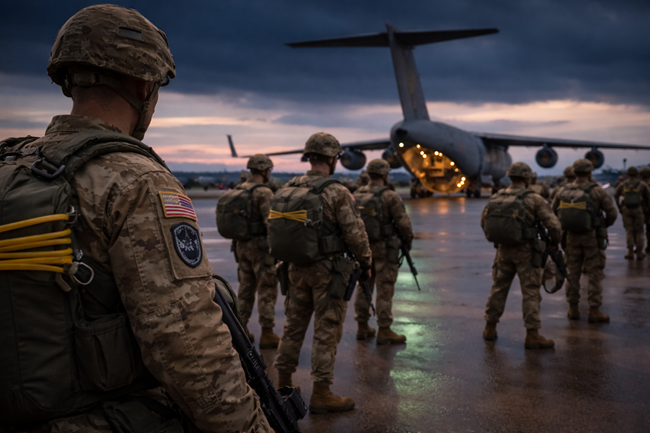
The United States Army abruptly canceled a major training exercise for the headquarters element of the 82nd Airborne Division, based at Fort Bragg in North Carolina, prompting speculation within the United States Department of Defense that soldiers specializing in ground combat and rapid intervention operations may be dispatched to the Middle East as the conflict with Iran continues to escalate. The headquarters staff of the 82nd Airborne Division was instructed to remain in North Carolina rather than travel to Fort Polk in Louisiana, where the exercise had been scheduled to take place. The remainder of the division continued training at Fort Polk as planned.
As of Friday, 6 March 2026, no formal deployment orders had been issued, according to officials who spoke on the condition of anonymity because they were not authorized to publicly discuss the matter. The United States Army directed inquiries to the Pentagon, which declined to provide specific information about the cancellation. The Pentagon stated that it does not discuss future or hypothetical movements for reasons of operations security. Officials from United States Central Command, which oversees military operations across the Middle East, also declined to comment.
What is the 82nd Airborne Division Immediate Response Force and what missions is it trained to conduct in the Middle East?
The 82nd Airborne Division includes a brigade combat team of approximately 4,000 to 5,000 soldiers capable of deploying anywhere in the world within 18 hours of notification. The division, which operates under the XVIII Airborne Corps at Fort Bragg in North Carolina, is the only United States Army division capable of executing a global airborne joint forcible entry operation within that timeframe. The division is trained for a broad range of missions, including seizing airfields and other critical infrastructure, reinforcing United States embassies, and enabling emergency evacuations. The headquarters element is responsible for coordinating the planning and execution of those operations.
The Immediate Response Force component of the 82nd Airborne Division draws on a brigade combat team combined with United States Air Force airlift and support units. The force traces its institutional origins to the Rapid Deployment Joint Task Force, which was established by the United States in 1980 following geopolitical shocks that included the Iranian Revolution of 1979 and the Soviet Union’s invasion of Afghanistan. The force was designed to provide rapidly deployable combat formations capable of confronting threats to American interests globally, including in the Middle East.
How has the 82nd Airborne Division Immediate Response Force been used during recent Middle East and global crises?
The Immediate Response Force has been activated in response to several significant crises in recent years. At the end of December 2019, the headquarters element and initial units of the division were deployed to Kuwait and the Baghdad area in Iraq to reinforce security at the United States Embassy in Baghdad following attacks by pro-Iranian militia on the compound. That deployment preceded the January 2020 killing of Iranian Islamic Revolutionary Guard Corps Quds Force Commander Qasem Soleimani in a United States airstrike at Baghdad International Airport.
In August 2021, the 1st Brigade Combat Team of the 82nd Airborne Division was deployed to Afghanistan as part of Operation Allies Refuge, the United States military operation supporting the evacuation of American citizens and Afghan allies following the Taliban’s rapid recapture of the country. Elements of the division were also mobilized and deployed to eastern Europe in early 2022 in support of North Atlantic Treaty Organization alliance deterrence operations during the period preceding Russia’s full-scale invasion of Ukraine. The division’s deployment pattern demonstrates a consistent role as one of the first United States ground combat formations considered for activation during rapidly deteriorating international security situations.
What has President Trump and the administration said about possible United States ground troop deployment to Iran?
President Donald Trump has offered varying public explanations for the decision to initiate the conflict with Iran and has stated publicly that United States ground forces would probably not be required as part of the ongoing military campaign. Neither Trump nor senior administration officials have categorically ruled out the deployment of ground combat troops, however. White House press secretary Karoline Leavitt stated that sending American ground troops into Iran was not part of the current plan but declined to remove the option from the table on behalf of the president.
During a Pentagon briefing, Chairman of the Joint Chiefs of Staff General Dan Caine declined to address questions concerning potential ground deployments, stating that his role was to execute policy rather than to make it. General Caine appeared at the briefing alongside Defense Secretary Pete Hegseth, who also declined to rule out the deployment of ground combat troops to the region. Reports from the preceding week indicated that General Caine had cautioned the White House about risks associated with a large-scale military campaign against Iran, including limited stockpiles of certain munitions and insufficient military backing from United States allies. The administration sought to minimize those concerns publicly.
What is the current military situation in the United States campaign against Iranian forces in the Middle East?
The conflict between the United States and Iran began approximately one week before the training cancellation was reported. United States commanders have to date relied primarily on air and naval strikes targeting Iranian military facilities, missile stockpiles, drone systems, and naval assets. As Iranian defensive capabilities have weakened, United States aircraft have increasingly operated directly over Iranian territory to conduct strikes using fighter jets, bombers, and other aircraft.
Admiral Charles Brad Cooper, who oversees United States naval operations in the region, indicated that United States combat power in the Middle East continues to grow while Iranian military capabilities are declining. Cooper noted that Iran has launched a reduced number of missiles and drones in recent days compared with earlier in the conflict. More than 50,000 United States military personnel are currently involved in regional operations related to the conflict. Six United States soldiers have been killed since hostilities began.
The officials who confirmed the training cancellation also noted that the United States Army is expected to announce a previously scheduled deployment of a helicopter unit belonging to the 82nd Airborne Division to the Middle East. That deployment had been planned before the conflict with Iran began and is not expected to take place until later in spring 2026. The pre-existing nature of that helicopter unit deployment indicates that United States military planners had already been adjusting force posture in the region independently of the current conflict.
What does the cancellation of the 82nd Airborne Division training event mean for United States military readiness and the Iran conflict?
The combination of the pre-planned helicopter unit deployment and the abrupt cancellation of the headquarters training exercise has contributed to elevated internal speculation within the Department of Defense about the potential activation of the Immediate Response Force for operations in or around Iran. Officials familiar with the situation have noted that preparation for contingencies does not constitute issuance of formal deployment orders but reflects standard operational readiness procedures for a formation maintained in a state of continuous high readiness.
The 82nd Airborne Division has historically served as a visible signal of United States military intent during periods of international crisis. The division’s operational status and any adjustments to its training schedule have therefore attracted close attention from analysts, allied governments, and regional actors at a time when the United States has not publicly committed to or excluded ground combat operations against Iran. The Pentagon’s refusal to comment on future or hypothetical movements leaves the question of a potential ground deployment formally unresolved.
Key takeaways on what this development means for United States military strategy, the Iran conflict, and the prospect of a ground deployment in the Middle East
- The United States Army abruptly canceled a headquarters training exercise for the 82nd Airborne Division at Fort Polk, Louisiana, directing the headquarters staff to remain at Fort Bragg, North Carolina; as of 6 March 2026, no formal deployment orders have been issued.
- The 82nd Airborne Division’s Immediate Response Force can deploy approximately 4,000 to 5,000 soldiers globally within 18 hours and has been activated for operations in Iraq, Afghanistan, and eastern Europe during recent international crises.
- Neither President Donald Trump, Defense Secretary Pete Hegseth, nor White House press secretary Karoline Leavitt has ruled out the deployment of United States ground combat troops to Iran, with Leavitt describing a ground deployment as not part of the current plan while declining to remove it as an option.
- United States Central Command and the Pentagon both declined to comment on the training cancellation, citing operations security; Admiral Charles Brad Cooper noted that United States combat power in the region is growing while Iranian military capabilities are declining.
- A previously scheduled helicopter unit deployment from the 82nd Airborne Division to the Middle East, planned before the conflict with Iran began, is expected to be announced and carried out later in spring 2026, indicating a broader adjustment of United States force posture in the region.
Discover more from Business-News-Today.com
Subscribe to get the latest posts sent to your email.