

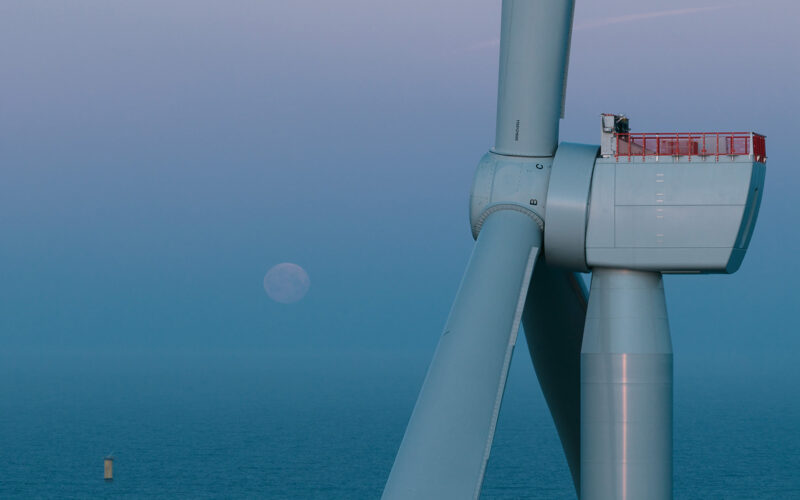
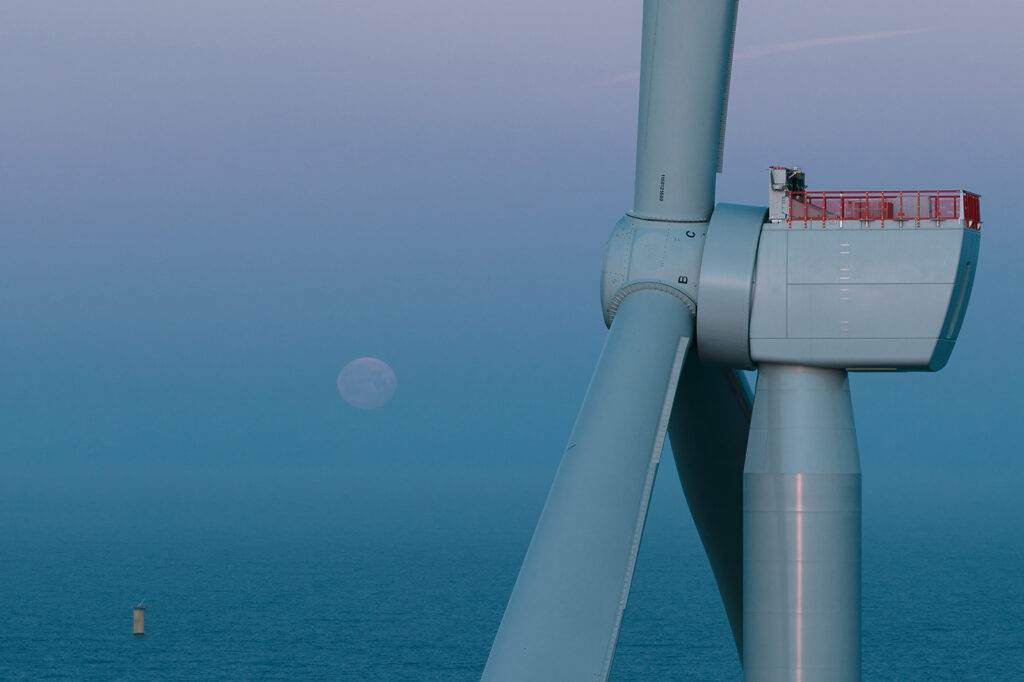
RWE Aktiengesellschaft (Xetra: RWEG), Germany’s largest electricity generator, has achieved a critical construction milestone at the 1.1-gigawatt Thor offshore wind farm located off Denmark’s western Jutland coastline, feeding electricity into the Danish national grid for the first time just hours after the inaugural turbine installation. The development confirms that Thor, Denmark’s largest offshore wind project and a joint venture with Norges Bank Investment Management, remains on schedule for full commercial operation in 2027. With all 72 Siemens Gamesa turbines rated at up to 15 MW each still to be commissioned, the project’s first power moment carries considerable strategic weight, representing RWE’s deepest penetration into the Danish offshore market and adding another reference asset to a European offshore portfolio that already spans 19 operational wind farms. For RWE’s shares, which have surged approximately 73 percent over the trailing twelve months to trade near EUR 57.36 on 16 March 2026, just below their 52-week high of EUR 57.48, Thor’s steady execution validates the offshore growth narrative that equity markets appear to have priced in.
What does Thor’s first grid connection mean for RWE’s offshore wind expansion strategy in northern Europe?
First power at Thor is more than a ceremonial milestone. It confirms that the offshore substation delivered by HSM Offshore Energy and the full turbine foundation set, both installed during 2025, have been successfully integrated with Denmark’s transmission system, which is operated by Energinet. In practice, this means civil and electrical infrastructure is validated before the bulk of turbine commissioning begins, reducing the risk of systemic rework that has plagued several comparable European offshore projects. The speed of the milestone, achieved within hours of the first turbine installation, points to tightly coordinated logistics between RWE’s project execution teams and Siemens Gamesa, the turbine supplier. Route-to-market services for Thor’s output are handled by Danske Commodities, a Norges Bank-related entity, which adds a clean alignment of commercial interests across the partnership structure. RWE is the construction and operations lead across the project’s full lifecycle, controlling 51 percent of the joint venture against Norges Bank Investment Management’s 49 percent stake.
How does the Thor offshore wind farm’s 1.1 GW capacity fit within Denmark’s renewable energy transition goals and grid infrastructure?
Once fully commissioned, the Thor offshore wind farm is projected to generate enough electricity to power the equivalent of more than one million Danish households. For a country of approximately six million people, that represents a material share of national residential consumption drawn from a single offshore cluster. Denmark has positioned itself among Europe’s most aggressive per-capita renewable energy adopters, and Thor aligns with national targets to substantially decarbonise electricity supply by the early 2030s. The Energinet grid connection via Thor’s dedicated offshore substation enables the farm to dispatch directly into the interconnected European power system, giving the project access to cross-border export revenues during periods of Danish supply surplus. The wind resource off western Jutland is among the most consistent in the North Sea basin, which supports the capacity factor assumptions underpinning the project’s long-run economics. For RWE, the Danish market represents a complementary geography to its existing Rødsand 2 installation in southern Danish waters, extending the company’s operational footprint across the country’s two primary offshore zones.
What are the sustainability innovations at Thor and why do recyclable turbine blades and low-carbon steel towers matter for the offshore wind industry?
Thor carries two sustainability distinctions that extend beyond standard offshore wind project specifications. First, 36 of the farm’s steel turbine towers have been manufactured by Siemens Gamesa using a reduced-carbon production process, making Thor the first offshore wind farm in the world to deploy this type of CO2-reduced steel tower at scale. Second, a portion of the turbine fleet will be equipped with recyclable rotor blades, addressing one of the offshore wind sector’s most persistent end-of-life challenges. Conventional blade disposal has drawn increasing regulatory scrutiny across the European Union, with several member states already moving to restrict landfill disposal of composite materials. By integrating recyclable blades into Thor’s design from the outset, RWE is establishing a procurement standard that could become a contractual baseline for future project tenders. This matters commercially as well as environmentally, given the tightening environmental, social and governance requirements attached to institutional infrastructure investment, including those applied by Norges Bank Investment Management as Europe’s largest sovereign wealth fund. Together, these features position Thor as a reference design for lifecycle sustainability in utility-scale offshore wind.
How does RWE’s active construction pipeline across the UK, Germany, and the Netherlands compare to European offshore wind peers?
Thor is one of four major offshore wind farms RWE is simultaneously constructing across three countries, a level of concurrent offshore execution that few European utilities can match. In the United Kingdom, the 1.4-gigawatt Sofia offshore wind farm is under construction in the North Sea, while in Germany the Nordseecluster project carries a combined capacity of 1.6 gigawatts with RWE holding a 51 percent share. OranjeWind in the Netherlands, at 795 megawatts, adds further pipeline depth with RWE owning 50 percent. Combined, RWE’s active offshore construction portfolio exceeds five gigawatts of gross capacity, a figure that places the company among the top tier of global offshore wind developers alongside Orsted, Vattenfall, and BP’s offshore ventures. The geography of this pipeline is strategically significant too: each market carries distinct support mechanisms, grid connection frameworks, and political risk profiles, which distributes RWE’s execution exposure while ensuring the company is positioned for capacity additions across multiple regulatory cycles. Thor’s on-schedule progress is therefore not only a Danish story but a benchmark read-across for the company’s ability to manage large parallel offshore commitments.
What execution and commissioning risks remain before all 72 Thor turbines reach full commercial operation by 2027?
Despite the positive first-power signal, the Thor offshore wind farm faces the more operationally intensive phase of its construction journey. Installing and commissioning 71 additional Siemens Gamesa turbines in the North Sea off Jutland requires sustained weather windows, uninterrupted vessel availability, and tight coordination between marine contractors and the onshore grid operator. The North Sea’s notoriously variable autumn and winter weather typically constrains offshore installation activity, meaning RWE will need to advance turbine installation at pace through the 2026 summer season to maintain the 2027 commercial deadline. Supply chain pressure on offshore installation vessels remains an industry-wide constraint, and any slippage in vessel scheduling could create sequencing bottlenecks given the concurrent construction activity at Sofia and the Nordseecluster. The recently granted 30-year electricity production licence from the Danish Energy Agency resolves a key regulatory prerequisite for commissioning, removing one potential administrative source of delay. Operations and maintenance infrastructure is also taking shape, with a new RWE service facility at the Port of Thorsminde scheduled to open formally in March 2026, creating 50 to 60 local jobs and anchoring the long-run operational model in the local coastal economy.
How is RWE AG stock (RWEG) performing in 2026 and does the Thor milestone align with the company’s current market valuation?
RWE’s shares have staged a remarkably strong recovery over the past twelve months. Trading at approximately EUR 57.36 on 16 March 2026, the stock sits near its 52-week high of EUR 57.48, having more than doubled from the 52-week low of EUR 30.06. The one-month gain of roughly 1.8 percent and a five-day advance of around 2.4 percent suggest sustained buying interest rather than a speculative spike. This trajectory appears partially anchored in the company’s full-year 2025 results, which saw RWE report net income above the upper end of its guidance range despite a 22 percent year-on-year decline driven by normalising electricity margins. Analysts covering the stock hold a predominantly positive stance, with 15 buy recommendations and one sell rating as of mid-March 2026, and a consensus 12-month price target of approximately EUR 56.83. The consensus target sits fractionally below current trading levels, indicating that near-term upside is already largely reflected in the share price. Thor’s milestone does not in itself shift the earnings trajectory for 2026 since no revenues are booked until commercial operation begins, but it reinforces the credibility of RWE’s offshore execution capability, which underpins the growth rate embedded in longer-term valuation models. Bernstein’s recent downgrade to market-perform, cited in public commentary, suggests at least some institutional caution about whether further multiple expansion is warranted at current levels.
Key takeaways: What the Thor offshore wind farm first-power milestone means for RWE, offshore wind investors, and the European clean energy sector
- RWE AG has delivered first power from the Thor offshore wind farm to the Danish national grid on 17 March 2026, confirming the 1.1 GW project remains on track for full commercial operation in 2027 and removing a key execution uncertainty from RWE’s near-term offshore delivery schedule.
- The milestone was achieved within hours of the inaugural turbine installation, signalling strong coordination between RWE’s project teams and Siemens Gamesa, and validates the foundation and substation infrastructure completed during 2025.
- Thor is structured as a 51/49 joint venture with Norges Bank Investment Management, aligning two of Europe’s most credible institutional infrastructure investors behind a single large-scale clean energy asset with a 30-year production licence.
- RWE is the first utility in the world to deploy CO2-reduced steel turbine towers and recyclable rotor blades at offshore scale, establishing a sustainability standard that may become a procurement baseline for future European offshore wind tenders.
- The Danish Energy Agency’s recently granted 30-year electricity production licence removed a key regulatory prerequisite for commissioning, with a new operations and maintenance facility at the Port of Thorsminde expected to create 50 to 60 permanent local jobs.
- With four major offshore projects simultaneously under construction totalling more than five gigawatts of gross capacity across Denmark, the UK, Germany, and the Netherlands, RWE’s offshore execution capability is under scrutiny across multiple markets simultaneously.
- RWE shares (Xetra: RWEG) have surged approximately 73 percent over the trailing twelve months, trading near their 52-week high of EUR 57.48. Analyst consensus remains Buy but the 12-month price target of EUR 56.83 implies limited near-term upside at current levels.
- Thor’s output will be marketed by Danske Commodities, providing RWE with a commercially aligned route-to-market partner while the project contributes to Denmark’s ambition to source a material share of national residential electricity demand from offshore wind.
- Execution risks through the 2026 installation season remain real: vessel availability, North Sea weather, and coordinated commissioning of 71 remaining turbines will be the primary tests of whether RWE can hold the 2027 commercial operation date.
- For the broader European offshore wind sector, Thor’s sustainability features and on-schedule construction trajectory provide a positive reference point at a time when several competing projects have experienced cost overruns and schedule slippage.
Discover more from Business-News-Today.com
Subscribe to get the latest posts sent to your email.