




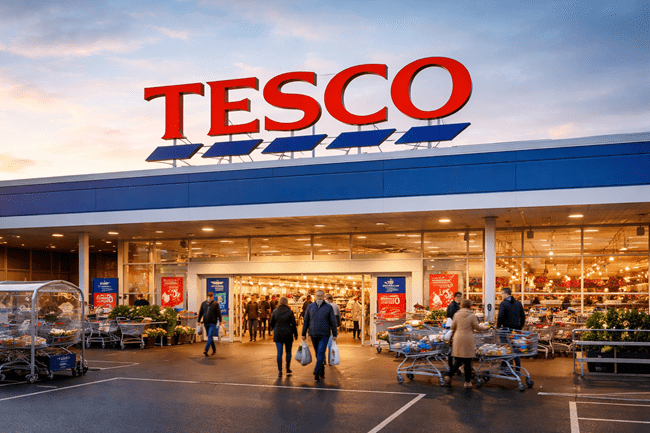
Tesco Plc (LSE: TSCO) has raised the lower end of its profit forecast for FY25/26 following a strong Q3 and Christmas trading period, underpinned by gains in fresh food, double-digit online growth, and its highest UK market share in over a decade. Group like-for-like sales rose 2.9 percent over the 19-week period ending January 3, 2026, with UK performance at 3.7 percent and ROI at 4.6 percent, offset by a 1.3 percent decline at wholesale arm Booker.
The company now expects adjusted operating profit to land at the upper end of its previously guided £2.9 billion to £3.1 billion range. This revision, just months ahead of its April 2026 full-year results, reinforces Tesco’s position as the dominant player in the UK grocery sector amid continued inflationary pressures and intense value-driven competition.
How did Tesco achieve its highest UK market share in over a decade during Q3 and Christmas 2025?
Tesco’s UK performance, with a 3.7 percent like-for-like uplift, was driven by a disciplined focus on pricing, own-brand innovation, and logistics execution. According to Numerator data, its market share rose 23 basis points over 12 weeks to 28.7 percent, and climbed 31 basis points to 29.4 percent during the critical four-week Christmas window.
Central to this surge was a 6.6 percent increase in fresh food sales, supported by both pricing initiatives and product upgrades, particularly within the premium Tesco Finest line, which recorded 13 percent growth and a 22 percent lift in party food sales. Notably, Tesco offered a Christmas dinner for six under £10 and promoted high-visibility half-price meat offerings, reinforcing its value proposition even in premium segments.
Tesco also recruited 28,500 temporary staff and added 100,000 extra online delivery slots in the run-up to Christmas, reflecting AI-powered scheduling tools deployed across its fulfillment network. Online sales grew 11.2 percent, with last-mile express service Whoosh reporting 47 percent growth and onboarding over 250,000 new customers during the holiday period.
Customer satisfaction, as measured by net promoter score (NPS), improved ahead of the market average. These operational gains reflect a multi-year focus on retail technology, dynamic pricing, and loyalty integration.
What is driving momentum in Ireland, and how is Tesco scaling Whoosh and private label offerings there?
Tesco’s Republic of Ireland operations delivered 4.6 percent like-for-like growth, including a 5.2 percent increase in food sales and continued leadership in fresh categories. The company posted its fourth straight year of Christmas market share gains, adding 41 basis points to reach 24 percent.
Product innovation played a key role. Tesco received 26 Taste of Ireland (Blas na hÉireann) gold medals and expanded its private label assortment, paralleling the UK strategy. It also launched Whoosh in 18 new Irish locations, including major rollouts in Dublin, Cork, and Galway, indicating a cross-border strategy for rapid grocery delivery and micro-fulfillment.
Five new store openings during the period further reinforced Tesco’s footprint in the region, amid accelerating consumer migration toward trusted grocery chains offering both value and quality assurance.
Why did Booker’s performance diverge from the core Tesco business—and what are the risks?
While core UK retail operations performed strongly, Tesco’s wholesale subsidiary Booker contracted by 1.3 percent over the 19-week period. The decline was driven by a 10.9 percent drop in tobacco sales and the loss of a low-margin national retail account, which had a 200-basis-point impact on core retail.
Still, core catering sales grew by 2.4 percent, and the specialist wine and spirits division, Venus, contributed meaningfully. Best Food Logistics, Booker’s foodservice logistics division, also managed modest growth at 0.6 percent, despite persistent weakness in the fast-food channel.
This divergence reflects the structural volatility within wholesale, especially around regulated categories like tobacco, and contract churn in competitive foodservice segments. Booker remains exposed to margin pressures and slower customer digitization compared to Tesco’s core retail, which could continue to weigh on consolidated performance.
How is Tesco’s Central Europe segment benefiting from premiumisation and online growth?
Central Europe posted a 1 percent like-for-like gain and 2.3 percent constant-currency growth, led by strong performance in fresh food and a 14.3 percent rise in online sales. Tesco’s strategic pivot toward higher-margin premium offerings is beginning to yield results in the region, with Finest product sales up 28 percent year-on-year.
More than 150 new own-brand Christmas items were introduced across regional markets, including over 70 in the premium Finest range. The targeted price repositioning efforts and assortment refresh suggest Tesco is steering away from margin erosion through discount-led growth and toward balanced premiumisation.
This contrasts with regional peers who remain heavily reliant on price war tactics, especially in Poland and Hungary, where wage inflation and cost-of-living issues continue to compress retailer margins.
How is Tesco leveraging Clubcard, retail media, and digital infrastructure to deepen customer stickiness?
Tesco’s non-core retail infrastructure is becoming an increasingly central part of its margin strategy. The company highlighted success in retail media, with Tesco named “Media Brand of the Year” at the 2025 Media Week Awards. This follows the launch of screen-based in-store ads at Booker and One Stop, as well as new video formats on Tesco.com and the Tesco app.
Meanwhile, Clubcard loyalty continues to be a powerful retention tool. Seasonal promotions like personalised Clubcard Challenges and Missions incentivised deeper customer engagement, while Everyday Low Prices and Aldi Price Match schemes—spanning over 3,650 branded lines—signaled a deepening commitment to price leadership without sacrificing personalization.
These capabilities, bolstered by AI-based logistics and consumer analytics, are giving Tesco a data and delivery advantage at a time when digital grocery penetration is stabilizing post-COVID.
What are the financial implications of Tesco’s revised FY25/26 outlook?
Following the strong 19-week trading performance, Tesco now expects to report full-year adjusted operating profit at the upper end of its previous guidance range (£2.9 billion to £3.1 billion), an upgrade likely to support investor confidence ahead of April results. Free cash flow is expected to remain within the medium-term target range of £1.4 billion to £1.8 billion.
The fiscal year ending April 2026 will include 53 weeks, but Tesco has clarified that guidance will be reported on a 52-week comparable basis. This signals continued financial discipline amid volume volatility, with capital allocation still weighted toward price investment, logistics tech, and strategic marketing platforms like Clubcard and retail media.
Investors are likely to view the reaffirmed outlook and margin resilience as validation of Tesco’s value-plus-premium hybrid strategy, particularly in contrast to profit warnings issued by European discount retailers facing input cost shocks.
Key takeaways on what Tesco’s holiday trading update means for the company, its competitors, and the industry
- Tesco achieved its highest UK market share in over a decade, with 32 consecutive four-week gains, underlining sustained momentum in core retail.
- Fresh food performance was a standout, growing 6.6 percent like-for-like, driven by pricing strategy and Tesco Finest premiumization.
- Online grocery grew 11.2 percent, while Whoosh express delivery surged 47 percent, signaling strong traction in last-mile execution.
- Republic of Ireland operations expanded market share for a fourth straight year, with new store openings and regional Whoosh rollout supporting growth.
- Booker underperformed due to a tobacco sales slump and contract loss, exposing structural risk in wholesale despite catering segment resilience.
- Central Europe saw success in premium private-label products, particularly Tesco Finest, and robust online growth, validating premiumisation efforts.
- Clubcard, retail media, and AI-powered logistics continue to deepen Tesco’s defensibility, monetization potential, and customer stickiness.
- Tesco raised the lower end of its FY25/26 operating profit guidance, aiming for the top of the £2.9–£3.1 billion range, bolstering investor sentiment.
Discover more from Business-News-Today.com
Subscribe to get the latest posts sent to your email.
