



Tesco PLC (LON: TSCO) delivered a solid performance for the first half of fiscal year 2025/26, showing how operational discipline and data-driven innovation can sustain profitability in one of the world’s most competitive grocery markets. The British retailer’s group sales rose 5.1 percent to £33.05 billion, driven by volume growth and targeted price investments, while adjusted operating profit increased 1.6 percent to £1.67 billion. The performance came despite rising regulatory costs, wage inflation, and continued rivalry from discounters Aldi and Lidl.
Statutory operating profit slipped marginally by 0.6 percent to £1.60 billion, mainly reflecting restructuring charges and fair-value adjustments on financial instruments. Profit before tax fell 6.3 percent to £1.31 billion, while diluted statutory earnings per share declined 2.7 percent to 14.22 pence. However, adjusted diluted EPS climbed 6.8 percent to 15.43 pence, boosted by higher operating profit and share buybacks.
Tesco’s free cash flow rose 2.9 percent to £1.3 billion as strong sales translated into working-capital inflows. The company’s interim dividend was raised 12.9 percent to 4.80 pence per share, consistent with its payout policy of distributing roughly a third of the prior full-year dividend. Net debt stood at £9.88 billion, up slightly from year-end levels due to capital returns. Chief Executive Ken Murphy said the first half showed the payoff from “decisive action to deliver the best possible value, quality, and service,” while Chief Financial Officer Imran Nawaz emphasised that the customer response was strong enough for Tesco to upgrade full-year guidance. The group now expects adjusted operating profit between £2.9 and £3.1 billion, up from the previous range of £2.7 to £3.0 billion, with free cash flow forecast between £1.4 and £1.8 billion.
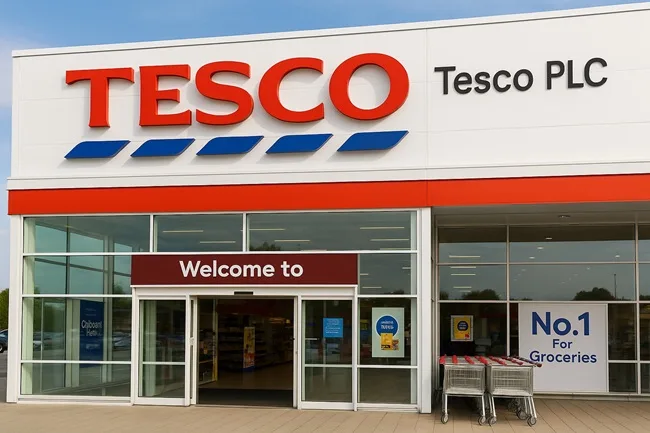
How did Tesco’s UK and Ireland operations power overall growth and reinforce market leadership?
The United Kingdom and Republic of Ireland segment remained Tesco’s strongest contributor, with like-for-like sales up 4.9 percent and total segment sales up 5.6 percent. Adjusted operating profit increased 2.1 percent to £1.47 billion, reflecting sustained volume momentum, favourable weather, and ongoing cost-saving measures under the Save to Invest programme.
In the UK, Tesco increased its market share to 28.4 percent, marking its twenty-eighth consecutive four-week period of growth. The company also achieved thirty-one straight periods of customer switching gains, extending its lead over traditional rivals. Irish operations continued their positive trajectory, consolidating three years of consistent market-share gains to reach 23.7 percent.
Food sales rose 5.7 percent, supported by a strong performance in fresh produce and premium ranges. Tesco’s Finest line recorded a remarkable 16 percent increase, reflecting the ongoing “dine-in” trend as households choose quality grocery indulgence over higher restaurant prices. Clothing revenue climbed 7.8 percent as the retailer’s seasonal collections resonated with customers. The launch of F&F Online allowed access to an expanded apparel and lifestyle assortment, while the Tesco Marketplace, now offering more than 600,000 products, further strengthened its e-commerce footprint.
Digital growth was another bright spot. Online grocery sales increased 11.4 percent year-on-year, pushing Tesco’s online market share to 36.9 percent. The company expanded its delivery network with 70,000 additional weekly slots and grew its Delivery Saver subscriber base by 9.3 percent to 788,000 customers. Rapid delivery arm Tesco Whoosh delivered 59 percent growth and now reaches more than 70 percent of UK households.
In Ireland, like-for-like sales climbed 4.8 percent, supported by product innovation and new store openings. Fresh food sales rose 6.3 percent, while non-food declined 1.8 percent due to a structural shift to a commission model through the partnership with toy retailer The Entertainer. Excluding that impact, non-food revenue increased by 2 percent.
How did Booker and Central Europe influence the group’s earnings mix and strategic diversification?
Booker, Tesco’s wholesale subsidiary, reported total sales of £4.73 billion, a 2.4 percent increase, with like-for-like growth of 1.7 percent. Its core retail segment advanced 4.1 percent, while catering rose 5.7 percent, offsetting an 8.8 percent decline in tobacco revenue. Adjusted operating profit edged up 0.6 percent to £162 million as operational efficiencies offset cost inflation and the new packaging levy.
Booker’s symbol brands—Premier, Londis, Budgens, and Family Shopper—expanded by a net 275 retail partners, underscoring its growing relevance among small business owners. The 2024 acquisition of Venus Wine and Spirit Merchants enhanced Booker’s wine distribution and hospitality channels, integrating smoothly within Tesco’s logistics network.
In Central Europe, sales increased 5 percent at constant exchange rates, but adjusted operating profit fell 11.2 percent to £44 million. Tesco cited pricing investments to remain competitive, particularly in Slovakia, and a decline in rental income following mall disposals. Analysts view the region as steady but low-growth, with margins constrained by regulatory pressure and subdued consumer sentiment. Nonetheless, customer satisfaction scores have improved, indicating that targeted value strategies are resonating across Poland, the Czech Republic, and Hungary.
How is Tesco leveraging data, Clubcard, and AI-driven retail media to enhance profitability and brand loyalty?
Tesco’s digital transformation continues to underpin its broader strategy. The retailer’s Clubcard loyalty programme now engages more than 24 million UK households and maintains penetration rates above 84 percent across all markets. Clubcard data enables highly targeted marketing campaigns, allowing Tesco to offer personalised discounts and recipe recommendations to more than 10 million customers. A partnership with Adobe has introduced new real-time data tools that optimise promotions and content delivery based on purchasing habits.
The company also expanded Clubcard benefits, marking its 30th anniversary with new partnerships such as discounted cinema tickets and electric-vehicle charging rewards through Pod, enabling customers to earn loyalty points while charging their cars.
Meanwhile, Tesco’s retail media network has become an additional profit stream. The Tesco Media and Insight Platform, recently named Retail Media Network of the Year, has drawn significant advertiser interest, particularly from smaller brands seeking access to Tesco’s extensive shopper base. Over 1,400 digital advertising screens have been installed in stores, and the retailer has rolled out new in-app video advertising formats on the Tesco app.
Tesco is increasingly applying machine learning and artificial intelligence to streamline operations. Proprietary routing software now optimises delivery logistics, reducing truck mileage by approximately 100,000 miles per week. The company’s AI-powered range-curation tool tailors product assortments to local demand, ensuring stores stock what customers in each area buy most often. Predictive “smart stock” analytics further allow Tesco and its suppliers to anticipate when households are likely to run out of essential products, creating a feedback loop that improves convenience and reduces waste.
How has Tesco’s stock performed and what does investor sentiment reveal about the company’s long-term appeal?
Tesco shares have remained resilient through 2025, outperforming the broader FTSE 350 Food and Staples Retailing Index despite modest fluctuations around results season. Following the interim announcement, the stock closed on October 3, 2025, at 446.00 GBX, down 1.41 percent on the day, as investors absorbed the lower statutory profit but welcomed the upgraded full-year guidance. Even with the dip, shares trade close to their 52-week high of 456.60 GBX and roughly 14 percent above levels at the start of the financial year, reflecting stable investor confidence.
Institutional sentiment remains constructive. Major UK brokerages have maintained “Buy” or “Overweight” ratings, citing Tesco’s defensive positioning, reliable cash flow, and the structural upside of retail media and digital channels. Long-only funds have reportedly increased holdings following the mid-year FTSE rebalance, while short interest remains negligible.
The group’s £1.45 billion share-buyback programme, half completed by October 2025, continues to underpin earnings growth. Since 2021, Tesco has repurchased approximately £3.7 billion of stock, shrinking its share count by over six percent and driving steady EPS improvement. With a forward price-to-earnings ratio near 12 times and a dividend yield around 3.5 percent, the shares trade slightly above domestic peers such as Sainsbury’s and Marks & Spencer but below global comparables like Walmart, suggesting balanced valuation and moderate upside.
Retail investors on UK brokerage platforms view Tesco as a reliable income stock. Its low beta and consistent dividend progression have made it a core defensive holding in diversified portfolios, particularly as UK bond yields soften heading into 2026. The company’s mix of dividend income, capital return, and steady growth continues to attract institutional and retail interest alike.
What risks could challenge Tesco’s outlook and profitability through the rest of FY25/26?
Ken Murphy described the UK grocery environment as “probably the most intense in the world,” highlighting sustained price competition and elevated cost inflation. Rising labour expenses, energy bills, and new compliance costs, including the Extended Producer Responsibility packaging levy and higher National Insurance contributions, continue to squeeze margins.
Central Europe faces sluggish demand and persistent regulatory oversight, while Booker contends with the structural decline in tobacco consumption. Analysts note that maintaining high single-digit EPS growth will depend on Tesco’s ability to sustain volume growth in food, scale digital revenues, and unlock additional savings from automation and supply-chain efficiency.
Nevertheless, Tesco’s diversification across grocery retail, wholesale, financial services, and retail media provides a wide earnings base. Upcoming investments in logistics automation, including the semi-automated Aylesford fresh-food centre and the planned DP World London Gateway hub scheduled for 2029, are expected to reinforce efficiency and ensure long-term capacity.
Can Tesco PLC’s first-half performance and upgraded outlook truly translate into sustainable long-term value creation for shareholders and investors?
Tesco’s H1 FY25/26 results illustrate a company that has adapted to economic volatility through scale, technology, and disciplined capital management. By combining value pricing with premium innovation, and coupling traditional retail operations with data-driven growth engines, Tesco has positioned itself as more than just a supermarket chain—it is becoming a multi-channel retail platform.
The upgraded guidance, robust free cash flow, and strong balance sheet highlight confidence in future performance. For investors, Tesco’s attraction lies in steady compounding: consistent earnings growth, reliable dividends, and incremental margin expansion from digital initiatives. Analysts expect the retailer to remain one of the FTSE’s most defensive consumer plays, balancing income and moderate growth potential.
If execution remains focused and competitive pricing continues to resonate, Tesco appears well placed to sustain long-term shareholder value while reinforcing its standing as the United Kingdom’s most trusted grocer.
Discover more from Business-News-Today.com
Subscribe to get the latest posts sent to your email.