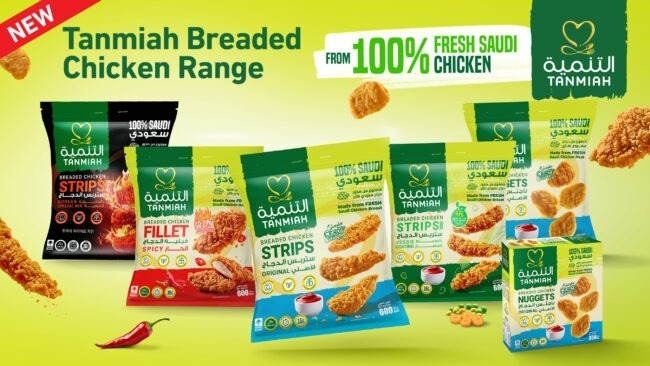
Tanmiah Food Company (Tadawul: 2281) has introduced a new frozen breaded chicken line made entirely from 100% fresh Saudi chicken, positioning the launch as a strategic inflection point in the Kingdom’s broader food security and import-substitution goals. The product debut, backed by the Ministry of Environment, Water and Agriculture (MEWA), reflects Tanmiah Food Company’s push to diversify its portfolio beyond fresh poultry and leverage its vertically integrated operations to scale value-added categories.
The new frozen range—comprising nuggets, strips, fillets, burgers, and a veggie-enhanced “PLUS” variant—aims to reclaim domestic market share long held by imported frozen chicken products, while appealing to a rising segment of health-conscious and time-constrained Saudi consumers.
How does Tanmiah’s new frozen range align with Saudi Arabia’s Vision 2030 food security goals?
The launch reinforces the Saudi government’s longstanding ambition to localize food production across strategic segments of the supply chain. Historically, much of the Kingdom’s frozen processed poultry market has depended on imports—particularly chicken breast meat from Brazil, Ukraine, and the United States. By developing a fully Saudi-sourced, processed product line, Tanmiah Food Company is directly supporting Vision 2030’s self-sufficiency objectives.
The decision to host the unveiling at the MEWA building in Riyadh, with attendance from senior ministry officials including Dr. Ali Mohammed Al-Shaikhi, underscores the symbolic importance of the move. The public endorsement signals government alignment with Tanmiah Food Company’s pivot to processed protein categories and could unlock further regulatory, logistical, and distributional advantages as the product scales.
Importantly, the launch challenges the presumption that domestic production cannot compete on cost or convenience in the frozen segment. By vertically integrating the supply chain—across feed, hatchery, farming, processing, and distribution—Tanmiah Food Company appears to be testing whether local sourcing, quality branding, and format innovation can win back share from international players.
What makes Tanmiah’s “PLUS” line and Korean flavor SKU strategically different?
Within the product lineup, two innovations stand out: a veggie-infused breadcrumb coating (marketed as the “PLUS” line) and a flavor SKU inspired by Korean cuisine. The former delivers the equivalent of two-thirds of a cup of vegetables per pack, an unusual feature in the region’s processed poultry category and one that speaks to shifting consumer health narratives. The latter taps into the growing cultural cachet of Korean food trends, particularly among younger urban Saudi buyers who are increasingly familiar with global flavor profiles via food delivery apps and social media.
These two SKUs offer insight into Tanmiah Food Company’s product segmentation strategy. The company is no longer only targeting traditional protein buyers or budget-focused value shoppers. Instead, it is expanding into lifestyle-positioned SKUs that target health-conscious parents, female professionals, and Gen Z snackers—segments that have been underserved in the frozen meat aisle.
The competitive implication is that global frozen meat brands with a narrow SKUs or no local sourcing strategy may face a recalibration in market share, especially if Tanmiah Food Company leverages its Saudi origin story effectively through distribution partners and point-of-sale education.
Can Tanmiah’s vertically integrated model scale frozen innovation without margin compression?
Tanmiah Food Company has long operated a vertically integrated model, spanning 150 farms, four primary processing plants, seven hatcheries, and four feed mills as of March 31, 2025. The launch of its frozen breaded chicken range offers a proof point for how the company intends to monetize upstream control by moving further downstream into value-added categories.
However, the economics of frozen meat differ sharply from fresh poultry. In processed categories, branding, shelf-life optimization, packaging costs, and channel partnerships play a far larger role in profitability. Success in this segment will hinge not only on quality and consumer appeal but also on whether Tanmiah Food Company can maintain its supply chain efficiency while investing in cold-chain logistics and in-store merchandising.
There’s also the capital allocation question. Scaling frozen SKUs may require new freezing lines, packaging capabilities, and retailer incentive structures. Whether these are funded through operating cash flows, joint ventures, or government-backed food security programs remains to be seen. But the message is clear: Tanmiah Food Company is attempting to enter the processed segment on its own terms, using local-sourcing as a moat rather than price parity.
What does this signal about the next phase of poultry industry evolution in the GCC?
The regional poultry industry has been in flux, with pressures ranging from avian flu outbreaks and import tariffs to rising feed costs and changing consumer demand. For much of the past decade, GCC nations have prioritized investment in domestic poultry farming, but processing capacity and product innovation have lagged.
Tanmiah Food Company’s entry into frozen processed formats signals that the next phase of evolution may be about brand-building, product innovation, and consumer segmentation rather than just volume expansion. The company’s model could set a precedent for peers in the UAE, Kuwait, and Bahrain, especially those with feed mill and hatchery integration but limited downstream product portfolios.
From a policy standpoint, this launch also demonstrates how governments can use soft levers—such as visibility, public endorsement, and retail access—rather than subsidies alone to support localization objectives. It will be instructive to see if other agri-food verticals, such as seafood, lamb, or dairy, adopt a similar domestication-plus-differentiation strategy.
What are the risks to execution and market acceptance for Tanmiah’s frozen pivot?
Despite the strategic alignment, risks remain. Saudi consumers have grown accustomed to global frozen poultry brands with standardized quality and low price points. Convincing them to switch to a premium, locally sourced product may require sustained brand education, sampling campaigns, and channel partnerships. While government backing provides initial momentum, retail shelf space remains fiercely competitive, especially with multinationals often wielding category management influence.
Moreover, frozen food uptake varies by demographic and region. Urban centers may be quicker to adopt Tanmiah Food Company’s new offerings, but penetration in secondary cities will depend on cold-chain reach and distributor reliability.
Execution missteps—such as flavor inconsistencies, packaging misalignment, or logistical breakdowns—could undercut consumer trust, especially for a brand that is leveraging its “100% fresh Saudi chicken” identity so heavily. The PLUS line, while innovative, will also require more nuanced messaging to resonate with health-driven consumers without alienating traditional buyers.
Still, the product rollout across Tanmiah Food Company’s e-commerce app, major aggregators, and traditional retail outlets suggests a measured go-to-market approach that may reduce the downside risk of overexposure.
What are the key takeaways from Tanmiah’s frozen breaded chicken launch?
- Tanmiah Food Company has launched a frozen breaded chicken line made entirely from 100% fresh Saudi chicken, aligning with Vision 2030 food localization goals.
- The launch targets import substitution by replacing a segment long dominated by international frozen poultry with locally sourced, value-added alternatives.
- Unique SKUs like veggie-infused nuggets and Korean-inspired flavors signal a shift toward lifestyle-oriented consumer segmentation.
- The move leverages Tanmiah Food Company’s vertically integrated supply chain to expand into processed meat categories without relying on imports.
- Government support, including a launch at the MEWA building, highlights the policy alignment and national relevance of the product.
- Success depends on whether Tanmiah Food Company can scale its cold-chain logistics, execute brand education, and maintain consistency across flavors and formats.
- This could reshape the competitive dynamics in the GCC frozen poultry sector, especially among peers with limited processing innovation.
- The initiative serves as a test case for how domestic food producers can build consumer trust and market share through origin transparency and targeted innovation.
Discover more from Business-News-Today.com
Subscribe to get the latest posts sent to your email.