


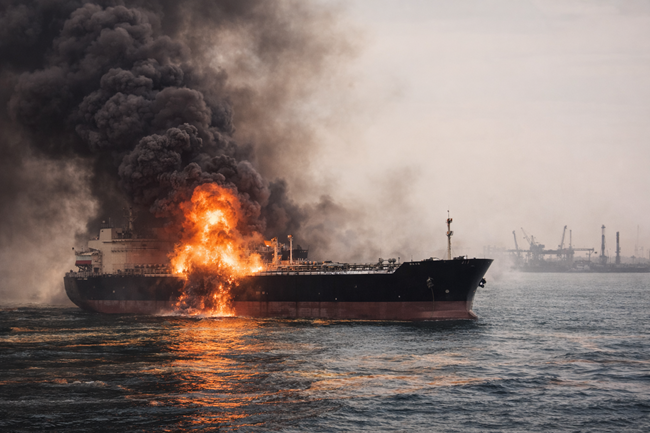
A commercial oil tanker at anchor in waters off the coast of Kuwait was struck by a large explosion on Thursday, March 5, 2026, triggering an oil spill and prompting an urgent maritime security advisory from the United Kingdom Maritime Trade Operations agency, which operates under the British military. The incident marks a significant northward expansion of the maritime conflict zone linked to the ongoing war among the United States, Israel, and Iran, which entered its sixth day on Thursday.
The United Kingdom Maritime Trade Operations agency issued Warning Incident 014-026 after receiving a report of an incident approximately 30 nautical miles southeast of Mubarak Al-Kabeer, Kuwait. According to the agency’s advisory, the master of a tanker at anchor reported witnessing and hearing a large explosion on the port side of the vessel, followed by the sighting of a small craft departing the vicinity. The advisory was published by the United Kingdom Maritime Trade Operations agency on the social media platform X.
The United Kingdom Maritime Trade Operations agency confirmed that oil was visible in the water originating from a cargo tank aboard the stricken vessel, and stated that the spill could carry some environmental impact on the surrounding waters. The tanker also took on water following the explosion. No fire was reported, and the crew of the vessel was confirmed to be safe. Vessels navigating the wider Gulf region were advised to transit with caution and to report any suspicious activity to maritime operations authorities.
Kuwait’s Interior Ministry issued a statement confirming that the explosion occurred outside Kuwait’s territorial waters, at a distance of at least 60 kilometres, approximately 37 miles, from Mubarak Al-Kabeer Port. Kuwaiti officials stated that investigations were ongoing to determine the cause of the blast. The explosion was recorded at approximately 22:40 Coordinated Universal Time on March 4, 2026. No group or state had claimed responsibility for the attack as of Thursday. The United Kingdom Maritime Trade Operations agency did not formally attribute the cause of the explosion in its advisory.
How does the Kuwait tanker explosion expand the geography of the US-Iran-Israel maritime conflict zone?
The explosion near Mubarak Al-Kabeer represents a marked geographic extension of the maritime threat zone since the outbreak of hostilities between the United States, Israel, and Iran on February 28, 2026. Previous attacks had been concentrated primarily in the Strait of Hormuz and the Gulf of Oman, the body of water connecting the Persian Gulf to the wider Arabian Sea. The Mubarak Al-Kabeer area lies substantially further north, in the upper Persian Gulf, in proximity to Iraqi territorial waters and within the primary oil export corridor used by Iraq.
Iraq, which has not formally entered the conflict, had already been affected by the broader disruption to Gulf shipping. Iraqi oil production and loading operations experienced delays and storage shortages caused by the maritime blockade imposed by Iran’s Islamic Revolutionary Guard Corps on the Strait of Hormuz. A sustained maritime threat in the upper Persian Gulf would further complicate Iraqi oil export logistics, extending the economic consequences of the conflict to a country not directly engaged in it. Iran has previously employed limpet mines affixed to commercial vessels as a maritime attack method, a tactic documented during earlier periods of Gulf tension between 2019 and 2021, though no attribution had been formally made in relation to Thursday’s incident off Kuwait.
What is the Strait of Hormuz and why has Iran’s blockade of the waterway triggered a global oil price crisis?
Iran’s Islamic Revolutionary Guard Corps declared complete control over the Strait of Hormuz following the outbreak of hostilities on February 28, 2026. The Strait of Hormuz is the narrow waterway separating the Persian Gulf from the Gulf of Oman and serves as the sole maritime exit for crude oil and liquefied natural gas exported from Saudi Arabia, the United Arab Emirates, Kuwait, Iraq, and Iran. Approximately one-fifth of the world’s total daily oil supply passes through the strait, along with a significant share of global liquefied natural gas shipments.
Iran warned that it would fire on any vessel attempting to transit the Strait of Hormuz without authorisation. Hundreds of tankers carrying crude oil and liquefied natural gas anchored or remained stationary in waters near the strait following the outbreak of hostilities. The sustained disruption drove global oil prices upward by approximately 10 percent since fighting began. United States retail fuel prices rose from an average of 3.10 dollars per gallon to 3.19 dollars per gallon, with further increases anticipated. Global equity markets declined in response to concerns that elevated energy costs could compress global economic output.
What other naval and maritime incidents between the United States and Iran have occurred since February 28, 2026?
The Kuwait tanker explosion followed a major naval engagement one day earlier in which a United States Navy submarine torpedoed and sank the Iranian frigate identified as IRIS Dena in international waters near Sri Lanka. United States Defense Secretary Pete Hegseth confirmed the strike. Sri Lankan authorities estimated that approximately 180 people had been aboard the vessel when it sank. Iranian Foreign Minister Abbas Araghchi condemned the sinking as an atrocity and stated that the United States would come to regret the precedent it had set. A second Iranian warship was subsequently reported to be approaching Sri Lankan territorial waters, according to a statement made before the Sri Lankan parliament.
Iran’s Islamic Revolutionary Guard Corps claimed on Thursday that it had struck a United States oil tanker with a missile in the northern Persian Gulf, setting the vessel ablaze. An Iranian corvette had separately been reported on fire at Bandar Abbas, Iran’s principal naval installation on the Strait of Hormuz, and Qatar’s liquefied natural gas export terminals suffered outages in connection with Iranian missile activity earlier in the week.
How has the broader US-Israel-Iran conflict escalated beyond the Persian Gulf on March 5, 2026?
On Thursday, Israel’s military announced a large-scale wave of airstrikes targeting what it described as the infrastructure of the Iranian government across Tehran. Iranian state media and local sources reported multiple explosions over the Iranian capital. Iran continued retaliatory strikes across the region, including missile attacks targeting Kurdish forces in Iraqi Kurdistan and further strikes across multiple Gulf states.
Additional explosions were reported over Doha, the capital of Qatar, with Qatar’s defence ministry confirming its military was working to intercept an incoming missile attack. A drone strike hit a United Kingdom Royal Air Force installation in Cyprus, prompting British Defence Minister John Healey to travel to the island. Italian Prime Minister Giorgia Meloni announced that Italy would send air defence assistance to Gulf states struck by Iranian attacks.
The total number of fatalities recorded since the outbreak of fighting on February 28, 2026, stood at 1,045 in Iran, including 175 school girls and staff killed in a single strike. Lebanon’s health ministry reported 77 deaths from Israeli airstrikes. Four people were killed in Syria when an Iranian missile struck a building in the southern Syrian city of Sweida. Bahrain, Oman, Kuwait, and the United Arab Emirates each reported casualties, with three deaths each recorded in Kuwait and the United Arab Emirates. Six United States service members were killed in a strike on a facility located in Kuwait.
What does the tanker explosion off Kuwait mean for Gulf shipping security and global energy supply?
The expansion of maritime attacks into the upper Persian Gulf, where Thursday’s tanker explosion occurred, signals that commercial shipping risks linked to the United States-Iran-Israel conflict are no longer confined to the Strait of Hormuz chokepoint or the Gulf of Oman. The upper Persian Gulf corridor serves as a critical route for oil exports from Kuwait, Iraq, and southern Iraqi terminals, including the Basra oil terminals that handle the majority of Iraq’s seaborne crude exports.
The United Kingdom Maritime Trade Operations agency, which issued the advisory following Thursday’s incident, is the primary maritime security coordination body for commercial shipping operating in the Gulf region, the Red Sea, and the Indian Ocean. Its advisories carry operational authority for merchant fleets and are used by major maritime insurers to assess war risk premiums.
A sustained advisory posture across the full length of the Persian Gulf could further deter commercial shipping operators and raise insurance costs for vessels attempting to transit the region.
What this development means for Gulf shipping, global energy markets, and regional security
- The United Kingdom Maritime Trade Operations agency confirmed a large explosion struck a commercial tanker approximately 30 nautical miles southeast of Mubarak Al-Kabeer, Kuwait on March 5, 2026, causing an oil spill and water intake; no fire was reported and the crew was confirmed safe.
- Kuwait’s Interior Ministry confirmed the blast occurred outside Kuwaiti territorial waters, at least 60 kilometres from Mubarak Al-Kabeer Port, with investigations ongoing and no group or state having claimed responsibility as of Thursday.
- The incident represents a geographic extension of the maritime conflict zone northward into the upper Persian Gulf, beyond the Strait of Hormuz and Gulf of Oman where earlier attacks in the United States-Iran-Israel war had been concentrated.
- Iran’s Islamic Revolutionary Guard Corps has declared complete control of the Strait of Hormuz since February 28, 2026, halting tanker traffic through a waterway that carries approximately one-fifth of the world’s daily oil supply and driving global crude oil prices up by approximately 10 percent.
- Separately, Iran’s Islamic Revolutionary Guard Corps claimed to have struck a United States oil tanker with a missile in the northern Persian Gulf on Thursday, and a United States Navy submarine sank the Iranian frigate IRIS Dena near Sri Lanka on March 4, 2026, with United States Defense Secretary Pete Hegseth confirming the strike.
Discover more from Business-News-Today.com
Subscribe to get the latest posts sent to your email.