


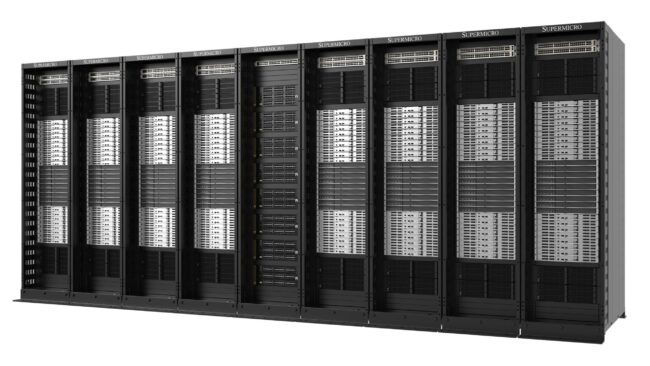
Super Micro Computer, Inc. (NASDAQ: SMCI), trading as Supermicro, has announced expanded rack-scale manufacturing and direct liquid-cooling capacity to support NVIDIA Corporation’s next-generation Vera Rubin NVL72 and Rubin NVL8 platforms. This move strengthens Supermicro’s position as a rapid deployment partner in the liquid-cooled AI infrastructure space—just as enterprise and hyperscale customers race to build exascale systems for generative AI and large language model training.
By being first to market with validated rack-scale solutions for NVIDIA’s Rubin-based platforms, Supermicro is betting that speed, thermal efficiency, and modular manufacturing will become the new cornerstones of AI infrastructure competitiveness.

How does Supermicro’s early launch of Vera Rubin systems position it in the AI infrastructure arms race?
Supermicro’s announcement is not just about adding support for a new GPU or CPU. It signals a calculated push to dominate the emerging AI infrastructure category that revolves around liquid-cooled, rack-scale, and modular system architectures. The Vera Rubin NVL72 and HGX Rubin NVL8 systems are engineered for high-density performance, and by bringing them to market ahead of many competitors, Supermicro is positioning itself as a go-to partner for turnkey deployment at exascale levels.
The Vera Rubin NVL72 platform alone—featuring 72 NVIDIA Rubin GPUs and 36 NVIDIA Vera CPUs—can deliver 3.6 exaflops of NVFP4 performance with 1.4 petabytes per second of high-bandwidth memory (HBM4). These figures are not theoretical marketing points—they represent a strategic leap in compute and memory performance for models with increasingly longer context windows and real-time inference demands.
Supermicro’s design around this includes warm-water cooling with in-row coolant distribution units, a technology that reduces power consumption and operational water usage. The company is also scaling up manufacturing capacity in the United States, signaling that vertical integration, supply chain control, and proximity to hyperscale buyers will be critical differentiators.
What makes Supermicro’s liquid-cooled rack-scale strategy distinct from traditional server vendors?
Supermicro’s competitive edge has long centered on its Data Center Building Block Solutions (DCBBS) model. Unlike legacy OEMs that require longer lead times for bespoke configurations, Supermicro uses a modular design system that enables faster iteration, validation, and deployment—especially important when clients are racing to secure GPU clusters amid ongoing supply chain bottlenecks.
The integration of Direct Liquid Cooling (DLC) across both the Vera Rubin NVL72 and Rubin NVL8 systems makes thermal performance a central part of its infrastructure value proposition. With NVIDIA pushing higher performance boundaries, traditional air-cooled systems are rapidly hitting power and density ceilings, making DLC a must-have for modern AI data centers.
Supermicro’s new 2U Rubin NVL8 platform supports eight GPUs per node, offers up to 400 petaflops of performance, and is configurable with the latest Intel Xeon or AMD EPYC CPUs. The inclusion of busbar-integrated liquid cooling in a compact footprint is particularly well-aligned with high-density deployments in co-located facilities, edge data centers, and hyperscale clusters.
Why is the timing of this announcement critical for hyperscalers and enterprise AI buyers?
Timing is the story. While NVIDIA’s Vera Rubin platform was only recently unveiled, Supermicro is already moving into deployment-readiness with validated rack-scale systems. This will be key for cloud and enterprise buyers under pressure to deliver AI capabilities—particularly those developing mixture-of-experts (MoE) models, real-time copilots, and autonomous AI agents.
These use cases demand not just compute density but also secure multi-tenancy, trusted execution environments, and lower total cost of ownership (TCO) via improved energy efficiency. Rubin-based systems deliver those features via NVLink 6, confidential computing, and next-generation Arm-based NVIDIA Vera CPUs, and Supermicro’s early support could give institutional buyers a faster ramp to production workloads.
The strategic alignment with NVIDIA also enhances Supermicro’s platform visibility across enterprise buying cycles, especially for customers investing in hybrid AI infrastructure that spans on-premise, cloud, and edge deployment models.
What are the capital and integration risks Supermicro faces with this manufacturing expansion?
Scaling liquid-cooled systems at volume is not trivial. Supermicro’s expanded rack-scale manufacturing facilities will require rigorous QA, thermal validation, and integration testing—especially as deployment scenarios become more complex. Whether Supermicro can maintain reliability at scale without slipping on lead times or margins will be closely watched by both investors and hyperscale customers.
Moreover, the transition to rack-level system sales rather than discrete server components demands a higher level of post-sale support, logistics coordination, and integration services—areas where traditional server OEMs have longstanding expertise.
Another critical execution factor will be how quickly enterprise buyers can adapt their facilities to accommodate liquid cooling infrastructure, especially in brownfield deployments where retrofitting for water-cooled systems may face both regulatory and operational hurdles.
How does Supermicro’s Rubin strategy compare to other AI hardware providers like Dell, HPE, and Inspur?
Supermicro’s Rubin launch puts it in direct competition with Dell Technologies, Hewlett Packard Enterprise, Inspur, and Gigabyte, all of which are investing heavily in AI server platforms. However, Supermicro’s advantage lies in its first-mover speed, modular rack-level configurations, and deep integration with NVIDIA’s platform roadmap.
Dell and HPE have broader enterprise service portfolios and global supply chains, which can be advantageous for end-to-end delivery. But those same advantages can slow down nimbleness in niche categories like AI racks. Inspur, meanwhile, has strong traction in China but faces geopolitical constraints in some Western markets.
If Supermicro can maintain its speed while scaling quality and support for enterprise clients, it could shift perceptions from a fast-moving niche vendor to a preferred supplier of rack-level AI infrastructure—an industry category that barely existed five years ago but is now essential for deploying the next trillion-parameter models.
Could rack-scale confidential computing become a future differentiator in enterprise AI deployments?
One of the most understated features in the NVIDIA Rubin stack—and by extension, Supermicro’s implementation—is rack-scale confidential computing. This feature enables secure, isolated AI workloads at the hardware level, shielding sensitive data, prompts, and model parameters from external access.
As large enterprises and government clients ramp up AI deployments in finance, healthcare, and national security, confidential computing at the GPU level could become table stakes for procurement. Supermicro’s first-to-market positioning on this front could open up access to high-trust verticals that demand compliance with data sovereignty and cybersecurity regulations.
It also aligns with emerging regulatory scrutiny over how AI models are trained and deployed—particularly in regions where data residency laws and supply chain localization are tightening.
What signals does this send about Supermicro’s long-term direction in the AI infrastructure market?
This announcement signals that Supermicro is not just a server manufacturer—it is attempting to evolve into a full-stack AI infrastructure integrator. The company’s manufacturing expansion, direct liquid cooling expertise, and DCBBS modularity strategy are all geared toward compressing time-to-deployment for customers deploying Rubin-class systems.
In a market where NVIDIA often captures most of the AI hardware spotlight, Supermicro is carving out relevance by reducing the friction between chip supply and data center readiness. As more AI models require hundreds of GPUs per cluster, rack-scale systems with built-in power, cooling, and interconnect validation are no longer a luxury—they are the deployment standard.
The company’s stock has seen strong institutional interest over the past year, driven in part by this AI tailwind. Execution risk remains real, but the Vera Rubin announcement cements Supermicro as one of the fastest-moving vendors in the AI systems space going into 2026.
Key takeaways: What Supermicro’s Rubin partnership means for enterprise AI infrastructure strategy
- Super Micro Computer, Inc. (NASDAQ: SMCI) has announced early support for NVIDIA’s Vera Rubin NVL72 and Rubin NVL8 AI systems with rack-scale, liquid-cooled deployment capability.
- The company’s modular DCBBS architecture and in-house U.S. manufacturing give it speed advantages over slower-moving OEMs.
- NVIDIA’s Rubin platforms introduce exascale AI performance with Arm-based CPUs, HBM4 memory, and NVLink 6 interconnects, demanding advanced cooling and dense integration.
- Supermicro’s direct liquid cooling stack and in-row coolant systems reduce energy consumption while enabling deployment in warm-water environments.
- The inclusion of rack-scale confidential computing and spatial multithreading positions Supermicro’s Rubin systems as secure, scalable options for regulated industries.
- Enterprise adoption may hinge on site readiness for liquid cooling and integration services—areas where execution risks remain.
- Supermicro’s strategy reflects a broader shift toward full-stack AI infrastructure providers that can compress deployment timelines and handle scale.
- Competitive pressure will intensify as Dell, Hewlett Packard Enterprise, Inspur, and others bring their own Rubin-compatible systems to market.
Discover more from Business-News-Today.com
Subscribe to get the latest posts sent to your email.