





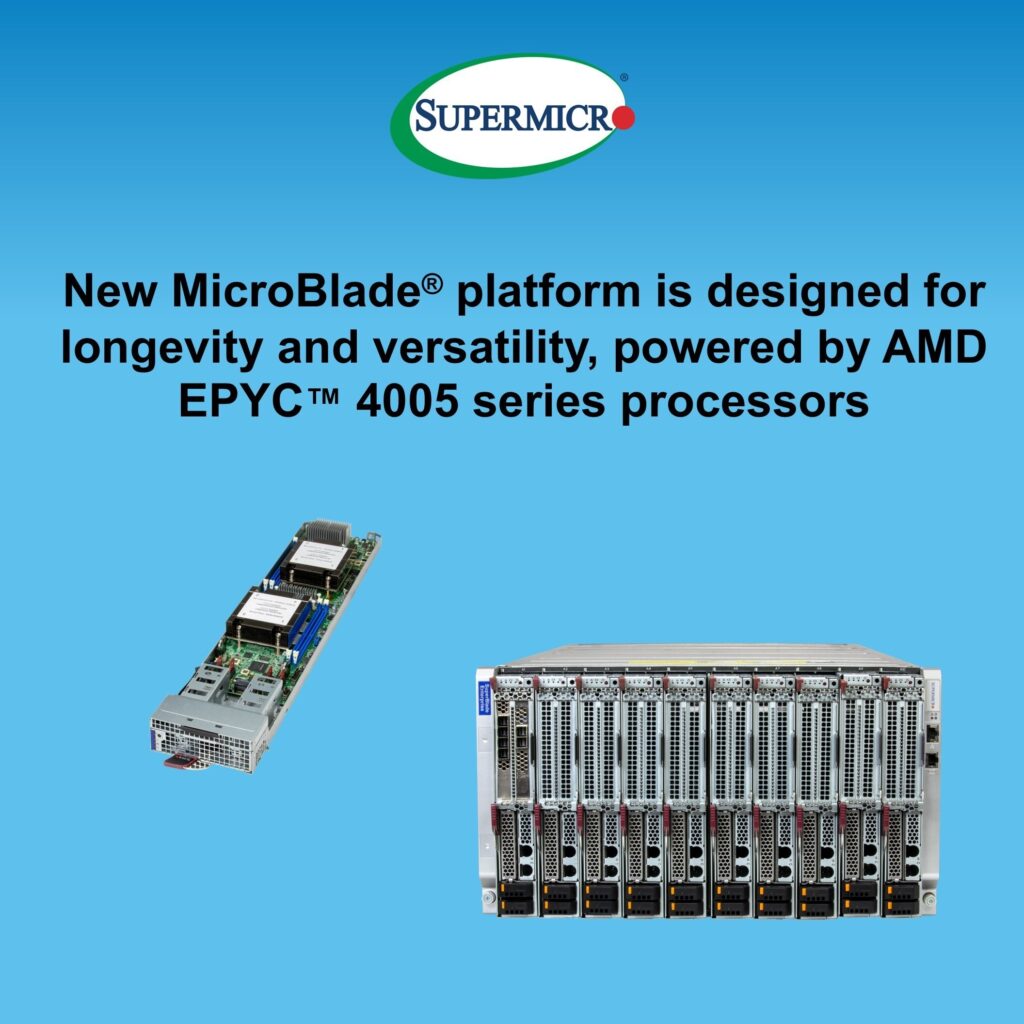
Super Micro Computer, Inc. (NASDAQ: SMCI), trading as Supermicro, has launched its highest-density MicroBlade server platform powered by AMD EPYC 4005 series processors, targeting cloud, edge, and SaaS workloads that prioritize efficiency over raw acceleration. The 6U blade system supports up to 40 server nodes per enclosure and as many as 320 nodes per rack, positioning the platform squarely at operators running scale-out, cost-sensitive infrastructure. The announcement underscores Supermicro, Inc.’s strategy of monetizing density, power efficiency, and modularity as cloud economics tighten globally.
Why Supermicro is positioning AMD EPYC 4005 MicroBlade for a post-GPU-first cloud market
The MicroBlade launch is less about chasing artificial intelligence headlines and more about addressing an increasingly uncomfortable reality for cloud operators. Not every workload benefits from expensive accelerators or top-bin CPUs, yet those workloads still consume space, power, and operational attention. Supermicro is betting that the next phase of data center optimization is not vertical scaling but horizontal efficiency.
AMD EPYC 4005 processors sit in a segment optimized for single-socket performance, lower power envelopes, and predictable scaling. Pairing them with a blade architecture that emphasizes node density allows Supermicro to address cloud service providers, software-as-a-service operators, and enterprise private cloud teams that are under pressure to do more with less. This is especially relevant as energy costs remain volatile and capacity planning becomes increasingly constrained by power availability rather than floor space.
By focusing on a platform that maximizes nodes per rack rather than peak performance per node, Supermicro is positioning itself for a market that values operational efficiency over benchmark leadership.
How MicroBlade density economics change total cost of ownership calculations for cloud operators
The core economic argument behind the MicroBlade platform is straightforward but powerful. Up to 40 nodes in a 6U enclosure and up to 320 nodes in a standard 48U rack materially alters how operators think about utilization. Rack-level density reduces networking sprawl, lowers cabling complexity, and simplifies power distribution.
Supermicro has also leaned into integrated networking with dual 25G Ethernet switches and 100G uplinks embedded into the enclosure. This reduces the need for top-of-rack switching for certain deployment models and lowers the overall bill of materials. In an environment where capital expenditure scrutiny has intensified, these design choices resonate with procurement teams as much as with architects.
Power capping and centralized chassis management further reinforce the total cost of ownership argument. The ability to allocate power budgets per blade and manage systems independently of CPU state allows operators to squeeze more predictable output from fixed energy envelopes. That capability is increasingly valuable as data centers encounter grid constraints and regulatory pressure around energy consumption.
What AMD EPYC 4005 brings to MicroBlade that prior generations could not
The decision to anchor this MicroBlade generation on AMD EPYC 4005 processors reflects a broader industry trend toward efficient single-socket designs. These processors offer sufficient core density, modern instruction sets, and DDR5 memory support without the power draw associated with higher-tier server CPUs.
Each node supports DDR5 ECC memory operating at up to 5600 MT per second, PCIe Gen5 storage via E1.S drives, and integrated 25GbE networking. This configuration aligns with workloads such as containerized microservices, virtual private servers, web front ends, and security appliances that scale horizontally rather than vertically.
Importantly, Supermicro has preserved backward and forward compatibility across processor generations. That signals a deliberate effort to reduce platform churn for customers who plan infrastructure refresh cycles measured in years rather than quarters. Longevity has become a selling point in a market fatigued by rapid obsolescence.
Why mix-and-match blade configurations matter more than headline density numbers
One of the subtler but strategically important elements of the MicroBlade platform is its ability to support mixed node types within a single enclosure. Operators can deploy single-wide and double-wide blades with different processor configurations side by side.
This flexibility allows infrastructure teams to tailor density and performance characteristics at a granular level. For example, a rack can host lightweight web services, API gateways, and security workloads without dedicating separate hardware pools. That reduces stranded capacity and improves utilization metrics, which increasingly matter to finance teams overseeing cloud operations.
In practice, this modularity also lowers deployment risk. Rather than committing to a homogeneous architecture that may not age well, customers can evolve configurations incrementally as workload profiles shift. This design philosophy aligns with how modern infrastructure is actually consumed, not how it is marketed.
How edge and enterprise deployments factor into Supermicro’s MicroBlade strategy
While cloud service providers are an obvious target, the MicroBlade platform also speaks directly to enterprise and edge deployments where space and power are constrained. Departmental private clouds, regional data centers, and industrial edge environments often lack the physical footprint to deploy traditional rack-scale solutions.
By delivering high node density in compact enclosures, Supermicro is addressing a segment that values reliability and manageability over peak throughput. Integrated security features such as hardware root of trust, signed firmware, and TPM support further reinforce suitability for regulated industries.
This positions the MicroBlade platform as a bridge between hyperscale design principles and enterprise operational realities. It is not a consumer of massive power budgets but a pragmatic response to distributed compute needs.
Where this MicroBlade launch sits within Supermicro’s broader platform narrative
Supermicro has spent the past several years balancing two parallel narratives. One focuses on high-performance infrastructure for artificial intelligence, while the other emphasizes modular, application-optimized systems for mainstream enterprise and cloud workloads.
The MicroBlade announcement clearly strengthens the latter. It reinforces the company’s identity as a systems integrator capable of tailoring platforms to specific economic and operational constraints. That diversification matters as artificial intelligence infrastructure cycles remain volatile and capital-intensive.
From a strategic standpoint, this also deepens Supermicro’s relationship with AMD across multiple market tiers. While NVIDIA dominates the accelerator conversation, CPU-centric platforms remain the backbone of cloud infrastructure. Maintaining relevance there is critical for long-term revenue stability.
What Super Micro Computer, Inc.’s MicroBlade execution signals for investor confidence beyond AI infrastructure cycles
As a publicly traded company, Supermicro operates under heightened investor scrutiny. The market has rewarded the company for its exposure to artificial intelligence infrastructure but has also shown sensitivity to execution risk, supply chain complexity, and margin sustainability.
The MicroBlade launch is unlikely to move the stock on its own, but it contributes to a broader perception shift. Investors increasingly value predictable, repeatable platforms that serve large addressable markets rather than one-off flagship systems. High-density blade servers for scale-out workloads fit that profile.
Recent trading patterns suggest investors are looking for evidence that Supermicro can monetize both ends of the compute spectrum. This announcement supports that thesis by reinforcing the company’s relevance beyond accelerator-heavy deployments.
What happens next as cloud buyers reassess infrastructure priorities in 2026
Looking ahead, the success of the MicroBlade platform will depend less on specifications and more on adoption patterns. Cloud operators and enterprises will evaluate whether density-driven architectures genuinely reduce operating costs over time.
If energy prices remain elevated and data center expansion continues to face regulatory friction, platforms that maximize output per rack will gain traction. Supermicro is positioning itself early in that shift.
Conversely, if demand swings back toward performance-heavy deployments, MicroBlade will remain a complementary offering rather than a centerpiece. Either way, the platform strengthens Supermicro’s portfolio resilience.
Key takeaways: What Supermicro’s AMD EPYC 4005 MicroBlade launch means for the market
- Supermicro is prioritizing density and efficiency over peak performance in response to tightening cloud economics
- The MicroBlade platform targets scale-out workloads that dominate real-world cloud and SaaS deployments
- AMD EPYC 4005 processors enable predictable, single-socket performance with lower power draw
- High node density materially improves rack-level utilization and total cost of ownership calculations
- Integrated networking and centralized management reduce operational complexity for cloud operators
- Mix-and-match blade configurations lower deployment risk and improve long-term flexibility
- The platform strengthens Supermicro’s relevance beyond artificial intelligence infrastructure
- Investor sentiment increasingly favors execution-focused platforms with large addressable markets
- MicroBlade positions Supermicro well for energy-constrained data center expansion scenarios
Discover more from Business-News-Today.com
Subscribe to get the latest posts sent to your email.



