Super Micro Computer, Inc. (NASDAQ: SMCI) announced on July 16, 2025, that it has started shipping its new 4-socket X14 servers powered by Intel Xeon 6 processors. The American server infrastructure developer highlighted performance gains of up to 50% compared to previous generations, support for up to 344 cores per system, 16 terabytes of DDR5 memory capacity, and the ability to host up to six double-width GPUs. These systems are designed for high-performance computing, enterprise databases, generative AI training and inference, and mission-critical workloads such as real-time ERP processing.
The launch follows a period of rapid expansion for Super Micro Computer, which more than doubled its revenue in fiscal 2024, reaching approximately $14.99 billion. The company’s trailing twelve-month revenue through March 2025 stood at around $21.57 billion, supported by robust enterprise demand for AI-ready infrastructure. Institutional sentiment remains broadly positive, with analysts citing the X14 release as a strategic leap forward in the enterprise server market. Despite a modest stock pullback following the announcement, investors continue to rate the stock as a long-term growth story, supported by strong liquidity and expanding free cash flow.
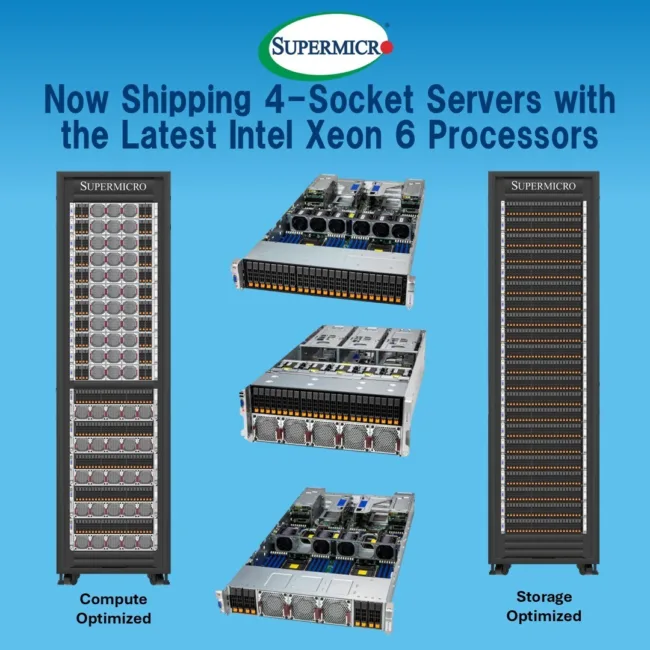
What compute and architectural advantages make the X14 servers significantly faster than previous Super Micro systems?
The X14 series represents a major architectural overhaul compared to Super Micro’s earlier X11 and X12 platforms. Powered by Intel Xeon 6 processors with both Performance-Core (P-core) and Efficiency-Core (E-core) variants, the servers achieve approximately 50% higher compute performance. Each 4-socket chassis supports up to 344 cores, 136 PCIe lanes per processor, 20 PCIe 5.0 slots, and full CXL 2.0 compatibility. This architecture enables memory pooling across processors and supports a maximum of 16 terabytes of DDR5 RAM, giving enterprise and HPC applications a significant boost in processing density and efficiency.
How are the X14 servers optimized for AI, SAP HANA, and enterprise database workloads?
Super Micro Computer has tailored the X14 series for mixed workloads, offering two chassis variants. The 2U configuration supports two double-width GPUs, while the larger 4U configuration accommodates up to six GPUs for AI training and inference alongside enterprise database processing. The servers are certified for SAP HANA and Oracle Linux, enabling enterprises to scale large-memory, high-throughput workloads within a single node. This eliminates the latency and complexity of distributed cluster scaling, making the systems ideal for ERP, CRM, and in-memory analytics applications.
How does the new X14 architecture improve data center efficiency and total cost of ownership?
The X14 servers are integrated into Super Micro’s Data Center Building Block Solutions® strategy, which focuses on modular deployment and optimized thermal and power management. With liquid and free-air cooling options, shared power and networking infrastructure, and high rack density, the systems are designed to reduce total cost of ownership. The combination of CXL 2.0 memory expansion and PCIe 5.0 connectivity allows data centers to achieve better performance-per-watt and deploy large-scale computing clusters more efficiently.
What is the investor and institutional sentiment around Super Micro’s X14 launch?
Institutional investors have described the X14 rollout as a “significant product advancement” aligned with high-margin AI and enterprise workloads. Analysts maintain a broadly positive outlook, noting the company’s strong fundamentals, including a current ratio above 6 and more than 80% net income growth in fiscal 2024. Despite a slight dip in SMCI’s share price after the launch, investor confidence remains high, driven by expectations that the X14 series will accelerate enterprise adoption and strengthen Super Micro’s position in the global server market.
How prepared is Super Micro to meet global demand for the X14 series?
Super Micro Computer confirmed that production of the X14 series is underway in its facilities in the United States, Taiwan, and the Netherlands. This diversified manufacturing footprint is designed to support first-to-market delivery and reduce supply chain risks. The company’s global capacity also aligns with its modular rack-scale data center strategy, which emphasizes rapid deployment across North America, Europe, and Asia.
What future catalysts could drive further growth following the X14 deployment?
Future growth drivers for Super Micro Computer are expected to revolve around both product and market expansion. Analysts point to the likelihood of additional certifications for enterprise software platforms such as SAP, Oracle, and VMware as a crucial factor that will enhance the X14 servers’ attractiveness for large-scale IT modernization projects. As enterprises increasingly consolidate AI training, inference, and database workloads onto fewer, more powerful nodes, certifications will remain a decisive purchasing criterion for CIOs managing multi-cloud and hybrid infrastructure.
Telecommunications edge computing is also emerging as a significant opportunity. Super Micro Computer has been gradually expanding its presence in this segment, and the X14’s high compute density combined with energy-efficient architecture makes it a natural fit for 5G core, private wireless, and content delivery workloads. The ability to host AI-driven analytics and caching systems in compact, high-performance nodes could position the X14 series as a preferred choice for telecom operators seeking to improve latency-sensitive applications.
The integration with NVIDIA GPU ecosystems is another factor that institutional investors are closely watching. Super Micro has already been collaborating with NVIDIA on AI training clusters, and the X14’s GPU scalability—supporting up to six double-width GPUs in its 4U configuration—is expected to enhance compatibility with NVIDIA’s latest H200 and future Blackwell-class accelerators. Analysts anticipate that future variants of the X14 will include liquid-cooled options optimized for high thermal-load GPUs, a critical requirement for generative AI and large-language-model training.
On the financial front, the X14 series is expected to become a key revenue driver over the next 18 to 24 months as AI infrastructure spending continues to rise. Global forecasts indicate that enterprise and hyperscale data center investments will grow at double-digit rates through 2026, with AI-specific server demand expanding at an even faster pace. Super Micro Computer’s manufacturing readiness, particularly its diversified footprint across the United States, Taiwan, and the Netherlands, positions it to capture a meaningful share of this market while mitigating regional supply chain disruptions.
Institutional sentiment remains underpinned by the company’s strong fundamentals. Its current ratio above 6, expanding free cash flow, and consistent year-over-year revenue growth create a financial buffer to invest aggressively in research, development, and capacity expansion. Analysts following the stock emphasize that Super Micro Computer is evolving beyond a traditional white-box server manufacturer into a vertically integrated infrastructure provider. The company’s Data Center Building Block Solutions® strategy, which promotes modular, rack-scale deployments, is increasingly seen as a differentiator in enterprise procurement decisions.
Market watchers also highlight that adoption trends will likely accelerate as more enterprises seek to replace multi-node clusters with single high-density systems, a transition that aligns perfectly with the X14’s architecture. Demand from sectors such as financial services, healthcare, and energy—where low-latency analytics and in-memory processing are critical—is expected to broaden the product’s customer base beyond cloud providers and hyperscalers.
While Super Micro Computer’s share price experienced a modest pullback following the product announcement, such movements are seen as typical investor recalibration after a major launch. Institutional investors expect momentum to build as initial shipments translate into reported revenue growth in upcoming quarters. Many see the X14 series as not only a technological leap but also a long-term growth catalyst that can solidify the company’s standing as one of the leading suppliers of AI-ready and mission-critical infrastructure.
Discover more from Business-News-Today.com
Subscribe to get the latest posts sent to your email.