



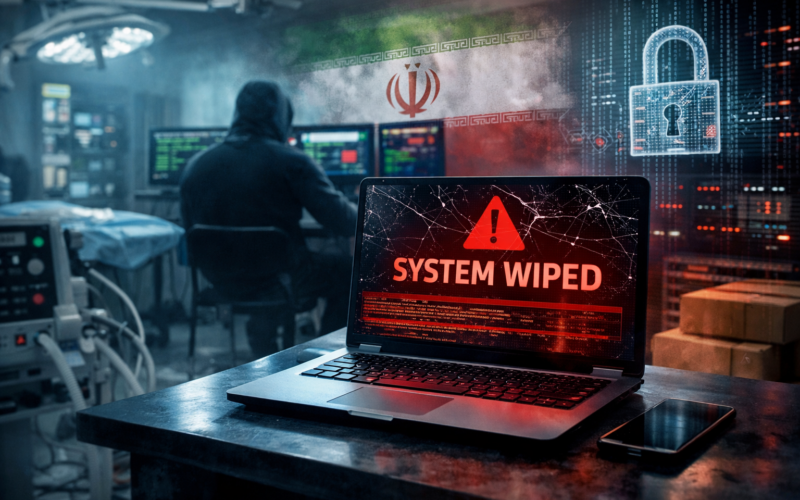
Stryker Corporation (NYSE: SYK), the Michigan-based medical technology giant with over $25 billion in annual revenue, disclosed on March 11, 2026 that it had suffered a destructive cyberattack that triggered a global network disruption across its entire Microsoft environment, idling approximately 56,000 employees worldwide. The attack was claimed by Handala, a pro-Iranian hacking group widely assessed by cybersecurity researchers to be affiliated with Iran’s Islamic Revolutionary Guard Corps, which stated it had wiped more than 200,000 servers, mobile devices, and laptops and extracted 50 terabytes of corporate data. Stryker confirmed the breach in a filing with the US Securities and Exchange Commission but said no ransomware or malware had been detected, and that the incident appeared contained to its internal Microsoft environment. As of March 16, no timeline for full system restoration has been provided, and the disruption to order processing, manufacturing, and shipping continues to have operational and financial consequences that remain unquantified.
Stryker’s stock opened at $358.76 before the attack became public on March 11 and fell 2.85% on that day to approximately $348.42. By March 12, shares had extended losses to a cumulative decline of roughly 9%, touching $328.68 intraday before partially recovering to approximately $338 to $346 in subsequent sessions. The company’s market capitalisation stood near $131 billion to $133 billion at the time of writing, down from pre-attack levels, with the stock trading below its major moving averages and in negative territory for the year. The market reaction, while sharper than typical IT incident sell-offs, is arguably calibrated rather than panicked given the operational severity: a wiper attack against a company supplying surgical equipment and orthopedic implants to hospitals globally is not analogous to a ransomware hit on a retailer.
How did the Handala group execute a wiper attack on Stryker’s Microsoft environment without deploying malware?
The technical mechanics of the Stryker intrusion distinguish it from the overwhelming majority of corporate cyberattacks. Rather than deploying wiper malware in the conventional sense, the attackers appear to have used Microsoft Intune, a legitimate cloud-based unified endpoint management platform, to push operating system reset commands to enrolled Windows devices across Stryker’s global fleet. Intune is designed to allow enterprise IT administrators to remotely wipe devices that are lost, stolen, or being retired, and the feature is a standard part of the Microsoft 365 ecosystem. The implication is that Handala obtained administrator-level credentials providing access to Stryker’s Intune management console, then turned the company’s own device management tooling against itself at scale.
Cybersecurity researchers, including analysts at Sophos, noted that the abuse of a native platform feature like Intune is meaningfully different from introducing external malicious code, both technically and forensically. It leaves fewer obvious indicators of compromise because no novel executable needs to be delivered or detonated. Industrial cybersecurity firm Smarttech247 noted that Handala’s primary initial access technique remains phishing, and the sequence of events suggests the group obtained privileged credentials through that route before escalating into Intune administration. Research by cybersecurity firm Check Point had separately linked Handala to multiple data breach and destructive wiper operations, primarily against Israeli targets, prior to the Stryker incident.
Threat intelligence published by Industrial Cyber noted that researchers had identified significant overlap between Handala and Void Manticore, an Iranian government-sponsored advanced persistent threat group, which in turn has links to another IRGC-affiliated cluster known as Scarred Manticore, or OilRig and APT34. The sophistication required to gain administrator-level cloud management access and execute a coordinated wipe across more than 200,000 endpoints globally is consistent with a well-resourced state-aligned actor rather than a financially motivated criminal group.
Why was Stryker targeted by an Iran-linked group and what role did geopolitics play in the timing?
Handala’s stated justification for the attack was retaliation for a missile strike on a primary school in Minab, Iran, on February 28, 2026, the opening day of joint US-Israeli military operations against Iran. Iranian authorities attributed approximately 168 deaths to the strike, more than 100 of whom were children. The Pentagon has launched an investigation and preliminary findings, reported by The New York Times, indicated the strike resulted from a US targeting error. In its social media post claiming responsibility, Handala framed the Stryker attack as part of a broader campaign against infrastructure connected to Israel and the United States.
Stryker’s specific targeting appears to have had a degree of intentionality beyond opportunistic scanning. The company acquired Israeli medical technology firm OrthoSpace in 2019, creating an Israeli corporate connection that Handala explicitly cited. Stryker also secured a US Department of Defense contract worth approximately $450 million to supply medical devices, a detail that further elevated its profile as a target following the IRGC’s formal designation of American companies with Israeli ties as legitimate retaliatory targets. It is also possible, as multiple cybersecurity analysts noted, that Handala conducts broad internet reconnaissance for vulnerable Microsoft environments and acted on an existing access opportunity once political conditions aligned.
The attack is notable in a broader strategic context because it represents one of the first confirmed significant cyberattacks by an Iran-affiliated actor against a US corporation since the beginning of armed conflict between the US-Israeli coalition and Iran. Prior to the Stryker incident, cybersecurity firms including Google and Proofpoint had observed Iranian groups largely limiting post-conflict activity to espionage operations and minor hacktivist defacements. The transition to a destructive attack against critical supply chain infrastructure in the healthcare sector marks a meaningful escalation that US federal agencies including the Department of Health and Human Services and the Cybersecurity and Infrastructure Security Agency were actively monitoring.
What is the operational impact on Stryker’s manufacturing, shipping, and hospital supply chain relationships?
Stryker’s own customer update confirmed that the attack caused disruptions to order processing, manufacturing, and shipping, the three operational pillars most directly tied to near-term revenue recognition. The company stated that orders entered before the event would be shipped once system communications were restored, while orders placed after the event were being examined manually. Its electronic ordering system remained offline at the time of the update. Stryker’s connected medical products, including the Mako robotic surgery system, Vocera communications platform, and LIFEPAK 35 defibrillators, were confirmed safe to use, a critical clarification for hospital customers whose clinical operations depend on those platforms.
The patient care dimension extended beyond Stryker’s own operations. Maryland’s Institute for Emergency Medical Services Systems notified hospitals in the state that Stryker’s Lifenet electrocardiogram transmission system, used by emergency responders to communicate patient data to receiving hospitals, was non-functional across most of the state and that EMS clinicians should revert to radio consultation protocols pending restoration. While this illustrated immediate clinical workflow disruption, Stryker’s connected products themselves were not the attack vector, limiting the direct patient safety risk.
Stryker operates in more than 60 countries and its manufacturing and research hub in Cork, Ireland, employing more than 4,000 people, was among the facilities disrupted. Ireland’s National Cyber Security Centre confirmed it had been notified and was assisting with the response. Additional operations in Limerick and Belfast were also affected. The geographic breadth of the disruption underscores the systemic risk of a single cloud management platform serving as the administrative layer across a globally distributed enterprise. For hospital systems relying on Stryker for surgical implants, neurotechnology equipment, and intraoperative devices, supply chain uncertainty entering a period where no recovery timeline exists is a material operational concern.
Does the Stryker cyberattack pose a credible risk to its 2026 organic growth guidance of 8% to 9.5%?
Stryker entered 2026 on the back of its strongest financial performance in recent history. The company reported $25.1 billion in global sales for 2025, an 11.2% increase year-on-year and its fourth consecutive year of double-digit growth, with net income of $3.2 billion and free cash flow of $4.283 billion. Management had guided for 8% to 9.5% organic revenue growth in 2026, with earnings per diluted share of $14.90 to $15.10. The company also held approximately $4 billion in cash and equivalents, providing meaningful financial buffer for remediation costs.
The central question the cyberattack poses to that growth trajectory is duration. Wiper attacks that destroy rather than encrypt data are structurally more difficult to recover from than ransomware incidents because there is no decryption key to be obtained. Historical precedent from comparable incidents, most notably A.P. Moller-Maersk’s experience with the NotPetya wiper attack in 2017, suggests that a major industrial company with mature continuity protocols and strong external resources can restore core operations within roughly ten days while full remediation extends over months. Stryker’s position entering the incident with strong balance sheet fundamentals and an activated incident response plan with external cybersecurity advisors is broadly comparable to that scenario, though the 200,000-device scale of the wipe is significantly larger.
Manufacturing and shipping disruption at a medical device company translates into delayed revenue recognition rather than permanently lost orders in most scenarios. Hospitals require Stryker’s products and will reschedule procedures, not cancel them. However, the disruption lands at an awkward strategic moment: Stryker had announced its new SmartHospital Platform on March 9, two days before the attack, and the platform’s entire value proposition is built around connected, digitally integrated hospital infrastructure. A cyber incident of this magnitude against Stryker’s Microsoft-based systems in the same week as that launch is a commercial and reputational complication that will require deliberate narrative management. The gap between Stryker’s digital growth ambitions and its demonstrated cyber resilience is now a question hospital CIOs and procurement teams will ask directly.
What are the regulatory, legal, and competitive consequences for Stryker and the broader medtech sector?
Stryker’s SEC 8-K filing acknowledging the cyberattack satisfied its most immediate disclosure obligation, but the regulatory exposure does not end there. The scale of the incident, encompassing data wiped from devices across 79 countries and the claimed exfiltration of 50 terabytes of information, triggers potential reporting and remediation requirements under multiple frameworks including the European Union’s NIS2 Directive, the US Health Insurance Portability and Accountability Act if any protected patient health information was affected, and Ireland’s data protection rules given the significance of its Cork operations. Stryker has not confirmed the 50-terabyte data theft claim, and whether any regulated data was among the extracted content will be a critical determination in assessing total liability exposure.
For Stryker’s medtech peers, the incident functions as a sector-wide stress test. Medtronic, Johnson and Johnson’s MedTech division, and Zimmer Biomet all operate similar globally distributed Microsoft-centric environments and serve the same hospital customer base. The specific attack vector through Microsoft Intune’s remote wipe capability is not proprietary to Stryker’s configuration, and the healthcare sector’s accelerating shift toward connected, software-intensive products has expanded the attack surface substantially. Hospital procurement teams that depend on Stryker for surgical continuity will now assess whether their contingency sourcing arrangements with alternative suppliers are adequate for a multi-week disruption scenario, a question that benefits Stryker competitors in the near term.
The broader geopolitical signal is arguably the most consequential dimension for the sector. The Stryker attack demonstrates that state-aligned actors operating in the context of kinetic military conflict are willing to target critical healthcare supply chain infrastructure rather than limiting themselves to government systems and energy assets. White House officials confirmed the Trump administration was monitoring potential cyber threats and coordinating with critical infrastructure operators, and FBI Director Kash Patel had publicly referenced the bureau’s cyber posture in the 24 hours before the attack. The institutional response is in motion, but the Stryker incident will accelerate legislative and regulatory pressure on both cloud infrastructure providers and medtech companies to harden their endpoint management security postures materially.
Key takeaways on what the Stryker cyberattack means for the company, medtech competitors, and global healthcare supply chains
- Stryker (NYSE: SYK) confirmed on March 11, 2026 that an Iran-linked wiper attack disrupted its entire global Microsoft environment, with the pro-Iranian Handala group claiming to have wiped more than 200,000 devices and extracted 50TB of data. No recovery timeline has been set as of March 16.
- The attack used Microsoft Intune, a legitimate enterprise endpoint management tool, to remotely wipe corporate devices, bypassing the need for conventional malware and making this a living-off-the-land attack of significant technical sophistication tied to administrator-level credential compromise.
- Handala has been assessed by multiple cybersecurity researchers as a front for Void Manticore, an IRGC-affiliated advanced persistent threat group with a documented history of destructive wiper operations, primarily against Israeli and US-connected targets.
- Stryker’s stock has fallen approximately 7% to 9% since the attack, trading near $338 to $346 as of mid-March from a pre-attack level of $358.76. The company’s $25.1 billion revenue base, $4.28 billion in free cash flow, and $4 billion cash position provide a financial cushion for remediation costs but do not insulate near-term earnings from manufacturing and shipping delays.
- Order processing, manufacturing, and shipping disruptions are ongoing. Stryker’s connected medical devices, including Mako, Vocera, and LIFEPAK 35, were confirmed safe to use, but the Lifenet ECG transmission system used by emergency medical services was temporarily non-functional in multiple US states.
- The incident occurred two days after Stryker launched its SmartHospital Platform, a connected digital hospital infrastructure product. The timing creates a direct reputational headwind for Stryker’s digital growth narrative and will elevate cybersecurity scrutiny from hospital procurement and CIO stakeholders.
- Medtech peers including Medtronic, Zimmer Biomet, and the Johnson and Johnson MedTech division operate comparable Microsoft-centric environments and face the same Intune-based attack vector risk. The sector’s transition to connected digital platforms has materially expanded its geopolitical cyber exposure.
- Regulatory exposure spans multiple jurisdictions. If any protected health or employee data was among the claimed 50TB extracted, HIPAA, NIS2, and Irish data protection authorities will require detailed disclosure and remediation. Stryker has not yet confirmed whether regulated data was affected.
- The attack is one of the first confirmed destructive cyberattacks by an Iran-affiliated actor against a US corporation since the start of US-Israeli military operations against Iran in February 2026, representing a strategic escalation from the espionage and hacktivist defacement activity previously observed.
- Historical recovery benchmarks from comparable wiper incidents suggest operational restoration of core functions within 10 to 30 days for a well-resourced company, but full remediation and security hardening typically extends over months. The 2026 organic growth guidance of 8% to 9.5% carries elevated execution risk until Stryker restores full operational capability and establishes revised endpoint security architecture.
Discover more from Business-News-Today.com
Subscribe to get the latest posts sent to your email.