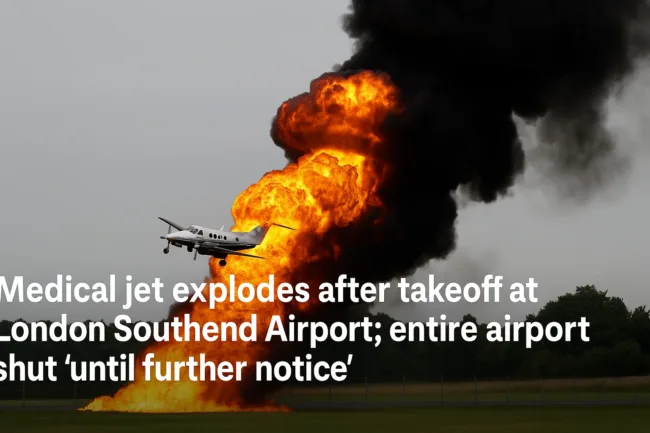
Why did a medevac flight explode after takeoff at Southend Airport and shut down all operations?
A medical evacuation aircraft crashed in a violent explosion moments after taking off from London Southend Airport on Sunday, July 13, leading to the immediate suspension of all operations and triggering a full-scale emergency response. The incident occurred at approximately 3:48 PM BST and involved a Beechcraft King Air B200 aircraft, operated by Dutch firm Zeusch Aviation. The aircraft, registered PH-ZAZ, was bound for Lelystad in the Netherlands. Eyewitness footage and air traffic data confirmed that the plane had just become airborne before banking sharply, losing stability, and erupting in flames within the airport perimeter.
Fire and ambulance services arrived within minutes. The East of England Ambulance Service dispatched four ambulances, paramedic teams, and an air ambulance unit. Essex Police declared the event a “serious incident,” prompting evacuations near the airport, including areas adjacent to Rochford Hundred Golf Club and Westcliff Rugby Club. A wide cordon remains in place.

Southend Airport was closed indefinitely as a result of the crash. Authorities reported that at least five international flights were immediately cancelled, and operations have not resumed as of Monday morning. The airport issued an advisory urging passengers not to travel and stated that further updates would be provided pending investigation progress.
What kind of aircraft was involved in the Southend crash and who was operating the medevac mission?
The aircraft involved in the crash was a Beechcraft King Air B200, a US-manufactured twin-turboprop aircraft often used for charter and medical evacuation operations. The PH-ZAZ variant was configured with a luxury eight-seat layout and high-performance medical equipment. Zeusch Aviation, headquartered in the Netherlands, confirmed it operated the flight under the callsign SUZ1. The aircraft had taken off from Southend and was expected to arrive in Lelystad before contact was lost shortly after departure.
Zeusch Aviation, which specializes in medevac and organ transport flights, acknowledged the incident in an official statement. The company said it was cooperating fully with UK authorities and the Air Accident Investigation Branch. Though the purpose of this specific mission has not been detailed, Zeusch aircraft often transport medical personnel, transplant materials, or emergency passengers under time-sensitive conditions.
The aircraft was airborne for only a few seconds before crashing. Witnesses described an abrupt bank to the left, an apparent roll or inversion, and then a fireball followed by thick black smoke. The aircraft crashed within the airport’s boundary, avoiding nearby structures or neighborhoods, but the explosion was visible across Essex.
What has been the response from police, aviation authorities, and the UK government?
The Essex Police Department has launched a joint investigation alongside the Air Accident Investigation Branch. The priority has been securing the crash site, identifying the flight’s occupants, and beginning data collection on possible causes. Chief Superintendent Morgan Cronin confirmed that police are working closely with air safety authorities to establish what led to the crash. In a public statement, Cronin said it was essential to act carefully during the early hours of the investigation and provide full support to those impacted.
Transport Secretary Heidi Alexander responded swiftly to the crash and said she was monitoring the situation closely. She extended her thoughts to everyone involved in the incident and has been receiving regular briefings from emergency services. As of Monday morning, neither the Department for Transport nor the Civil Aviation Authority has issued a formal update on aviation policy implications, but officials remain engaged.
Local representatives, including Southend West MP David Burton-Sampson, issued public statements urging calm and cooperation with emergency teams. Messages of solidarity have also emerged from Dutch consular officials, who are in contact with UK authorities given the aircraft’s ownership and flight destination. Consular staff may be involved in family liaison and formal identification if any Dutch nationals were onboard.
How has the crash impacted Southend Airport operations and travel across the region?
Southend Airport remains closed as of the latest official reports, with a wide security perimeter maintained throughout the night. Passengers booked on affected flights were instructed to check airline portals and avoid traveling to the airport until further notice. At least five flights to international destinations were marked as cancelled on the airport’s departure board shortly after the crash.
Airlines operating out of Southend, including easyJet, Aer Lingus Regional, and Eastern Airways, have initiated rerouting efforts through alternate London-area airports such as Stansted and City. Travelers scheduled for onward connections are facing significant disruptions. The Holiday Inn and other businesses within the airport campus have offered to assist stranded travelers. Public transport services that connect to the airport have been partially suspended or rerouted in response to the ongoing investigation and closure.
The airport, which serves nearly two million passengers annually, had recently expanded its medevac and charter operations. This accident marks a rare and highly disruptive event at Southend, which typically handles short-haul leisure and business traffic as part of the London regional airport network.
What do we know about Zeusch Aviation and its operations in the UK and EU?
Zeusch Aviation is a private operator specializing in medical aviation and specialty charter services. Its fleet of Beechcraft King Air aircraft is used for transplant logistics, patient transfers, real-time aerial video relay, and mapping missions. The company is based at Lelystad Airport and holds a European AOC (Air Operator Certificate) allowing cross-border flights in the EU and UK under post-Brexit bilateral arrangements.
The aircraft involved in the Southend crash joined the Dutch registry in early 2025. It was reportedly upgraded with medevac modules including a LifePort stretcher system, oxygen equipment, and defibrillator storage. Although the operator has not disclosed passenger details, its fleet is often staffed with two pilots and may include onboard medical technicians.
Zeusch has operated safely in the UK for years and maintains a clean accident record. However, given the increasing number of short-notice medevac missions and organ transport flights post-COVID, the safety conditions of such operations are coming under fresh scrutiny following this crash.
Have there been similar air crashes or incidents at Southend Airport in the past?
While Southend Airport has not seen a fatal crash of this magnitude in recent decades, it has experienced several minor incidents. A Piper Seneca crash in 1997 during approach resulted in one fatality due to instrument failure. A 2006 Cessna training accident also led to one death after a stall on final descent. More recently, a taxiway collision involving a cargo plane in 2022 caused minor damage but no casualties.
The current crash is the first to prompt a full closure of Southend Airport in recent memory. The last significant disruption occurred during the COVID-19 pandemic, when all commercial flights were suspended due to travel restrictions. In this case, the airport shutdown has been ordered for safety, investigation, and recovery operations.
The Air Accident Investigation Branch has dispatched a specialized team to the site. Black box recovery, flight logs, and maintenance records will form the basis of the investigation. Findings may influence future operational rules for private aviation at regional UK airports.
What unanswered questions remain about the crash, casualties, and technical causes?
As of July 14, authorities have not confirmed how many individuals were aboard the aircraft. Zeusch Aviation has withheld the manifest pending notification of families. Local officials have not issued a casualty count but confirmed that emergency teams remain on-site and prepared to support families and collect forensic evidence.
Technical data suggests the aircraft entered an unusual attitude immediately after takeoff. Whether this was caused by mechanical failure, overloading, pilot incapacitation, or external interference is unknown. The aircraft was reportedly operating under Visual Flight Rules at the time, with no adverse weather in the area.
The AAIB has urged members of the public who recorded the incident to submit footage via its secure upload portal. Investigators will be reviewing surveillance video, witness statements, and radio transcripts as part of the official inquiry. A preliminary report is expected within the next 30 days, though full findings may take several months.
Could this crash lead to changes in medevac aviation policy or regional airport safety?
The Southend crash has reignited debate over how small medevac flights are regulated. The King Air B200 does not legally require a cockpit voice recorder or flight data recorder under current EASA and UKCAA standards. Safety analysts have called for that to change, particularly for aircraft operating emergency missions over densely populated areas.
Regulators may also face pressure to review fatigue management protocols, pilot licensing for rapid dispatch missions, and infrastructure investments at secondary airports. Southend’s fire response and runway clearance procedures will be examined as part of the AAIB investigation. If deficiencies are found, the airport may be required to revise emergency readiness procedures.
The incident has also drawn attention to post-Brexit airspace coordination, as Zeusch operates regularly between the UK and EU. Any findings related to air traffic control coordination could impact future cross-border medevac operations.
A developing aviation emergency with wide regional and policy implications
The crash of flight SUZ1 marks a rare and catastrophic incident at one of London’s secondary airports. The full details of what caused the Beechcraft King Air to crash remain unclear. Zeusch Aviation is cooperating fully with UK authorities, and both the aviation industry and the public await answers. With air ambulance and medical charter flights increasing in volume, this crash may become a turning point in how such missions are governed, recorded, and monitored.
Further updates will follow as more details emerge from Essex Police, the AAIB, and Zeusch Aviation.
Discover more from Business-News-Today.com
Subscribe to get the latest posts sent to your email.