


Tiny reactors, huge impact! Are SMRs the game-changer the energy world has been waiting for?
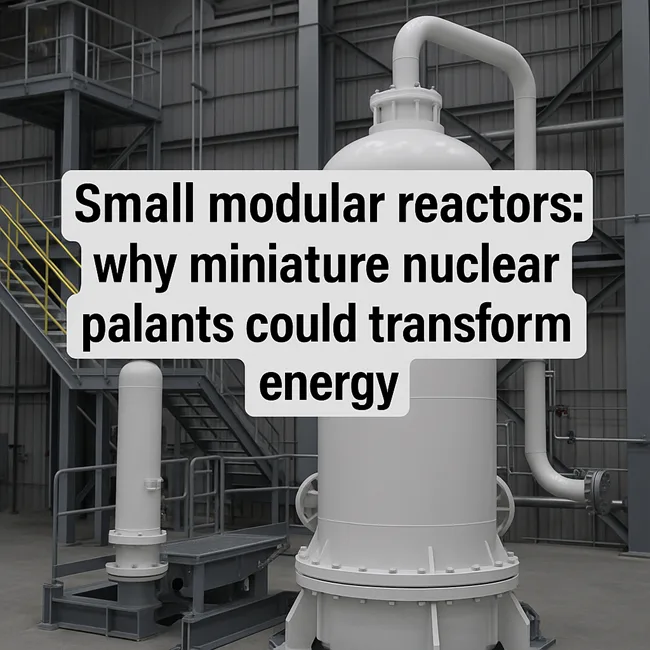
Small modular reactors (SMRs), which generate under 300 megawatts of power, are fast becoming one of the most promising innovations in the global energy transition. Built in factory settings and then assembled on-site, these miniature nuclear power plants offer a solution to one of nuclear energy’s biggest challenges: time and cost of construction. Unlike traditional gigawatt-scale reactors, SMRs offer the advantage of faster deployment, lower financing risk, and deployment flexibility in off-grid or remote locations. The International Energy Agency (IEA) has noted that as nations strive toward net-zero commitments, innovations like SMRs are seen as vital for providing scalable, low-carbon, and dispatchable power solutions. Their potential to also supply heat and hydrogen makes SMRs a strategic asset not just for electricity grids, but for industrial decarbonization as well.
What kinds of small modular reactor designs are in development around the world today?
SMRs are not a one-size-fits-all solution; they encompass a broad spectrum of technologies under development across the globe. Among the most mature are light-water SMRs, which are downsized versions of traditional nuclear power plants using the same fuel and cooling mechanisms. Other designs such as high-temperature gas-cooled reactors (HTGRs) aim for greater thermal efficiency and are suitable for delivering industrial heat. Molten-salt reactors, often highlighted for their passive safety characteristics, are also gaining attention due to their ability to potentially use thorium as fuel. The IEA has identified nearly 80 SMR designs in progress globally, reflecting the race to commercialize safe, cost-effective, and versatile nuclear options. While third-generation SMRs prioritize enhanced safety and are expected to reach commercial deployment by 2030, fourth-generation designs are still in earlier phases of development and focus on recycling nuclear waste and operating at higher temperatures.
How do SMRs reduce costs and risk compared to traditional nuclear plants?
One of the key advantages of SMRs lies in their potential to significantly reduce both capital costs and construction risk. Because SMRs are manufactured as modules in controlled factory environments and transported to sites for assembly, they avoid many of the delays and budget overruns associated with custom-built, on-site nuclear projects. Utilities can also adopt a phased investment strategy, scaling capacity in line with demand instead of committing to a massive upfront outlay. Government support for SMRs has accelerated in recent years, with public-private partnerships driving deployment. Notable initiatives include a joint commitment by the United States, Japan, South Korea, and the United Arab Emirates to invest up to USD 275 million in Romania’s SMR deployment program. The U.S. Department of Energy has expanded its Advanced Reactor Demonstration Program, funding first-of-a-kind commercial SMR projects. In Europe, France is directing EUR 1 billion toward SMR development, while Canada has launched a clean tech investment tax credit of 30 percent that explicitly includes SMRs. These moves signal that leading governments are betting on SMRs to stabilize energy systems while stimulating local innovation and manufacturing ecosystems.
What industrial sectors could benefit most from small modular reactor deployment?
SMRs are increasingly viewed not just as electricity producers but as versatile platforms capable of serving diverse industrial applications. Their ability to produce high-temperature heat makes them particularly well-suited to sectors such as chemicals, steelmaking, and fertilizer production—industries that have traditionally relied on fossil fuels and struggle with electrification. Their compact scale allows for localized deployment at or near industrial sites, reducing transmission losses and enabling co-generation of power and heat. Moreover, SMRs can support green hydrogen production through both electrolysis and thermochemical processes, potentially lowering the cost of hydrogen in the long term. The IEA also highlights SMRs’ suitability for district heating in urban areas, with excess thermal energy from electricity generation injected into municipal heating networks. By expanding their use cases beyond grid power, SMRs offer multi-dimensional value in supporting deep decarbonization of hard-to-abate sectors.
What regulatory shifts are underway to support small modular reactor deployment?
The regulatory landscape for SMRs is undergoing a transformation, as most existing nuclear laws were written with gigawatt-scale reactors in mind and are ill-suited to modular designs. In response, several countries are modernizing their frameworks to streamline licensing for advanced nuclear technologies. The U.S. Nuclear Regulatory Commission has created a dedicated Office of Advanced Reactors and has already certified NuScale Power’s SMR design, marking a major milestone in nuclear innovation. Canada is working closely with reactor developers to establish clearer regulatory pathways for small reactors. Meanwhile, the International Atomic Energy Agency is developing universal safety guides to help harmonize standards across national borders. By aligning global regulations, these efforts aim to reduce duplication, lower approval costs, and enable faster commercialization of SMRs in multiple jurisdictions.
How large is the commercial opportunity for SMRs in off-grid and developing markets?
The market for SMRs extends far beyond national grids. Mining operations, remote communities, island nations, and military bases often rely on expensive and polluting diesel generators. A single 50-megawatt SMR could replace these legacy systems with lower-cost, zero-carbon energy, reducing both fuel logistics and emissions. Governments in Canada and Alaska are evaluating microreactors with outputs below 10 megawatts for localized energy needs in harsh climates. In developing economies, SMRs could provide the first reliable power source for rural hospitals, telecom towers, water treatment facilities, and emergency infrastructure. According to the OECD Nuclear Energy Agency, the global SMR market could reach hundreds of billions of dollars by 2050 if key deployment and financing barriers are overcome. However, widespread rollout will depend heavily on successful demonstration projects, as well as the ability to earn public trust and investor confidence.
What is the status of real-world SMR projects in development or nearing deployment?
Several SMR projects are already under development or moving toward commercial deployment. NuScale Power’s 77-megawatt light-water SMR, approved by U.S. regulators, is expected to be operational in Idaho by 2030 and will provide electricity to a group of municipal utilities. In Canada, Ontario Power Generation has announced plans for a 300-megawatt SMR at the Darlington site. Romania is working with U.S.-based partners to install six NuScale modules on the site of a former coal plant, backed by G7 government funding. France has launched a national program aimed at producing its first SMR by the early 2030s. Holtec International has entered into an agreement to deploy up to 20 SMRs in Ukraine in partnership with the national operator Energoatom. In Southeast Asia, Indonesia is exploring SMRs to power an ammonia fertilizer plant, while Japanese companies have invested USD 80 million in molten-salt SMR technology. These varied use cases highlight the flexibility of SMRs in meeting both energy and industrial needs across diverse geographies.
How are SMR developers addressing safety, waste, and public perception risks?
Safety is often cited as a primary advantage of SMRs. Most designs incorporate passive safety systems, which rely on natural convection and gravity rather than active mechanical intervention, reducing the likelihood of operator error or system failure. Their smaller core size and lower heat output reduce the thermal load in case of an emergency, while underground or underwater siting options enhance containment and reduce exposure risks. SMRs also produce less high-level radioactive waste per megawatt-hour than conventional reactors, although waste handling and storage still remain critical policy challenges. Public acceptance will ultimately determine SMR success, with concerns around nuclear proliferation, site security, and environmental impact continuing to stir debate. Transparent risk communication, rigorous international safeguards, and effective community engagement will be necessary to build trust. The IEA emphasizes the importance of coordinated policy and licensing reforms that maintain high safety standards while enabling efficient deployment.
What are the limitations of SMRs—and where do realistic expectations matter?
Despite their promise, SMRs are not a panacea. Most designs remain in early stages of commercialization, and initial deployment costs may exceed estimates due to supply chain immaturity and learning curve dynamics. Components like advanced heat exchangers and neutron moderators are not widely manufactured and may introduce logistical challenges. Additionally, integrating SMRs into existing energy systems may face resistance from incumbent fossil fuel stakeholders or regional political constraints. It is also important to recognize that SMRs are best viewed as a complementary solution—not a substitute—for renewables, grid modernization, and large-scale reactors. The real value of SMRs lies in their niche applications, particularly in geographies or industries where flexibility, speed, and heat integration matter most. Overhyping the technology could lead to disillusionment or policy fatigue; measured, data-driven rollouts remain essential.
How is NuScale Power performing in public markets, and what does sentiment look like for SMR stocks?
NuScale Power Corporation, listed on the New York Stock Exchange under the ticker SMR, is widely regarded as the market bellwether for SMR technology. The company’s stock surged in early 2025 following U.S. President Donald Trump’s order to fast-track SMR deployment and the G7’s funding support for the Romanian project. Investors responded positively to NuScale’s status as the only company with a certified SMR design and an imminent deployment timeline. However, volatility has set in amid concerns over execution risk, unproven economics, and regulatory headwinds. While the broader institutional sentiment remains bullish on SMRs as a category, public market confidence is closely tied to the success of first-of-a-kind deployments and the ability of firms like NuScale to meet their delivery and cost targets. Analysts caution that while SMRs offer tremendous potential, investor enthusiasm must be tempered by realistic expectations around timelines and capital intensity.
Is the SMR revolution real, or still aspirational?
Small modular reactors are no longer just theoretical; they are edging closer to commercial viability in multiple regions. Their promise lies in the convergence of faster deployment, modular flexibility, industrial compatibility, and lower carbon emissions. However, the road ahead requires more than optimism—it demands policy coordination, community trust, patient capital, and flawless execution. If these conditions are met, SMRs could play a transformative role in reshaping how the world generates not just electricity, but also industrial heat and clean hydrogen. In a fragmented global energy landscape, SMRs may offer a rare common ground: a compact solution to the massive challenge of decarbonizing the future.
Discover more from Business-News-Today.com
Subscribe to get the latest posts sent to your email.