




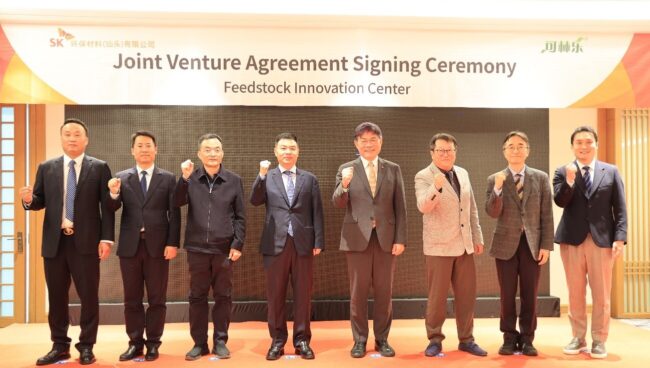
SK Chemicals has unveiled a landmark move for Korea’s plastics recycling sector by announcing a joint venture with Kelinle, a specialist in plastics recycling from Shaanxi Province, China, to build the Feedstock Innovation Center (FIC). This project, targeting start-up in the second half of 2026, is positioned as Korea’s first full vertical integration in the recycling industry, giving SK Chemicals a direct and reliable in-house source of waste-plastic feedstock. The FIC will be constructed on a 13,200-square-meter site owned by Kelinle in Weinan, China, and aims to process hard-to-recycle plastics—including end-of-life textiles and PET bottle fines—into high-quality recycled PET pellets.
With President Ahn Jae-hyun at the helm, SK Chemicals is betting that controlling its own feedstock will significantly boost cost competitiveness and supply stability in a global market where regulations are driving up demand—and volatility—for recycled materials. The initial capacity of 16,000 tons per year is expected to ramp up to 32,000 tons, supplying most of the feedstock for SK Shantou, SK Chemicals’ production subsidiary in China. The initiative marks a pivotal expansion from simply producing recycled materials to building a fully circular value chain, extending SK Chemicals’ reach into the very sourcing of waste plastics.
How will SK Chemicals’ in-house sourcing model reshape feedstock pricing and market risk?
Historically, most recycled plastics producers have relied on external suppliers for feedstock, exposing them to fluctuating prices and unpredictable supply—problems only set to intensify as regulations tighten and consumer brands chase recycled content targets. By sourcing waste plastics in-house through the Feedstock Innovation Center, SK Chemicals expects to insulate itself from much of this volatility. Internal analysis suggests the initiative could reduce raw material costs for the recycling business by as much as 20 percent, primarily by tapping into materials like waste blankets that are typically incinerated due to processing difficulties.
This move stands out because the FIC will focus on chemically recycling items that have previously escaped the recycling ecosystem—such as fiberfill, colored PET, and end-of-life textiles. SK Chemicals’ technological edge in depolymerization, which breaks plastics down to the molecular level, will enable repeated recycling without quality degradation, distinguishing the business model from conventional mechanical recycling. In essence, SK Chemicals is seeking to set a new price floor for recycled plastics, leveraging cost savings and supply certainty while helping address the world’s ballooning waste textile problem.
What makes the Feedstock Innovation Center different from conventional recycling plants?
Mechanical recycling still dominates the PET recycling market, but its dependence on clear PET bottles as feedstock has left a large chunk of waste materials—especially colored bottles, textiles, and mixed plastics—outside the economic loop. The Feedstock Innovation Center aims to change this by processing materials considered too challenging for standard recycling lines. By integrating SK Chemicals’ proprietary depolymerization process, the center will convert difficult-to-handle feedstock into new PET pellets, which are in high demand for use in sustainable packaging and textiles.
The center is not just about scale, but about shifting the quality threshold for what can be recycled. By starting with inputs that would otherwise be incinerated or landfilled, such as discarded blankets and PET bottle fines, SK Chemicals positions itself as an innovator in waste valorization. This approach could have significant environmental impact: globally, more than 4.6 million tons of bedding are discarded each year, yet less than one percent is recycled.
How will SK Chemicals’ China partnership accelerate its circular recycling ambitions?
SK Chemicals’ partnership with Kelinle is not just a one-off project, but part of a larger blueprint to become a global leader in circular plastics. Kelinle brings a decade of operational experience in China’s plastics recycling market, a robust local collection network, and an R&D platform with 12 recycling-related patents, many developed with Xi’an University of Technology. With this JV, Kelinle will leverage its local know-how to secure consistent waste-plastic streams, while SK Chemicals provides the advanced processing technology needed to turn that feedstock into high-value recycled materials.
This deal follows SK Chemicals’ 2023 move to set up a chemical recycling subsidiary in Shantou, China, and a series of investments in depolymerization pilot plants at its Ulsan facility in Korea. These investments form a research-to-production bridge, supporting the company’s longer-term roadmap to integrate depolymerization and repolymerization of textiles and other difficult-to-recycle waste into its mainstream operations.
Why is chemical recycling, rather than mechanical recycling, the future focus for SK Chemicals?
Mechanical recycling works for a narrow range of inputs—mainly clear, clean PET bottles. SK Chemicals’ focus on chemical recycling is all about flexibility and quality. The depolymerization-based approach allows virtually any polyester-based waste, even colored and contaminated materials, to be broken down into raw feedstock and built back up into new products without loss of quality or hygiene.
Industry experts view this as an important evolution, since mechanical recycling can degrade the quality of plastics with each cycle, limiting their use in food-grade or high-value applications. SK Chemicals’ CEO, Ahn Jae-hyun, has pointed out that the FIC’s ability to process low-cost, hard-to-recycle materials will help overcome the historic price disadvantage of recycled plastics compared to petroleum-based plastics, potentially unlocking new market opportunities for both the company and the broader sector.
What is the outlook for SK Chemicals’ circular recycling business and what are analysts watching next?
As a first-mover in Korea’s chemical recycling space, SK Chemicals is likely to benefit from regulatory tailwinds and growing customer demand for truly circular, traceable materials. The new in-house feedstock model could improve margins and reduce risk, but success will depend on how quickly SK Chemicals and Kelinle can bring the FIC to commercial scale and maintain high-quality output at volume. The plan to double FIC’s capacity in the years after launch signals aggressive growth ambitions, while the company’s expanding research and innovation footprint suggests it is aiming for regional leadership in circular plastics.
Investors and analysts tracking SK Chemicals will be watching for execution milestones around the FIC’s construction, initial ramp-up, and cost savings delivery, as well as broader regulatory developments in both Korea and China. There’s also keen interest in how the integration of waste textiles and complex feedstock into the value chain could be replicated in other markets, especially as textile and plastic waste management becomes a global policy priority.
Which investor trends and institutional signals are shaping the future outlook for SK Chemicals’ recycling strategy in 2026?
While SK Chemicals is not among the most heavily traded names in global chemicals, its recycling ambitions are seen as strategically significant in Korea’s drive for a more circular economy. Institutional sentiment remains constructive, with analysts viewing the feedstock JV as a potential model for other market players facing similar volatility and supply issues. The long-term impact will depend on SK Chemicals’ ability to scale its new model, capture the promised cost savings, and position itself as a premium supplier to global brands prioritizing sustainability.
Can SK Chemicals’ vertical integration become a blueprint for Asia’s recycling sector?
SK Chemicals’ move to create Korea’s first vertically integrated circular recycling business represents a bold bet on the future of plastic and textile waste management. By taking direct control of its feedstock, leveraging advanced depolymerization technology, and partnering with a China-based recycler, SK Chemicals is not just hedging against supply risk—it is setting a new standard for cost efficiency and environmental impact in the region. The next two years will reveal whether this new model can scale—and if others in the sector will follow.
What are the most important facts and strategic insights from SK Chemicals’ recycling integration deal?
- SK Chemicals is launching Korea’s first vertically integrated circular recycling value chain through a joint venture with China-based Kelinle.
- The new Feedstock Innovation Center (FIC) in Shaanxi Province, China, will process hard-to-recycle waste, including discarded textiles and PET fines, into high-quality recycled PET pellets.
- By sourcing waste plastics in-house, SK Chemicals expects to reduce raw material costs by around 20 percent and stabilize supply in a volatile market.
- The initial processing capacity will be 16,000 tons per year, scaling to 32,000 tons, supplying most feedstock for SK Shantou.
- The FIC will use depolymerization technology to convert low-value waste into premium recycled materials, bypassing the limitations of conventional mechanical recycling.
- Analysts believe SK Chemicals’ vertical integration model could become a blueprint for recycling businesses across Asia, especially as regulations tighten globally.
- Institutional sentiment remains positive, with market watchers focused on cost savings, supply security, and potential expansion to new markets.
- The project is seen as a strategic move to future-proof SK Chemicals’ recycling business and drive sustainability in the plastics industry.
Discover more from Business-News-Today.com
Subscribe to get the latest posts sent to your email.

