


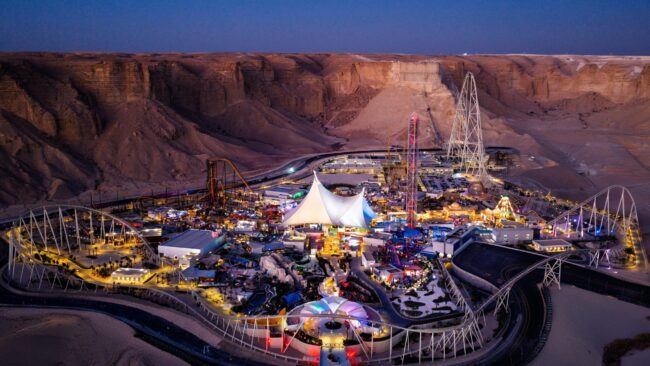
Six Flags Entertainment Corporation (NYSE: FUN) has officially opened Six Flags Qiddiya City in Saudi Arabia, marking its first international theme park developed and built outside North America. The launch brings with it not just a new geography but a strategic inflection point—tapping into Saudi Arabia’s giga-project economy and youth-focused entertainment agenda while potentially redefining Six Flags’ growth trajectory.
The destination, which debuted December 31, 2025, under the Qiddiya Investment Company’s “Power of Play” initiative, is being framed as more than a thrill park—it is the flagship anchor for Qiddiya City, a government-backed mega-development that aims to converge entertainment, sports, and culture 40 minutes outside Riyadh.
Why is Six Flags Qiddiya City a strategic experiment for the company’s future beyond North America?
This opening is not just a milestone for Six Flags Entertainment Corporation; it is a strategic experiment in exporting the Six Flags model to a non-Western, high-growth market with virtually unlimited state support. The project’s location—Qiddiya City—is itself a $10 billion+ Saudi giga-project designed to be a showcase for the Kingdom’s Vision 2030 diversification strategy.
The Kingdom’s heavy investment in entertainment infrastructure gives Six Flags a unique sandbox to test premium pricing, themed lands, and hybrid family-oriented offerings. Notably, ticket prices at Qiddiya are significantly higher than the U.S. average, starting at $85 for adults, suggesting a shift toward a more upscale brand positioning than traditionally associated with Six Flags parks.
By anchoring itself in Qiddiya’s vision of “play as economic engine,” Six Flags is repositioning from a regional U.S. park operator to a global leisure brand integrated into national tourism and economic development plans. The question is whether this model is repeatable in other high-growth geographies or uniquely tailored to Saudi state-backed investment dynamics.
What makes the ride portfolio at Qiddiya uniquely competitive—even by global standards?
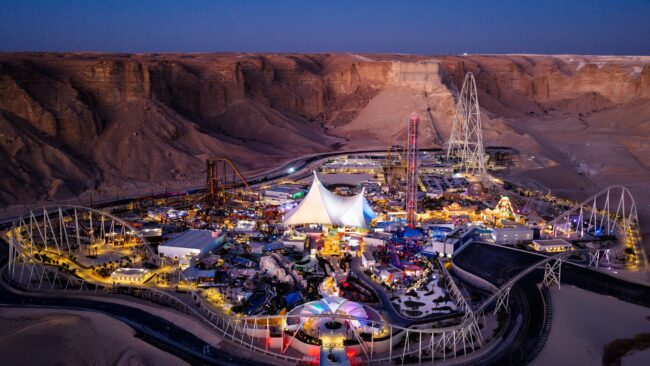
Six Flags Qiddiya City debuts with 28 attractions, including three new global record-breakers: Falcons Flight, which is now the world’s tallest, fastest, and longest roller coaster; Iron Rattler, the tallest tilt coaster; and Spitfire, the tallest inverting coaster. These are not incremental thrill enhancements—they are purpose-built statement pieces meant to assert technological and design leadership.
While Six Flags parks in North America have long touted flagship coasters, Qiddiya’s ride mix appears designed to elevate the brand into the elite tier of global destination parks alongside Universal and Disney, not just regional competitors like Cedar Fair or SeaWorld.
Furthermore, 18 of the 28 rides are geared toward younger audiences and families, signaling that the park is meant to serve as a multi-generational draw rather than simply a thrill-seeker’s paradise. This dual-targeting could be critical for maintaining year-round visitation in a market where demographic diversity and social norms are different from U.S. operating contexts.
How does the Qiddiya City project align with Saudi Arabia’s broader entertainment strategy?
Qiddiya City is not just an entertainment zone—it is a crown jewel in Saudi Arabia’s Vision 2030 blueprint to diversify away from oil, generate non-oil GDP, and stimulate tourism, sports, and cultural participation. As the first fully realized entertainment district under the Qiddiya Investment Company, this launch is a symbolic and functional milestone.
Saudi Arabia’s Public Investment Fund (PIF) has positioned Qiddiya as one of several giga-projects—alongside NEOM, Diriyah, and The Red Sea Project—that are meant to deliver infrastructure-led economic transformation. Six Flags Qiddiya is the first “signature” park to open under this framework, which raises expectations for visitor metrics, employment generation, and global perception impact.
The Kingdom is betting that such projects can drive not only domestic entertainment spending but also inbound tourism. For Six Flags, being embedded within that transformation gives the company geopolitical visibility and potentially more stable long-term cash flows—provided it meets the performance bar.
What are the commercial risks and operational unknowns for Six Flags Entertainment Corporation?
Despite the celebratory tone of the launch, there are non-trivial risks. First, the success of Qiddiya hinges on sustained tourism flows and local visitation, both of which require shifts in social behavior and global travel patterns. Saudi Arabia remains a novel destination for many global tourists, and regional geopolitics remain volatile.
Second, this is Six Flags’ first greenfield park built outside its home region, introducing execution risk in everything from supply chains and staff training to maintenance and cultural experience design. The operational complexity of maintaining the world’s largest and fastest roller coaster in a desert climate also introduces durability and maintenance cost variables not seen in legacy U.S. parks.
Third, monetization models may require recalibration. While pricing appears premium, Six Flags must ensure repeat visitation and local loyalty—not just one-time tourist surges. Whether the company can implement dynamic pricing, loyalty programs, and regional marketing at scale in this market remains to be seen.
Could this become a blueprint for Six Flags’ international growth or a one-off state-aligned outlier?
The long-term question is whether Six Flags Qiddiya City becomes the first of many international deployments or remains a flagship partnership with limited replication potential. Saudi Arabia’s funding structure and willingness to underwrite infrastructure at massive scale is not easily replicated in other markets.
However, the Qiddiya model could serve as proof of concept for partnerships in other state-led developments across Asia or the Middle East. Countries like the United Arab Emirates, India, or even Indonesia may find appeal in licensing the Six Flags brand if Qiddiya achieves sustainable throughput and profitability.
Still, Six Flags has historically been a lean operator with minimal exposure to high CapEx ventures. Scaling this model without similar sovereign underwriting would likely require strategic joint ventures, private capital partners, or even further shifts in the company’s capital allocation philosophy.
What does this signal about Six Flags’ brand repositioning and investor strategy going into 2026?
For institutional investors, this opening may mark a subtle but important shift in Six Flags’ brand arc—from an undervalued U.S. coaster chain to a lifestyle entertainment company exploring global avenues. That said, the stock’s performance will hinge on more than ribbon-cuttings. Investors will want to see clear financial contribution from Qiddiya and any subsequent international projects.
The company’s capital markets narrative in 2026 could benefit from highlighting Qiddiya’s EBITDA trajectory, margin profile, and monetization levers. If Six Flags can demonstrate that premium pricing, state partnership, and themed IP integration drive higher margins than legacy parks, it may unlock new valuation frameworks and expand its institutional shareholder base.
At the same time, the company must guard against over-reliance on one-off international headlines. The U.S. park portfolio still accounts for the lion’s share of cash flow, and investors will continue to scrutinize domestic attendance, season pass renewals, and guest spending per capita.
Key takeaways: What does Six Flags Qiddiya City mean for global theme park strategy and investor outlook?
- Six Flags Entertainment Corporation has opened its first international theme park, Qiddiya City, in Saudi Arabia, signaling a strategic global shift.
- The project is embedded in Saudi Arabia’s Vision 2030 giga-project framework and benefits from significant sovereign infrastructure support.
- Falcons Flight and other record-breaking rides position the park at the top tier of global thrill experiences, not just regional competition.
- The park introduces premium pricing and dual family-thrill targeting, with implications for brand repositioning and monetization strategy.
- Execution risks include climate challenges, tourist behavior shifts, and the operational complexity of maintaining first-of-its-kind rides.
- The Qiddiya model could open doors for expansion across Asia and the Middle East, depending on partner appetite and geopolitical stability.
- Investor sentiment will depend on the park’s performance metrics and whether Qiddiya becomes a high-margin contributor to corporate earnings.
- The company’s ability to scale this model without similar state support remains a key strategic uncertainty heading into 2026.
Discover more from Business-News-Today.com
Subscribe to get the latest posts sent to your email.