How did Saraswati Saree Depot perform in Q1 FY26 and what drove its steady revenue growth despite margin pressures?
Saraswati Saree Depot Limited, a wholesaler-turned-retailer rooted in India’s ethnic fashion trade, reported a steady set of first quarter fiscal 2026 results. Revenue from operations for the April–June 2025 period climbed 11 % year-on-year to Rs 144.77 crore, underscoring the company’s ability to sustain growth in a competitive apparel market. Ebitda excluding other income rose 14.4 % to Rs 8.98 crore, while net profit advanced 4.1 % to Rs 6.35 crore.
Margins, however, reflected accounting pressures. Net margins dipped slightly to 4.39 % from 4.65 % a year earlier due to higher depreciation and lease-related adjustments under Ind AS 116. Even so, the company maintained capital efficiency and cash flow strength, with management highlighting that investments in retail formats and digital platforms remain fully funded through internal accruals.
The results reinforced the perception among investors and industry watchers that Saraswati Saree Depot is balancing modernisation with financial prudence. Analysts described the performance as “steady rather than spectacular,” noting that the business is expanding cautiously rather than chasing scale at any cost.
Why is the launch of Saraswati Saree Depot’s first exclusive retail outlet seen as a strategic shift in its decades-old model?
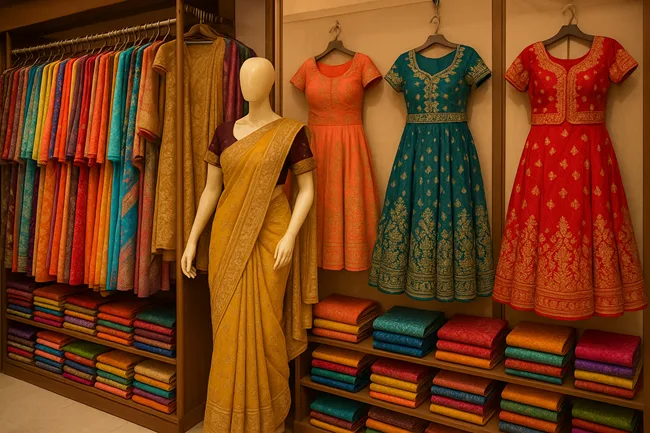
Founded in 1966, Saraswati Saree Depot built its reputation as a wholesale distributor of handloom and power-loom sarees sourced from Maharashtra and Karnataka. For decades, it was a name wholesalers knew well, but consumers seldom encountered directly. That narrative began to change in the June quarter with the opening of its first exclusive retail outlet in Kolhapur, Maharashtra.
The store is positioned not merely as a showroom but as a curated space blending traditional craftsmanship with contemporary fashion sensibilities. Management signalled that the outlet is expected to deliver a return on capital employed of around 20 %, suggesting the venture is intended as a profit-generating business unit rather than a brand-building experiment.
By entering retail selectively, Saraswati Saree Depot is following a broader industry trend where ethnic wear players, from Vedant Fashions’ Manyavar and Mohey to Aditya Birla Fashion’s ethnic portfolio, are strengthening their presence through omnichannel formats. For Saraswati Saree Depot, the Kolhapur store is a litmus test—success here could pave the way for expansion into other tier-II and tier-III cities where consumer appetite for organised ethnic wear remains underserved.
How does the company’s new WhatsApp store and digital strategy reflect India’s apparel industry shift to mobile-first commerce?
Beyond brick-and-mortar, Saraswati Saree Depot rolled out a WhatsApp store during the quarter, allowing wholesalers and retailers to place orders directly via catalogued messaging. In an industry where time-sensitive reorders during festive spikes are crucial, this move streamlines procurement and shortens working capital cycles.
Digital-first engagement has become a defining feature of India’s apparel trade. Industry data suggests that more than 35 % of ethnic wear transactions are now routed through e-commerce or social commerce platforms. For Saraswati Saree Depot, leveraging WhatsApp offers a low-cost, scalable way to integrate digital convenience into a B2B-heavy business model.
The company also piloted a men’s ethnic wear line, marking its first foray beyond women’s apparel. Offering sherwanis, kurtas, and Indo-Western ensembles, the line caters to rising demand among men seeking traditional outfits for weddings and festivals. By cautiously testing the waters ahead of the festive season, management is signalling both diversification intent and risk awareness.
What does Saraswati Saree Depot’s financial breakdown reveal about operating leverage and margin dynamics?
For Q1 FY26, the topline increase to Rs 144.77 crore was attributed to both volume growth and stronger wallet share from existing customers. Ebitda margins improved slightly by 19 basis points to 6.20 %, reflecting cost discipline. However, net margins narrowed due to lease accounting adjustments and higher depreciation charges.
Earnings per share fell to Rs 1.61 compared with the prior year, largely because of the expanded equity base following the company’s late FY25 public listing. Despite this, cash flows remained robust, giving management confidence to fund expansion without resorting to significant borrowings.
Chairman Shankar Dulhani stated in management commentary that new ventures such as the Kolhapur outlet and digital initiatives are designed to generate a targeted ROCE of 20 %, underscoring the company’s commitment to disciplined capital deployment. He further noted that the men’s ethnic wear pilot is being introduced cautiously, with a focus on refining the product mix before scaling.
How have Saraswati Saree Depot’s shares performed post-listing and what is the prevailing investor sentiment?
Saraswati Saree Depot’s shares have experienced sharp swings since their listing. As of August 14, 2025, the stock traded at Rs 94.86, implying a market capitalisation of roughly Rs 368 crore. Shares have touched a 52-week high of Rs 218.80 and a low of Rs 80, highlighting post-IPO volatility.
The trailing twelve-month price-to-earnings ratio of about 10.4 and dividend yield of 4.14 % suggest that the stock is valued conservatively compared to higher-growth consumer discretionary peers. Promoters retain nearly 75 % of ownership, limiting free float. Foreign institutional investors hold just 0.15 %, while domestic institutions have negligible stakes.
This concentrated shareholding structure constrains liquidity but also leaves scope for rerating if institutional participation increases. Market watchers note that the limited analyst coverage makes the stock more attractive to patient, income-oriented investors rather than momentum seekers. The dividend yield provides downside protection, but with modest growth expectations, institutional sentiment broadly leans toward a “hold” outlook.
What are the risks and opportunities for Saraswati Saree Depot in India’s evolving ethnic wear industry?
The ethnic wear segment is valued at more than US $115 billion globally in 2025, with India contributing nearly half of that demand. Analysts project the market could reach US $198 billion by 2033, expanding at a compound annual growth rate of about 7 %.
Opportunities lie in increasing e-commerce penetration, greater consumer acceptance of fusion fashion, and rising demand for sustainable fabrics. Saraswati Saree Depot’s heritage in authentic handloom sarees offers an advantage, but competition is fierce. Pan-India brands like Manyavar, Fabindia, and Aditya Birla Fashion are aggressively building digital ecosystems and branding campaigns.
For Saraswati Saree Depot, cautious expansion is both strength and limitation. It allows the firm to test concepts like men’s wear and WhatsApp ordering without overextending financially, but it also risks losing share to more aggressive peers. Success will depend on maintaining authenticity while scaling selectively, strengthening digital capabilities, and integrating sustainable practices.
What is the outlook for Saraswati Saree Depot’s stock and business strategy heading into the festive season?
Looking ahead, the festive season offers a near-term demand catalyst. If the men’s wear pilot resonates with consumers and WhatsApp ordering gains traction among B2B clients, quarterly revenues could surprise positively. Longer-term, Saraswati Saree Depot’s growth will be determined by its ability to replicate its Kolhapur retail model across other cities while preserving capital efficiency.
From an investor standpoint, the stock’s valuation multiples and dividend yield suggest a hold strategy. Share price appreciation will likely hinge on visible improvement in operating margins and broader institutional participation. The company’s promoter-heavy structure and limited float remain key risks, though any incremental foreign investor buying could lift liquidity and valuation.
Overall, Saraswati Saree Depot is positioning itself as a measured, heritage-driven ethnic wear player modernising gradually. Its cautious yet deliberate foray into retail and men’s wear shows a willingness to adapt without losing sight of its capital-efficient DNA. For investors with a long-term horizon and appetite for volatility, the stock may serve as a structural play on India’s growing ethnic fashion industry.
Discover more from Business-News-Today.com
Subscribe to get the latest posts sent to your email.