

A massive electrical substation fire in downtown San Francisco caused a widespread power outage over the weekend, disrupting transit, communications, and businesses during the holiday rush. While Pacific Gas and Electric Company has restored service to most affected customers, critical repairs are still underway.
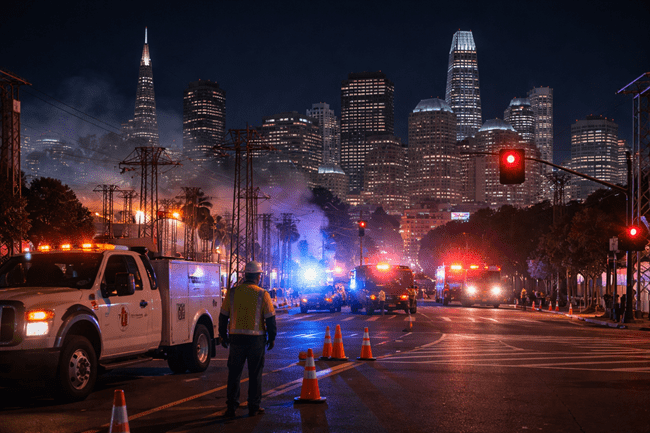
Pacific Gas and Electric Company said Sunday it had restored power to the majority of the 130,000 customers affected by a sweeping blackout that began Saturday after a fire broke out at an electrical substation near Eighth and Mission Streets. The blaze, which damaged key switching infrastructure, led to cascading outages across as much as 30 percent of San Francisco and temporarily knocked out traffic signals, transit services, and even autonomous vehicles.
By late Sunday evening, the number of customers without power had dropped to between 13,000 and 21,000, with full restoration expected by early Monday afternoon. The incident, one of the city’s most disruptive electrical failures in years, has prompted renewed concern about substation safety, outage protocols, and grid resilience as California’s urban infrastructure ages under increasing load.
What caused the San Francisco blackout and how did it spread?
Pacific Gas and Electric Company officials confirmed the source of the outage was a fire that erupted at a downtown substation just after noon on Saturday. The fire, which was quickly extinguished by emergency crews, severely damaged components that route power across key parts of the city. The substation’s failure triggered a loss of service across central and southern neighborhoods, including SoMa, Civic Center, the Mission District, and parts of the Financial District.
Officials said automated protections helped limit further spread of the outage, but the impact was immediate and widespread. Traffic lights across major intersections went dark, public transportation systems including Bay Area Rapid Transit and San Francisco Municipal Railway rerouted trains and buses, and essential services scrambled to activate backup power systems.
While Pacific Gas and Electric Company has not yet released a formal root-cause analysis of the substation failure, early reports indicate that critical transformer equipment was likely involved. Utility crews have remained on-site since Saturday performing diagnostics, replacing damaged components, and running safety inspections before bringing circuits back online.
How the outage disrupted San Francisco’s transportation and business ecosystem
The scale and timing of the outage caused ripple effects beyond residential neighborhoods. BART trains bypassed several downtown San Francisco stations, and multiple Muni bus and tram routes were disrupted. City officials advised residents to avoid non-essential travel and treat intersections as four-way stops due to widespread signal failures.
Waymo, the autonomous vehicle company owned by Alphabet Inc., confirmed that several of its self-driving cars became stuck at intersections where signals had failed. The company paused operations for several hours and issued a public statement noting that safety overrides had functioned as designed.
Local businesses reported significant losses. Restaurants and grocery stores were forced to dispose of perishable goods, while retail shops saw a sharp drop in foot traffic during what would have been a high-sales weekend ahead of Christmas. Some hotels in the affected area temporarily lost heating and elevator service, further complicating hospitality operations.
How Pacific Gas and Electric Company is managing restoration and damage control
Pacific Gas and Electric Company said it mobilized multiple restoration teams immediately following the incident and prioritized power restoration for essential services, hospitals, and vulnerable populations. As of Sunday night, crews had completed the majority of the switching required to reroute power, but infrastructure repairs at the substation itself were still underway.
Company spokespersons emphasized that safety inspections were a critical component of the final restoration phase. Crews needed to verify equipment stability before restoring full voltage, especially in areas directly linked to the damaged substation.
In addition to physical repairs, Pacific Gas and Electric Company also opened temporary support centers for affected residents, offering power banks, charging stations, water, and snacks. The San Francisco Department of Emergency Management coordinated closely with the utility and deployed street-level teams to assist with pedestrian and vehicle traffic management.
What the incident reveals about grid vulnerability and urban resilience
The outage reignited broader concerns about the resilience of San Francisco’s electrical infrastructure. With substation equipment often operating beyond its originally intended lifespan, experts say urban centers like San Francisco are at elevated risk of cascading outages from single-point failures. In particular, fire hazards at substations are becoming more acute in densely populated areas where space constraints limit design options for redundancy and isolation.
Critics of Pacific Gas and Electric Company’s infrastructure investments have pointed out that despite billions in capital expenditure over the past decade, reliability incidents continue to occur with limited public transparency about upgrade timelines. The utility has faced legal and regulatory scrutiny in the past over wildfire-related incidents and remains under pressure to accelerate modernization of its transmission and distribution systems.
California’s Public Utilities Commission is expected to request a detailed incident report and may initiate hearings depending on the findings. The commission has previously asked Pacific Gas and Electric Company to increase investment in fire prevention and rapid fault detection technologies.
Is San Francisco prepared for the next major outage?
Saturday’s blackout serves as a real-world test of San Francisco’s emergency readiness, especially in the face of compounding risks from aging infrastructure, dense urban development, and climate-related stresses. While local authorities received early praise for their rapid coordination, the event also exposed gaps in autonomous mobility management, digital communications continuity, and backup power provisions for both private and public infrastructure.
City Hall remained closed Monday as restoration work continued, affecting municipal services and government operations. Officials are expected to review emergency protocols in the coming weeks and update business continuity frameworks for both public and private sector stakeholders.
The incident also offers lessons for other cities grappling with the integration of next-generation transportation, smart grid technologies, and public safety systems in legacy infrastructure environments.
Will Pacific Gas and Electric Company face legal or regulatory fallout?
While there have been no reported injuries linked to the substation fire or the subsequent outage, the scope of the disruption has already drawn attention from city officials, state regulators, and legal observers. It remains unclear whether the utility will face formal penalties, but the incident may prompt a review of its substation design standards, maintenance schedules, and outage response capabilities.
Consumer rights groups have indicated they may pursue claims for spoiled food, lost business income, and other financial losses suffered during the blackout. Class-action lawsuits are not uncommon in the wake of extended utility disruptions, particularly if investigators identify prior warnings or deferred maintenance as contributing factors.
For now, Pacific Gas and Electric Company’s leadership is focusing on completing restoration efforts, issuing public safety updates, and coordinating with local agencies to mitigate fallout. However, the utility’s broader reputation and regulatory standing could be influenced by how thoroughly and transparently it handles post-incident reporting and customer compensation.
Key takeaways from San Francisco’s PG&E blackout and fire incident
- Power has been restored to most of the 130,000 customers impacted by Saturday’s substation fire, with full restoration expected by Monday.
- The fire at a downtown Pacific Gas and Electric Company substation triggered widespread outages, paralyzing transit, traffic, and autonomous vehicle systems.
- San Francisco’s business districts and key transport networks were heavily affected, highlighting fragilities in urban energy infrastructure.
- The utility deployed multiple teams to handle emergency restoration, while local agencies opened community support centers for residents.
- No injuries were reported, but legal and regulatory scrutiny of Pacific Gas and Electric Company’s infrastructure and emergency response is likely to follow.
Discover more from Business-News-Today.com
Subscribe to get the latest posts sent to your email.