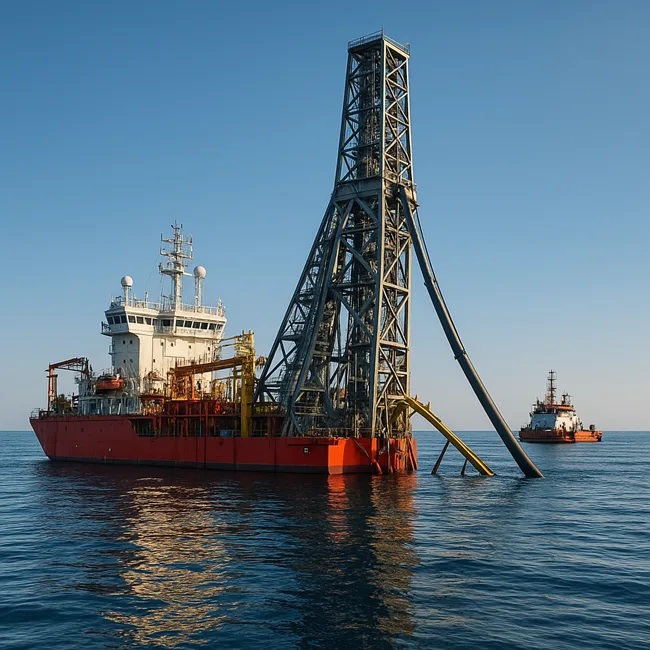
Subsea 7 S.A. (Oslo Børs: SUBC) has landed a major contract valued between USD 750 million and USD 1.25 billion from Turkish Petroleum Offshore Technology Center (TP-OTC) for Phase 3 of the Sakarya gas field development in the Black Sea. The award, announced in late August 2025, tasks the offshore engineering contractor with delivering the subsea umbilicals, risers, and flowlines (SURF) scope that will tie back the next wave of wells into production.
Subsea7 confirmed that engineering and project management have already commenced, to be led from its Istanbul office. For the contractor, which has positioned itself as a trusted execution partner in Türkiye, the deal represents one of its most significant single-country awards outside of the North Sea and Brazil. For Ankara, it is a critical step in turning the Sakarya field into a cornerstone of its domestic energy strategy.
How does the Phase 3 award advance Türkiye’s ambition to scale Sakarya into a fully fledged gas hub?
The Phase 3 scope covers procurement and installation of SURF systems, vital arteries that connect subsea wells to the surface production network. This infrastructure will enable additional gas volumes from new wells to flow into Türkiye’s grid, extending Sakarya’s ramp-up toward its 2026–2028 production plateau.
Subsea7’s Senior Vice President for the Global Projects Centre East, David Bertin, said the award highlights both the contractor’s regional track record and TP-OTC’s confidence in its ability to deliver safely in challenging deepwater conditions. He pointed to the project as not only an engineering achievement but also a contribution to Türkiye’s longer-term energy independence goals.
Subsea7 defines “major contracts” as those valued between USD 750 million and USD 1.25 billion. The Phase 3 deal therefore sits at the upper end of its backlog pipeline, underlining its materiality for investors tracking offshore order intake.
What role does the floating production unit play in expanding Sakarya beyond pipeline-linked development?
This latest award builds on Subsea7’s earlier work in Türkiye. In May 2024, Subsea Integration Alliance — a partnership between OneSubsea and Subsea7 — was awarded a contract extension to handle the installation of the country’s first floating production unit (FPU) under Phase 2a. That project involves installing risers, umbilicals, hook-ups, and mooring systems to integrate the FPU into Sakarya’s subsea network.
Floating production units are critical in deepwater regions lacking mature coastal infrastructure, allowing hydrocarbons to be processed offshore before being exported to shore. Analysts described Türkiye’s adoption of FPU technology as a breakthrough, since it reduces dependency on fixed onshore facilities and accelerates the monetization of new discoveries.
While the FPU contract was smaller in value, classified as “large” at USD 300–500 million, it represented a symbolic first for Türkiye. Combined with the Phase 3 SURF award, the two contracts signal TP-OTC’s intent to maintain momentum and diversify its offshore infrastructure.
Why is the Sakarya field regarded as Türkiye’s most strategic gas discovery in recent history?
The Sakarya gas field, discovered in August 2020 by state-owned Turkish Petroleum (TPAO), represents a turning point in Türkiye’s energy history as the country’s first deepwater gas discovery and its largest-ever hydrocarbon find. Situated approximately 170 kilometers off the coast of Zonguldak in the western Black Sea, the field lies in water depths exceeding 2,000 meters, making it one of the most technically challenging upstream projects ever attempted in the region. Independent assessments place recoverable reserves at more than 710 billion cubic meters, a scale that instantly elevated Türkiye into the ranks of countries with material domestic gas production potential.
At full ramp-up, Sakarya is projected to deliver between 15 and 20 billion cubic meters of gas annually, a volume that could offset around one-third of Türkiye’s current domestic demand. This output profile is especially significant given that the country historically imported more than 99 percent of its gas requirements, primarily from Russia, Iran, and Azerbaijan. By anchoring supply security in the Black Sea, Türkiye hopes to both lower its import bill and gain greater leverage in long-term contract negotiations with external suppliers.
Phase 1 of Sakarya, completed in 2023, consisted of 10 subsea wells connected to shore through a 170-kilometer pipeline—the longest of its kind in the Black Sea. The pipeline ties back to an onshore processing facility in Filyos, where gas is treated before entering the national grid. The government officially inaugurated first gas in April 2023, with President Recep Tayyip Erdoğan hailing it as a “historic milestone” toward energy independence. Industry observers noted that the pace of development—from discovery to production in less than three years—was unusually rapid by global offshore standards, underlining Ankara’s political will to showcase progress.
Subsequent phases have expanded both the scale and sophistication of the development. Phase 2 introduced floating production infrastructure to handle incremental wells, while Phase 3 now incorporates a broader SURF (subsea umbilicals, risers, and flowlines) network, entrusted to Subsea 7 S.A. The layered expansion strategy is designed not only to boost production but also to gradually reduce Türkiye’s reliance on imported technology by embedding local workforce participation and supply chain development.
For Türkiye, however, the Sakarya field is about more than simply substituting Russian gas volumes. Strategically, it is part of a wider ambition to establish the country as a regional gas hub that can balance indigenous production with transit flows from Azerbaijan’s Shah Deniz field, Russian pipeline supplies, and potentially new Eastern Mediterranean resources. By leveraging its geography straddling Europe and Asia, Türkiye aims to position Sakarya as both a symbol of self-reliance and a foundational asset in its campaign to become a linchpin of Eurasian energy flows.
How is investor sentiment shaping around Subsea7’s deepening involvement in the Black Sea?
On the Oslo Børs, Subsea7 stock (SUBC) has benefited from robust order intake throughout 2024 and 2025, supported by rising offshore capital expenditure globally. Institutional sentiment toward the Sakarya awards has been broadly positive, with investors citing backlog visibility, multi-year cash flow potential, and geographical diversification as key benefits.
Analysts highlight execution risk as the main cautionary factor. The Black Sea presents harsh metocean conditions, limited subsea supply chain depth compared with the North Sea, and regional geopolitical sensitivities. Yet Subsea7’s track record in Brazil, West Africa, and Australia is seen as mitigating those risks.
Within Türkiye, the deal is also framed domestically as part of a national industrial strategy. Subsea7 Türkiye’s Managing Director, Hulya Ozgur, emphasized the focus on local content development and workforce integration, aligning with Ankara’s preference for joint ventures that deliver both energy and employment dividends.
What is the future outlook for Sakarya’s phased expansion and Subsea7’s regional role?
Phase 3 is expected to feed into the government’s 2030 energy strategy, which aims to reduce import dependency from 99% of gas demand in 2019 to closer to 70% by the end of the decade. Sakarya will also provide a hedge against price volatility in international LNG markets, which surged after Russia’s invasion of Ukraine.
For Subsea7, continued involvement in Sakarya reinforces its positioning as a strategic partner in Türkiye, with prospects of further contract awards in later phases. Industry observers also note that Subsea7’s embedded presence in Istanbul positions it for future exploration or tie-back campaigns should Türkiye pursue additional Black Sea drilling.
From an investor standpoint, Subsea7’s exposure to large, multi-phase projects in emerging deepwater markets like Türkiye is increasingly attractive as oil and gas companies prioritize long-cycle offshore developments alongside shorter-cycle shale and LNG plays. Analysts expect institutional flows into Subsea7 stock to remain supportive as long as execution milestones are achieved and Sakarya’s production ramp meets government targets.
Discover more from Business-News-Today.com
Subscribe to get the latest posts sent to your email.