



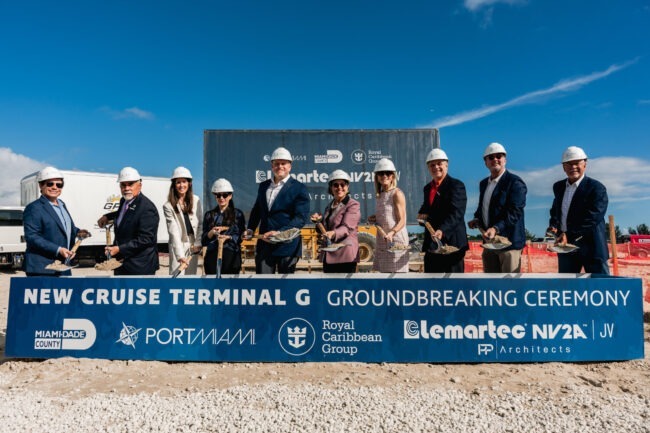
Royal Caribbean Group (NYSE: RCL) has officially broken ground on Cruise Terminal G, a new $345 million facility at PortMiami, in collaboration with Miami-Dade County and construction partners Lemartec-NV2A. Designed to accommodate the company’s largest vessels—including its 7,000-passenger Icon-class ships—the new terminal marks a long-term bet on Miami’s leadership in global cruise traffic and waterfront infrastructure.
Slated for completion in late 2027, the single-berth terminal is positioned to enhance Royal Caribbean Group’s operational footprint at its flagship homeport while supporting scalable passenger growth across its Royal Caribbean, Celebrity Cruises, and Silversea brands. The move comes as the industry reorients around higher-margin fleet composition, port efficiency, and destination experience amid changing travel behavior and climate-aligned port development standards.

Why is Royal Caribbean Group building a dedicated $345M terminal at PortMiami now?
The strategic rationale behind Cruise Terminal G rests on a convergence of capacity needs, urban infrastructure evolution, and brand experience differentiation. With a projected rise in larger vessels and elevated guest expectations, cruise lines are increasingly investing in shore-side infrastructure—not just for volume handling, but to deliver branded, seamless transitions from land to sea.
Royal Caribbean Group’s decision to anchor its long-range growth plans at PortMiami through a custom-built terminal is a clear endorsement of Miami as its strategic operating and embarkation hub. This is particularly relevant as the group continues to bring in newer classes of ships with higher passenger loads, complex logistics, and integrated digital systems that require customized boarding and turnaround infrastructure.
The facility is being designed to meet LEED certification standards, reflecting a broader sustainability push that aligns with investor expectations around ESG accountability in the travel and leisure sector. Integrating energy efficiency, multimodal connectivity, and scalable parking and transport systems, Terminal G also demonstrates a capital allocation strategy that favors high-traffic, high-return locations.
How does Cruise Terminal G reinforce Miami’s position as the global cruise capital?
PortMiami has long branded itself as the “Cruise Capital of the World,” but that title faces increasing competition from ports in the Caribbean, the Mediterranean, and Asia. Terminal G strengthens Miami’s position by reinforcing throughput capacity and modernizing its terminal infrastructure to handle larger, more technologically advanced vessels.
The joint investment structure—funded by Royal Caribbean Group in partnership with Miami-Dade County—signals long-term institutional confidence in Miami’s cruise economy. The port already contributes $61 billion annually to the local economy and supports more than 340,000 jobs. Terminal G is designed to extend that economic engine well into the next decade.
Notably, the architecture and engineering partners involved, including Lemartec-NV2A and Perez & Perez Architects & Planners, are also emphasizing the terminal’s role as a civic landmark. This mirrors a growing trend where ports are not just functional assets, but visual and symbolic extensions of city identity—especially in skyline-visible projects.
What is the significance of terminal design and technology for cruise brand differentiation?
Cruise Terminal G will serve as a branded gateway for all three of Royal Caribbean Group’s core cruise lines. Its design reflects a trend seen in airports and luxury retail: the terminal becomes part of the experience.
With integrated embarkation systems, intermodal transport hubs, and personalized passenger flow optimization, Royal Caribbean Group aims to deliver a “smarter, faster, more seamless experience,” according to Chief Executive Officer Jason Liberty. For guests boarding the Icon of the Seas or Silversea luxury cruises, that experience begins not at sea—but the moment they enter the terminal.
This directly affects loyalty and brand equity in an increasingly commoditized leisure travel space. Companies that can deliver low-friction onboarding, personalized amenities, and intuitive navigation will hold a competitive advantage. A well-designed terminal becomes both a marketing asset and an operational necessity.
How are capital and execution risks being managed in this large-scale port project?
While the $345 million budget underscores Royal Caribbean Group’s capital commitment, it also raises questions about delivery timelines, cost inflation, and regulatory permitting. The terminal is expected to complete in late 2027, giving stakeholders a relatively long construction window to accommodate complexities in zoning, environmental approvals, and port operations continuity.
Lemartec-NV2A, the joint venture leading the build, has emphasized its track record in aviation and seaport development. This could help de-risk the project’s execution phase, but integration with existing port systems and the need to remain operationally adjacent to other terminals will require precise coordination.
Further, as cruise volumes rise and sustainability mandates intensify, there is pressure to future-proof Terminal G against emerging standards in emissions control, digital customs processing, and mobility-as-a-service interconnectivity. How well the project integrates these elements could determine whether it becomes a durable strategic asset or a dated showpiece.
What are the broader implications for Royal Caribbean Group’s balance sheet and investor positioning?
The investment comes at a time when Royal Caribbean Group is managing post-pandemic recovery dynamics and expanding aggressively across both ocean and land-based experiences. Its portfolio includes high-capex assets such as Perfect Day at CocoCay and the Royal Beach Club network, alongside continued investment in new vessels and fuel efficiency retrofits.
Analysts tracking Royal Caribbean Group’s capital expenditure profile will be watching to see whether terminal investments dilute shareholder returns or enhance operating leverage through higher throughput and better brand control. The company’s ability to maintain pricing power while scaling capacity will be key.
Stock sentiment has remained largely constructive following a strong 2025 showing, with investors focusing on forward bookings, per diem yields, and cost discipline. However, as the company increases exposure to physical infrastructure, it becomes more vulnerable to geopolitical risk, extreme weather disruptions, and local permitting challenges—especially in densely regulated U.S. ports.
Could Terminal G set a precedent for public-private port infrastructure elsewhere?
The Cruise Terminal G project reinforces the growing role of public-private partnerships in U.S. port modernization. As climate resilience, supply chain redundancy, and economic development pressures rise, cities and counties are increasingly turning to private operators and tenants to co-invest in infrastructure that serves both commerce and civic identity.
If successfully executed, Terminal G could become a reference case for future cruise and ferry terminal development, particularly in markets like Los Angeles, New York, Singapore, and Barcelona where urban density and waterfront constraints limit traditional expansion.
From a policy lens, it also supports the Trump administration’s emphasis on infrastructure-led economic growth, urban resilience, and climate-aligned development. For Royal Caribbean Group, it offers brand control and boarding efficiency; for Miami-Dade County, it creates jobs, tax revenues, and an architectural landmark.
Key takeaways on what the new Cruise Terminal G means for Royal Caribbean Group and PortMiami
- Royal Caribbean Group is investing $345 million to build Cruise Terminal G at PortMiami, targeting late 2027 completion.
- The terminal is designed to accommodate up to 7,000 passengers and integrate LEED-certified sustainability features.
- PortMiami’s role as the “Cruise Capital of the World” is reinforced through this landmark public-private infrastructure project.
- Royal Caribbean Group aims to use the facility to strengthen brand experience and operational throughput across its cruise lines.
- Capital discipline and project execution will be closely watched by investors amid rising infrastructure exposure.
- Terminal G could serve as a blueprint for future public-private port modernization efforts in urban waterfronts.
- The project aligns with long-term trends in travel infrastructure, ESG compliance, and branded customer journeys.
Discover more from Business-News-Today.com
Subscribe to get the latest posts sent to your email.