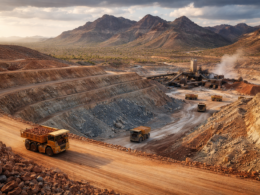
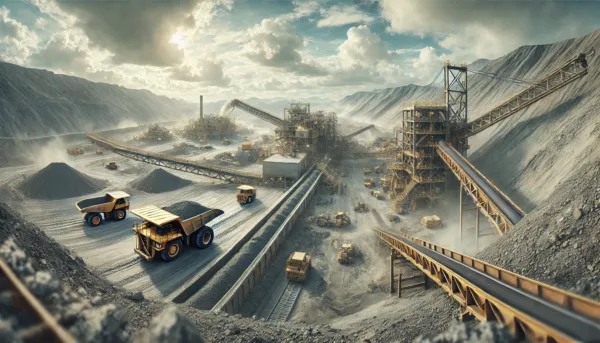
Resolution Minerals Ltd (ASX: RML; OTCQB: RLMLF) is accelerating plans to reestablish a vertically integrated tungsten supply chain in the United States, announcing a strategic update on January 23, 2026 that outlines the advancement of its Horse Heaven Gold-Antimony-Tungsten-Silver Project in Idaho. The company is progressing toward restarting operations at the past-producing Golden Gate Tungsten Mine and acquiring the nearby Johnson Creek processing mill, a move that would consolidate legacy ore stockpiles, on-site infrastructure, and permitted private land under Resolution Minerals’ full control.
This dual-track development initiative not only signals Resolution Minerals’ intent to fast-track critical mineral output in North America but also aligns directly with rising institutional demand for domestically sourced tungsten amid high geopolitical tension, Chinese export restrictions, and mounting supply chain constraints across defense, clean energy, and semiconductor industries.
With due diligence on the Johnson Creek Mill acquisition nearing completion and a new tungsten drilling campaign scheduled for mid-2026, Resolution Minerals is positioning itself as a potential near-term player in the rebirth of strategic mineral production within the continental United States.
Why Resolution Minerals’ tungsten strategy in Idaho could reshape the U.S. critical minerals narrative
Resolution Minerals Ltd is leveraging legacy geological data, historical production assets, and a favorable permitting environment to carve out a differentiated position in the tungsten development space. The company’s Horse Heaven Project spans approximately 59 square kilometers in Valley County, Idaho and lies directly adjacent to Perpetua Resources Corp’s fully permitted Stibnite Gold Project, a five-billion-dollar asset that has long been central to U.S. Department of Defense supply chain discussions.
Unlike greenfield plays still mired in early-stage permitting and infrastructure hurdles, Resolution Minerals is building around a brownfield nucleus. The Golden Gate Tungsten Mine operated intermittently from the 1950s through 1980, with ore processed first at the Stibnite Mill and later at the Johnson Creek Mill. While production records are classified as historical estimates and not yet verified under JORC (2012) compliance, legacy documentation points to more than 1,800 tons of milled ore in the 1950s averaging 1.5 percent tungsten trioxide, followed by another 227 tons processed in 1973 at 2.03 percent grade and 456 tons stockpiled in 1977 at 1.8 percent grade. These figures, while non-compliant, provide a foundation for near-term metallurgical evaluation and resource targeting.
The company has engaged David Hembree, a Certified Professional Geologist with direct operational experience at the Golden Gate Tungsten Mine, to oversee exploration and development activities. Hembree’s previous tenure at the mine in the early 1980s and extensive background across Western U.S. geology is expected to play a central role in mapping out new tungsten targets both along the 3-kilometer Golden Gate Fault corridor and in previously underexplored anomalies to the south.
What the Johnson Creek Mill acquisition reveals about Resolution Minerals’ downstream integration plans
One of the most significant strategic levers in Resolution Minerals’ Idaho asset base is the acquisition of the Johnson Creek Tungsten and Antimony Mill. Located on 15 acres of private land adjacent to the Horse Heaven Project, the site includes approximately 2,000 tonnes of legacy tungsten ore, industrial water rights, and the remains of a custom-built processing facility historically used to treat ore from the Golden Gate mine. The mill sits roughly three miles from the village of Yellow Pine, creating a closed-loop logistical model for future ore processing and refining.
Control of private land is a critical differentiator in a U.S. mining context where federal permitting can often delay infrastructure development for years. By securing freehold property, Resolution Minerals gains flexibility in siting, upgrading, and operating downstream facilities that might otherwise face protracted environmental or zoning reviews. This positioning could allow the company to fast-track development under state-level oversight while retaining optionality for partnerships in smelting, refining, and offtake agreements tied to both military procurement and civilian technology applications.
Company executives have indicated that the Johnson Creek acquisition, once finalized, will provide a strategic base camp for expanded exploration, mining, and metallurgical operations across the broader Horse Heaven lease. The site also enhances the company’s ability to respond to increasing U.S. federal interest in rebuilding domestic supply chains for defense-critical materials, particularly as the United States remains almost entirely dependent on Chinese tungsten imports.
Why tungsten’s shift from industrial metal to national security asset is reshaping capital flows and project priorities
Tungsten is experiencing a strategic reclassification within global commodity markets. Traditionally viewed as a niche industrial metal, tungsten is now widely regarded by defense agencies, aerospace firms, and semiconductor manufacturers as a critical input for future-proofing national supply chains. Its role spans applications in armor plating, artillery, AI semiconductors, lithium-ion batteries, high-temperature alloys, and high-performance electronics.
Ammonium paratungstate prices have surged to approximately 900 U.S. dollars per metric ton unit, the highest in years, driven by tightened Chinese export controls, minimal new mine development outside Asia, and an uptick in long-duration procurement contracts by U.S. and allied defense agencies. These tailwinds have created new valuation frameworks for tungsten development projects that combine operational readiness, infrastructure leverage, and geopolitical relevance.
Resolution Minerals’ asset footprint in Idaho appears well-suited to capitalize on these macro trends. With tungsten drilling expected to begin in June 2026, the company is working through a due diligence program that includes sampling of historical stockpiles, volumetric surveys, density analysis, and metallurgical testing. Completion of this work is expected within three months, and successful results could open the door to early revenue streams through toll treatment or pilot-scale production while full-scale exploration continues.
How Resolution Minerals’ brownfield strategy compares with peer activity in North American tungsten and critical minerals
Across the North American mining landscape, few publicly listed companies are pursuing tungsten with the immediacy and integration focus displayed by Resolution Minerals. Several Canadian and U.S.-based juniors have announced exploration-stage tungsten projects, but most remain years away from processing viability due to either permitting bottlenecks or lack of nearby infrastructure.
In contrast, Resolution Minerals is sequencing its capital deployment around three already de-risked anchors: a known mineralized fault structure, a processing site with historical tungsten flows, and stockpiles of known tungsten ore. This approach allows for a modular scale-up of operations and reduces capital intensity compared to greenfield projects.
From a permitting and development standpoint, the acquisition of private land near an existing exploration site remains a rarity in Western U.S. resource development. This alone gives Resolution Minerals a strategic advantage in mobilizing capital, navigating regulatory reviews, and negotiating offtake discussions. The proximity to Perpetua Resources Corp’s Stibnite Gold Project, which itself has received national attention as a defense-relevant asset, further strengthens Resolution’s visibility with institutional investors and policy stakeholders.
What could derail Resolution’s plan and what success would signal for the U.S. critical minerals market
While Resolution Minerals’ strategy is clearly aligned with macro demand signals and regulatory momentum, execution risks remain nontrivial. The historical estimates at Golden Gate and Johnson Creek are not JORC-compliant and require independent verification before they can underpin resource classification or reserve conversion. Furthermore, the current state of the Johnson Creek Mill is unclear, and substantial refurbishment may be required before any processing can occur at scale.
Environmental permitting, while less stringent on private land, may still raise challenges given the proximity to Boise National Forest. Additionally, while strategic demand for tungsten is rising, the absence of well-developed tungsten offtake markets in the United States means that Resolution may need to invest in market development alongside technical ramp-up.
If successful, however, Resolution Minerals could establish one of the first U.S.-based integrated tungsten operations in decades. This would not only validate its Horse Heaven investment thesis but also set a precedent for how legacy sites with partial infrastructure can be reactivated under a critical minerals strategy. In doing so, the company may influence the design of future funding mechanisms, such as those being considered under the U.S. Department of Energy’s Loan Programs Office or the Defense Production Act Title III allocations.
Key takeaways on what this development means for Resolution Minerals, critical minerals supply chains, and the U.S. tungsten strategy
- Resolution Minerals is moving to restart the Golden Gate Tungsten Mine and acquire the adjacent Johnson Creek Mill to re-establish a U.S.-based tungsten production hub.
- The company’s Horse Heaven project now combines historical stockpiles, permitted mill infrastructure, and exploration upside along a known mineralized fault corridor.
- Former Golden Gate geologist David Hembree is leading site-specific development, lending operational continuity to a legacy site with unexplored zones.
- Due diligence on the Johnson Creek Mill acquisition is nearing completion, with sampling and metallurgical studies targeting stockpile validation within three months.
- Resolution’s strategy aligns with U.S. federal priorities on critical mineral independence, especially in tungsten where China dominates global exports.
- Tungsten prices are at record highs, with strong tailwinds from defense, AI, battery tech, and semiconductor sectors driving 2026 demand forecasts.
- The acquisition of private land offers Resolution a permitting advantage compared to federal lands, streamlining development timelines.
- If the project validates economic-grade resources and scalability, it could position Horse Heaven as a model for rapid reactivation of legacy U.S. mines.
- Execution risks include uncertainty around historical estimates, infrastructure readiness at the mill, and exploration success beyond known targets.
- Resolution is aiming to begin tungsten-specific drilling in June 2026, with short-term milestones centered on metallurgical results and permitting updates.
Discover more from Business-News-Today.com
Subscribe to get the latest posts sent to your email.