




Why is Red Mountain Mining’s share price rallying after releasing its latest antimony and gold exploration results?
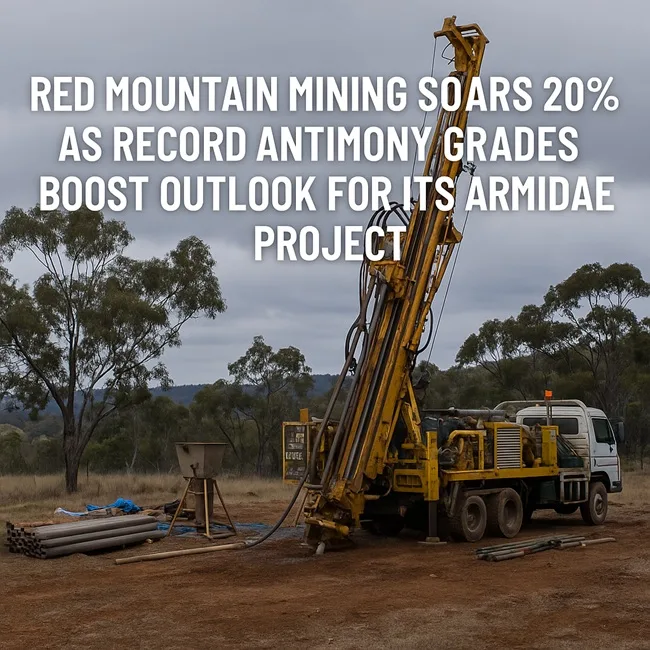
Red Mountain Mining Limited (ASX: RMX) experienced a sharp surge in its share price on October 2, 2025, after the explorer reported its strongest set of exploration results to date at the Oaky Creek prospect within its 100 percent-owned Armidale antimony-gold project in New South Wales. Shares in Red Mountain climbed 20.69 percent to close at AUD 0.035, with trading volumes approaching 40 million shares. That performance not only marked one of the most active days in the company’s recent history but also lifted its one-year return to an eye-catching 337.5 percent.
The rally was driven by confirmation of record-breaking assays. Rock chip samples collected from Oaky Creek South returned values as high as 39.3 percent antimony and 1.09 grams per tonne gold. These figures surpassed earlier sampling rounds and reinforced the potential of the Armidale project to host a significant orogenic antimony-gold system. Investors responded strongly to the announcement, with market capitalization rising to AUD 22.44 million and Red Mountain’s ranking within the basic materials sector improving despite its junior status.
How do the Oaky Creek results strengthen the geological case for a major antimony-gold system in New South Wales?
The Oaky Creek prospect has steadily gained momentum since initial soil sampling revealed anomalous antimony signatures in mid-2025. The latest rock chip program extended mineralisation across a 500-meter strike length at Oaky Creek South, while Oaky Creek North has yielded a further 700 meters of mineralised samples. Combined, the results indicate a potential 1.5-kilometer soil anomaly that has yet to be fully tested.
Geological analysis shows strong correlations between elevated antimony, gold, and arsenic values, a hallmark of orogenic systems within the Southern New England Orogen. These findings reinforce the strategic position of the Armidale project, which lies along the Peel Fault, a structure with recognised world-class potential. The presence of consistently high antimony and supporting gold grades elevates the credibility of Red Mountain’s exploration model and suggests continuity across multiple zones.
For investors, the importance lies in the fact that Oaky Creek’s mineralisation appears consistent with established antimony-gold systems in the region. The assays now confirm grades surpassing earlier rock chip highs of 28.3 percent antimony and 0.54 grams per tonne gold, making the Armidale project one of the more promising new entrants in New South Wales’ critical minerals landscape.
What is the significance of antimony in the global critical minerals supply chain, and why does it matter for investors?
Antimony has emerged as a critical mineral with global strategic importance. It is used in flame retardants, semiconductors, military applications, and energy storage technologies, particularly in advanced battery chemistries. Global production is dominated by China and Russia, leaving Western governments exposed to supply disruptions.
Australia, alongside the United States and the European Union, has officially classified antimony as critical. This policy designation is driving investment flows into exploration companies capable of diversifying future supply. For Red Mountain Mining, confirmation of some of the highest antimony grades recorded at Oaky Creek enhances its appeal to institutional investors seeking exposure to non-Chinese supply chains. Analysts increasingly highlight the potential for Australian juniors to play a role in the reshaping of global critical minerals sourcing.
Investor sentiment also draws on historical precedent. Antimony once played a role in the Australian mining industry during earlier gold rushes, but systematic exploration has been limited compared with other metals. The revival of antimony interest in 2025 therefore places Red Mountain at the intersection of historical underexploration and contemporary strategic demand.
How does Red Mountain Mining’s broader project pipeline position it beyond Armidale?
Red Mountain Mining has deliberately built a diversified exploration portfolio. In addition to the Armidale project in New South Wales, it holds lithium and base metal projects across Utah, Idaho, and Nevada in the United States. The explorer also controls the Fry Lake gold project in Canada. This tri-continental spread allows Red Mountain to remain flexible as commodity cycles evolve, particularly as lithium markets continue to fluctuate and gold retains its role as a defensive asset.
Management has stressed that recent oversubscribed placements give the explorer sufficient funding to continue aggressive exploration across its portfolio. The company has also flagged interest in value-accretive acquisitions in North America, particularly assets aligned with critical minerals policy priorities. This dual strategy of organic exploration and opportunistic acquisition provides investors with exposure to both discovery upside and potential inorganic growth.
How are institutional investors interpreting Red Mountain’s latest exploration update and stock momentum?
Market reaction to the October 2 announcement underscored the speculative but powerful influence of exploration news on small-cap resource stocks. The 20 percent intraday gain was driven by a mix of retail enthusiasm and selective institutional buying. While Red Mountain remains mid-tier in its sector ranking, its 337.5 percent annual return positions it as a standout among junior explorers.
Institutional investors are adopting a cautiously optimistic stance. On the one hand, the results confirm high-grade mineralisation in a strategic jurisdiction, which is precisely the profile sought by funds building exposure to critical minerals. On the other hand, the project remains in its early exploration phase, with no drilling yet undertaken. Analysts are therefore tempering enthusiasm by noting that further sampling and eventual drill results will be needed before valuation assumptions can be upgraded.
The sentiment could be summarised as constructive but provisional. Investors are encouraged by the grades and continuity but remain aware that without defined resources, the current valuation is speculative.
What are the next steps for the Armidale project, and how could they influence Red Mountain’s valuation?
Red Mountain Mining has already outlined the forward work program for the Armidale project. Pending assay results from the current hand auger soil sampling campaign at Oaky Creek South will be critical in confirming the scale of the anomaly. Similar sampling will then be extended to Oaky Creek North, which boasts the 1.5-kilometer long anomaly requiring detailed definition.
At the same time, the explorer has completed initial soil sampling at East Hills, with results expected before the end of October. Additional campaigns are planned at Horsley Station and Horsley North after land access agreements were secured. Further fieldwork will also target stibnite and jarosite anomalies adjacent to known mineralisation across the 391 square kilometer EL9732 license area.
Investors will view these upcoming assays as near-term catalysts. Positive results would not only extend mineralisation but also pave the way for Red Mountain’s first drilling program at Armidale. That step would represent a critical milestone, shifting the company from surface sampling into resource definition territory.
Could Red Mountain Mining attract strategic partners or funding on the back of its antimony discoveries?
Analysts suggest that the high-grade assays improve the company’s chances of attracting strategic interest. Western governments are actively incentivising domestic critical minerals projects, and the ability to demonstrate world-class antimony grades in Australia places Red Mountain in a favorable position.
Although no partnership announcements have been made, the combination of strong exploration results and policy support creates the conditions for potential joint ventures, government-backed funding, or even downstream interest from processing companies. For now, Red Mountain remains dependent on equity markets, but drilling success could alter its funding trajectory significantly.
What should long-term investors consider about Red Mountain’s outlook in 2025 and beyond?
The surge in Red Mountain Mining’s share price following its October 2 exploration update reflects the market’s excitement about high-grade antimony discoveries in a critical jurisdiction. The Armidale project has quickly become one of the more closely watched exploration stories on the ASX, particularly given its proximity to Larvotto’s Hillgrove deposit, Australia’s largest known antimony resource.
For long-term investors, the opportunity lies in the potential scale of Oaky Creek and the broader EL9732 license area. If continuity is confirmed through soil sampling and subsequent drilling, Red Mountain could transition from a speculative explorer into a strategically important critical minerals player.
At the same time, the risks should not be overlooked. The absence of drilling data means valuations remain speculative, and future capital raisings may dilute shareholders. Institutional sentiment therefore remains cautiously optimistic, supportive of the project’s potential but realistic about its early stage.
As Red Mountain continues its exploration push, the combination of geological momentum, critical minerals tailwinds, and strong market performance positions it as a junior miner with outsized potential. Investors will now be watching the next round of assays closely, knowing that confirmation of scale could mark a turning point in the company’s evolution.
Discover more from Business-News-Today.com
Subscribe to get the latest posts sent to your email.


