




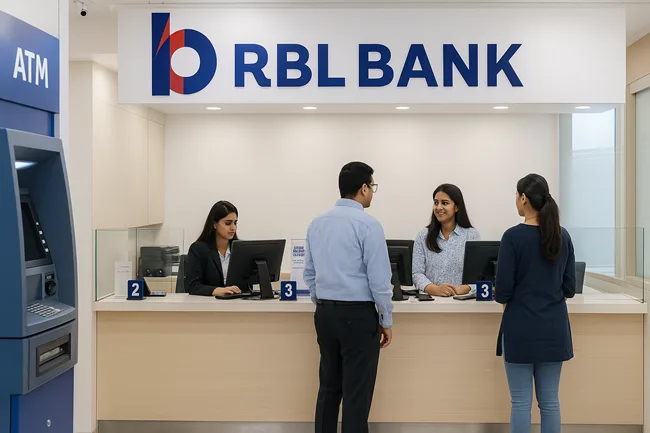
RBL Bank Limited (NSE: RBLBANK; BSE: 540065) closed at ₹260.70 on July 18, 2025, slipping 2.85% after touching an intraday low of ₹260.26, despite a sharp rebound in quarterly profitability. The private sector bank reported a net profit of ₹200 crore for Q1 FY26, a 192% sequential surge but a 46% decline year-on-year due to weaker unsecured lending and margin compression following repo rate cuts. Total market capitalization stood at ₹15,881 crore, with a traded value of ₹405.64 crore and volumes crossing 151.91 lakh shares, signaling heightened investor activity around earnings.
The bank’s results, announced on July 19, 2025, reflected a clear strategic tilt toward secured retail lending and granular deposit mobilization. Analysts have suggested that this liability and asset shift could stabilize RBL Bank’s risk profile, although its net interest margin (NIM) remains under pressure.
How is RBL Bank’s retail deposit growth influencing liability stability, and what does the granular deposit momentum indicate for investor confidence?
RBL Bank’s total deposits rose 11% year-on-year to ₹1,12,734 crore, supported by a similar 11% increase in current account savings account (CASA) deposits to ₹36,614 crore. The CASA ratio stood at 32.5%, marginally lower on a sequential basis due to seasonal outflows, but analysts viewed the ratio as healthy compared to other mid-tier private lenders.
The standout trend was the acceleration in granular deposits—those below ₹3 crore—which expanded 16% year-on-year and 5% sequentially to ₹57,934 crore, now representing 51.4% of the total deposit base. Institutional investors have interpreted this shift as evidence of improved liability granularity, reducing the bank’s dependence on volatile bulk deposits. Such diversification typically helps mitigate liquidity shocks, offering a cushion against short-term rate volatility and enhancing investor confidence in the bank’s liability profile.
Can secured retail and commercial banking growth compensate for declining unsecured lending, and how might this shift affect net interest margins in FY26?
The bank’s net advances grew 9% year-on-year to ₹94,431 crore, with secured retail lending rising 23% and commercial banking advances expanding 32%. The retail book touched ₹56,625 crore, maintaining a retail-to-wholesale mix of 60:40. By contrast, unsecured retail loans declined 10% year-on-year as RBL Bank deliberately reduced exposure to volatile segments such as joint liability group (JLG) microfinance, where slippages had previously pressured asset quality.
This strategic pivot has materially improved asset quality, as evidenced by the drop in net non-performing assets (NNPA) to 0.45% from 0.74% a year earlier. However, the trade-off has been visible in the bank’s NIM, which fell to 4.50% compared to 5.67% in Q1 FY25. Analysts believe the bank could sustain low credit costs under this secured-lending-heavy strategy, but profitability will depend on whether RBL Bank can scale high-yield, low-risk segments such as affordable housing, two-wheeler loans, and vehicle finance. Without such diversification, NIM pressures could persist through FY26.
How sustainable is RBL Bank’s current asset quality trend, and what are institutional expectations regarding provisioning and credit cost management?
Gross non-performing assets (GNPA) stood at 2.78%, marginally higher than 2.69% in Q1 FY25, but NNPA dropped significantly, highlighting better recoveries and write-offs. The provision coverage ratio, including technical write-offs, stood at a robust 94.2%, while total provisions—including specific, general, and contingent buffers—covered 105% of GNPA.
Institutional investors have generally welcomed this conservative provisioning stance, viewing it as a critical buffer against macroeconomic uncertainties. However, some analysts remain cautious about whether the ongoing withdrawal from unsecured lending could dilute yields if retail credit demand remains sluggish. A key watchpoint will be the performance of the JLG portfolio, where management reported that slippages have already moderated to Q1 FY25 levels. If this trend holds, analysts expect credit costs to remain below 1% for FY26.
Can RBL Bank’s capital position and liquidity coverage ratio support retail and commercial expansion without equity dilution in the near term?
The bank reported a capital adequacy ratio of 15.59%, up 3 basis points year-on-year, with a Common Equity Tier 1 (CET 1) ratio of 14.05%. Liquidity coverage remained strong, with the average LCR for the quarter at 152%. Analysts believe these buffers are sufficient to support loan book expansion through FY26 without the need for immediate equity infusion, provided asset quality trends remain stable.
R Subramaniakumar, managing director and chief executive officer of RBL Bank, noted that the bank’s “disciplined execution and profitability-driven growth remain the core engine,” emphasizing that the focus would remain on deepening customer relationships and strengthening secured retail and commercial banking franchises.
What do analysts project for RBL Bank’s stock performance and valuation trends following Q1 FY26 earnings and recent market reaction?
Despite the sequential earnings recovery, RBL Bank’s stock has underperformed post-results, dropping 2.85% to ₹260.70 on July 18, 2025. Daily volatility remained at 2.65%, with a 52-week high of ₹272.88 touched on the same day. Analysts attribute the immediate market reaction to investor caution over margin pressures and a high cost-to-income ratio, which rose to 72.4% in Q1 FY26 compared to 65.7% a year earlier.
The bank’s return on assets (ROA) at 0.56% and return on equity (ROE) at 5.11% also lag behind peers such as Federal Bank and City Union Bank, which maintain double-digit ROEs in the same category. Institutional investors are adopting a selective approach, with some expecting a gradual re-rating if secured lending growth translates into sustainable earnings and cost optimization over the next two to three quarters. Analysts also point out that any improvement in NIMs, combined with continued deposit granularity, could drive valuation rerating closer to 1.2–1.3 times FY26 estimated book value from the current sub-1x levels.
What is the broader outlook for RBL Bank as it balances profitability, asset quality, and expansion plans in FY26?
The medium-term outlook for RBL Bank hinges on its ability to scale secured retail and commercial lending without compromising profitability. Institutional sentiment remains cautiously optimistic, with analysts highlighting three critical drivers: sustained granular deposit growth to manage funding costs, disciplined provisioning to keep credit costs low, and selective growth in high-yield secured segments to protect NIMs.
If these parameters hold, RBL Bank could gradually regain investor confidence and attract institutional flows, particularly from domestic mutual funds focusing on mid-cap banking plays. However, failure to reverse NIM compression or any resurgence in JLG slippages could weigh on earnings momentum, keeping the stock range-bound in the near term.
Discover more from Business-News-Today.com
Subscribe to get the latest posts sent to your email.



