


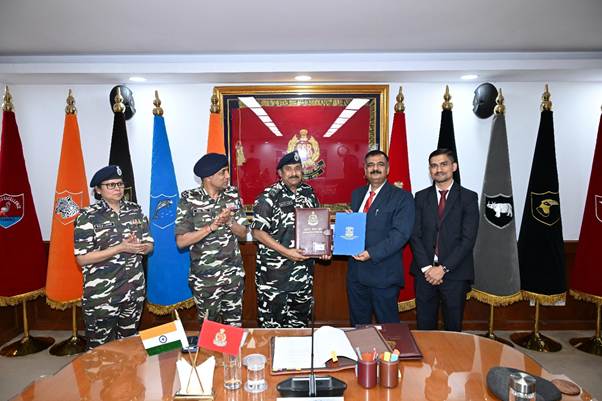
Rashtriya Raksha University (RRU) and the Sashastra Seema Bal Academy (SSB), along with its training establishments, signed a Memorandum of Understanding on 21 March 2026 to formally affiliate and accredit specialised security courses offered by the paramilitary border guarding force. The signing ceremony took place at the Sashastra Seema Bal headquarters in New Delhi and was attended by senior officials from both institutions.
The agreement establishes a structured framework under which Rashtriya Raksha University, designated an Institution of National Importance, will evaluate, affiliate, and provide academic accreditation for a range of training programs conducted at the Sashastra Seema Bal Academy and its associated training establishments. Both institutions have committed to a comprehensive exchange of resources spanning faculty expertise, pedagogical tools, and specialised training facilities.
The formal signing was attended by Prof. (Dr.) Kalpesh H. Wandra, Pro-Vice Chancellor of Rashtriya Raksha University; Mr. Avinash Kharel, Dean of Affiliation and Accreditation at Rashtriya Raksha University; and Shri Sanjay Singhal, Director General of the Sashastra Seema Bal, along with senior officials from both organisations.
What is the purpose of the RRU and SSB Academy MoU signed in New Delhi on 21 March 2026?
The Memorandum of Understanding is designed to bridge the gap between academic research in national security and the operational, on-ground requirements of India’s border guarding forces. The partnership commits Rashtriya Raksha University to evaluate the current curriculum at Sashastra Seema Bal training establishments, determine the equivalence of training hours and content to academic credits, and collaborate with the force on designing additional course content where required to meet credit thresholds for specific degree or diploma pathways.
Prof. (Dr.) Kalpesh H. Wandra noted during the ceremony that the collaboration had already produced results, citing a specialised Smart Border Management course recently conducted by Rashtriya Raksha University for Sashastra Seema Bal officials. The university will extend this practical engagement by providing Sashastra Seema Bal personnel with hands-on training through its laboratories and field-based workshops. This is intended to modernise the training curriculum of the force by focusing on technology-driven solutions for border surveillance and internal security challenges.
Shri Sanjay Singhal, Director General of the Sashastra Seema Bal, affirmed confidence in Rashtriya Raksha University’s capacity to deliver the necessary educational infrastructure for the force. He stated that the partnership would focus on the upskilling and reskilling of personnel to adapt to the evolving demands of border management and internal security operations.
How will Rashtriya Raksha University accredit Sashastra Seema Bal training courses under the agreement?
Under the terms of the Memorandum of Understanding, Rashtriya Raksha University will accredit existing and future courses conducted by the Sashastra Seema Bal. The accreditation may lead to the award of a Certificate, Diploma, Postgraduate Diploma, Advanced Diploma, Bachelor’s Degree, or Master’s Degree, depending on the course assessed and the requirements outlined in the Joint Accreditation and Certification of Courses Guidelines issued by Rashtriya Raksha University.
The implementation framework operates in three stages. In the first stage, Rashtriya Raksha University will assess existing Sashastra Seema Bal courses by evaluating training hours and content against academic credit equivalences. In the second stage, both institutions will collaborate on designing supplementary course content or syllabi to satisfy any additional credit requirements for specific academic pathways. In the third stage, a standardised evaluation and grading mechanism will be introduced for every accredited course to meet the academic standards prescribed under the Rashtriya Raksha University statutes.
To maintain pedagogical integrity over time, the agreement mandates periodic vetting and validation of both existing and additional course content. This requirement is intended to keep the curriculum responsive to evolving security threats and operational contexts. The agreement also provides for the establishment of a dedicated Rashtriya Raksha University desk at the Sashastra Seema Bal Academy to manage data, facilitate communications, and oversee the day-to-day implementation of the accreditation process.
What role does Rashtriya Raksha University play in India’s national security and policing framework?
Rashtriya Raksha University was established under the leadership of Prime Minister Narendra Modi and under the guidance of Union Home Minister Amit Shah. Its primary mandate is to function as a premier academic and research ecosystem for national security and policing in India, utilising a global network of experts to deliver specialised professional education within a disciplined academic framework.
The university’s role in the national security education architecture gives it a formal standing to affiliate and accredit courses offered by paramilitary and border guarding institutions. This function aligns with the broader mandate of the Ministry of Home Affairs to advance an Integrated Training vision that connects theoretical academic research with the practical requirements of frontline security operations.
The Memorandum of Understanding with the Sashastra Seema Bal Academy represents a significant application of this mandate. By aligning the rigorous training undertaken by Sashastra Seema Bal personnel with the National Credit Framework, the agreement ensures that the professional development of officers and personnel receives formal academic recognition at the national level. This provides Sashastra Seema Bal personnel with enhanced career progression opportunities alongside the operational skills they develop through their service.
How does the Sashastra Seema Bal SSB operate as a border guarding force in India?
The Sashastra Seema Bal is one of India’s Central Armed Police Forces operating under the administrative control of the Ministry of Home Affairs. The force is primarily responsible for guarding India’s borders with Nepal and Bhutan and has a long-standing mandate to prevent trans-border crimes, illegal immigration, and smuggling across these frontiers. With a substantial deployed strength across remote and sensitive border terrain, the force’s operational effectiveness depends heavily on sustained and structured professional training.
The evolving nature of border security challenges, including the integration of surveillance technology, drone monitoring, biometric systems, and real-time communication networks into border management operations, has increased the demand for technically upskilled personnel. The Memorandum of Understanding with Rashtriya Raksha University directly responds to this institutional requirement by creating a structured pathway through which Sashastra Seema Bal personnel can acquire both operational competencies and formally recognised academic credentials.
The partnership leverages the talent pool of both institutions to create, in the words of both parties, a robust ecosystem for continuous professional development within the Sashastra Seema Bal. By certifying the training already undertaken by personnel, the collaboration also addresses a long-standing gap between the extensive professional development conducted within paramilitary forces and the absence of formal academic recognition for such training at the national level.
What does the RRU and SSB Academy partnership mean for India’s National Education Policy alignment?
The Memorandum of Understanding has been framed explicitly within the context of India’s National Education Policy and the National Credit Framework. By aligning the professional training of Sashastra Seema Bal personnel with these national academic standards, the agreement represents a policy-level effort to integrate security sector training into the broader higher education recognition architecture of India.
The National Credit Framework provides a mechanism through which learning achieved in diverse institutional contexts, including vocational training, professional development programs, and non-traditional educational settings, can be recognised and accumulated toward formal qualifications. The application of this framework to Sashastra Seema Bal training programs means that personnel who undergo structured courses at the force’s training establishments will now be able to obtain degrees and diplomas that are recognised nationally, rather than credentials that are limited to internal professional use.
The Ministry of Home Affairs has described the initiative as a step toward the professionalisation of India’s security architecture. The agreement represents a formal attempt to align the tactical and operational expertise developed within a frontline border guarding force with the standards of a premier national security university, producing a model that could inform similar partnerships between Rashtriya Raksha University and other Central Armed Police Forces or state police training institutions in the future.
Key takeaways: What the RRU and SSB Academy MoU means for India’s national security training
- Rashtriya Raksha University and the Sashastra Seema Bal Academy signed a Memorandum of Understanding on 21 March 2026 to affiliate and provide academic accreditation for specialised security training programs conducted at the Sashastra Seema Bal’s training establishments.
- The agreement allows Sashastra Seema Bal personnel to earn formal academic qualifications ranging from certificates to Master’s Degrees through the Joint Accreditation and Certification of Courses Guidelines of Rashtriya Raksha University, aligned with the National Credit Framework.
- A dedicated Rashtriya Raksha University desk will be established at the Sashastra Seema Bal Academy to manage data, communications, and the implementation of the accreditation process, ensuring administrative continuity across both institutions.
- The partnership aligns with the Ministry of Home Affairs’ Integrated Training vision and India’s National Education Policy, creating a formal link between professional paramilitary training and the national higher education recognition system.
- The collaboration is expected to focus on technology-driven border surveillance and internal security skills, addressing the upskilling and reskilling requirements of Sashastra Seema Bal personnel in an environment of evolving border management challenges.
Discover more from Business-News-Today.com
Subscribe to get the latest posts sent to your email.