Delpharm has secured another major public investment in its bid to transform its Boucherville site into a North American hub for sterile injectable pharmaceuticals. With the Québec government injecting CAD 60 million in new funding—on top of a CAD 60 million federal commitment made in March and CAD 100 million in private capital—the total modernization package now stands at CAD 220 million, aimed for full execution by 2031.
This expansion project will overhaul nearly 95% of existing equipment and introduce a state-of-the-art sterile filling line, marking what government officials and industry leaders alike see as a strategic response to Canada’s fragile medicine supply chains.
How is Québec’s government support helping position Delpharm as a pharmaceutical sovereignty anchor?
Québec’s Minister of Economy, Innovation and Energy, Christine Fréchette, emphasized that the province’s investment reflects more than just economic development—it is a calculated step to safeguard healthcare resilience in Québec and across Canada. By partnering with Delpharm, she noted, the government is strengthening local control over critical injectable medicines while deepening the province’s role in the global life sciences sector.
Health Minister Christian Dubé echoed that sentiment, highlighting Delpharm’s role as Canada’s largest producer of sterile injectable drugs. The Boucherville facility, in particular, has long supplied hospitals across Canada with life-saving injectables for operating rooms and ICUs. The expansion will ensure that this supply not only remains stable but grows in step with rising demand.
Delpharm’s Site Director Mathieu Grondin credited the Québec government’s support as instrumental in accelerating the modernization effort. He also acknowledged the long-standing partnership with Sandoz, which recently renewed a 10-year contract to manufacture generic hospital medicines locally. Grondin framed the partnership as a “guarantee of stable and reliable access” to essential medicines for both Québec and the wider Canadian healthcare system.
What production capabilities and pharmaceutical volumes will this investment unlock?
Delpharm’s Boucherville site already plays a crucial role in Canada’s hospital infrastructure. According to a commissioned study by Sandoz, the facility manufactures 20 of the 100 most essential medicines used nationwide—many of which are sterile injectables integral to surgeries, ICU treatments, and emergency care.
At present, Delpharm Boucherville produces approximately 65 million units annually and generates revenue of CAD 150 million. Following the modernization, the site is expected to significantly boost output capacity. Company estimates suggest that 3,000 doses are administered to Québec patients every hour—an astonishing metric that reflects the facility’s pivotal role in real-time patient care.
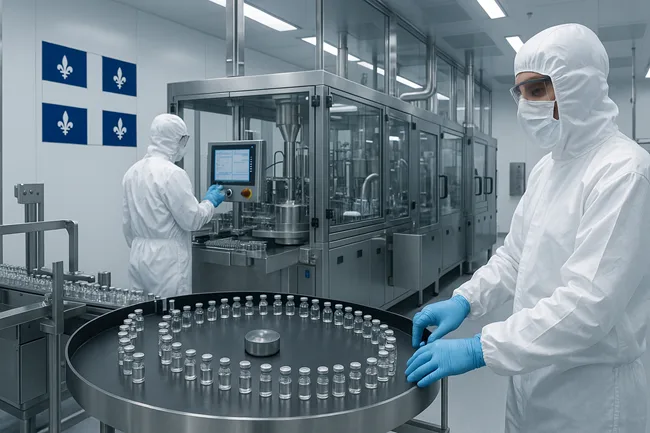
Upgrades under the 2031 roadmap include installing a sterile filling line, expanding the plant footprint, and aligning all equipment with updated Health Canada standards. This will effectively retool the entire plant with next-generation infrastructure.
What economic and employment impact will the Delpharm project have on Québec’s life sciences ecosystem?
Delpharm’s expansion is projected to preserve more than 500 skilled jobs in Québec, with CAD 100 million circulating through the local economy annually via salaries and supplier contracts. Moreover, Delpharm has committed to repay CAD 105 million of the CAD 120 million in total government funding over time, in addition to paying dividends to the Québec government.
This financing model blends public-private partnership principles with cost recovery, setting an example of how industrial policy can be tied to measurable public return on investment.
Québec officials have positioned the project as a catalyst for broader life sciences development, particularly in sterile biologics manufacturing, an area seeing increased global demand. Analysts note that in a post-pandemic world, governments are no longer viewing pharmaceutical supply as a market issue alone—it is now a matter of national resilience and strategic autonomy.
What does the Sandoz–Delpharm partnership mean for Canada’s injectable medicine supply chain?
The 10-year agreement between Delpharm and Sandoz ensures long-term production continuity for high-importance generics, many of which are essential for critical care. These include drugs used in anesthesia, infection control, and electrolyte balance—products that are typically manufactured at scale but have experienced periodic shortages due to supply chain disruptions.
The Delpharm-Sandoz partnership, which predates the current wave of geopolitical and logistics challenges, is seen as a rare success story of domestic pharmaceutical continuity. The Boucherville site acts not just as a production hub but as a firewall against external volatility.
Stéphane Lepeu, Delpharm’s Chief Commercial Officer, described the Boucherville site as the company’s center of sterile and biological expertise in North America. He emphasized that the site’s strategic role is increasingly valuable in a market environment where outsourcing partners with GMP-compliant sterile capacity are in short supply.
What is Delpharm’s broader growth trajectory and how does Boucherville fit into its global strategy?
Delpharm, a global contract development and manufacturing organization (CDMO), operates 19 production sites across France, Canada, Italy, the Netherlands, and Poland. The group employs over 6,500 people and posted global revenue of USD 1.65 billion in 2024.
The Boucherville facility is a cornerstone of Delpharm’s North American expansion, particularly in the sterile injectable segment. Delpharm’s other dosage form capabilities span tablets, ampoules, prefilled syringes, lyophilized drugs, soft gelatin capsules, and topical products—making it one of the few CDMOs with full-spectrum manufacturing for both small- and large-volume parenterals.
Executives see the Boucherville transformation as a long-term strategic asset that enhances Delpharm’s competitiveness for global contracts and bolsters Canada’s biomanufacturing autonomy at a time of intensified global competition for CDMO capacity.
How are institutional investors and analysts viewing Delpharm’s modernization program?
Though privately held, Delpharm’s investment narrative aligns with broader trends in CDMO market sentiment. Institutional stakeholders have consistently signaled strong interest in companies with resilient supply chains, high-mix manufacturing, and domestic government backing.
Delpharm’s ability to secure dual-level government funding is being seen by investors as a proxy for long-term contract visibility and market stability. Moreover, Québec’s dividend-linked participation model adds a fiscal layer that appeals to sovereign wealth, pension, and impact funds focused on healthcare infrastructure.
Analysts tracking the CDMO space also note that sterile injectable capacity has become a high-value segment due to regulatory hurdles, specialized cleanroom requirements, and sustained demand in oncology, ICU, and surgical care. Delpharm’s move to modernize 95% of its sterile operations positions it squarely within this premium niche.
What is the outlook for Canada’s pharma manufacturing strategy and Delpharm’s role in it?
Delpharm’s Boucherville project may well become a blueprint for how governments and global manufacturers can jointly bolster domestic capacity in strategic sectors. The Canadian government’s March 2025 investment—delivered by Innovation Minister Anita Anand—was framed as a national health security measure, underscoring Ottawa’s shift toward proactive pharmaceutical industrial policy.
Minister Anand had emphasized that “a made-in-Canada supply chain” for sterile injectables is now essential for both public health and economic resilience. This view has since been echoed across provinces as hospitals increasingly prioritize local procurement where feasible.
With the federal and provincial governments aligned, and private capital from Delpharm and partners like Sandoz locked in, the Boucherville modernization represents a rare alignment of strategic, fiscal, and industrial incentives.
The roadmap now runs through 2031—but its outcomes may ripple across Canada’s healthcare and life sciences landscape for much longer.
Discover more from Business-News-Today.com
Subscribe to get the latest posts sent to your email.