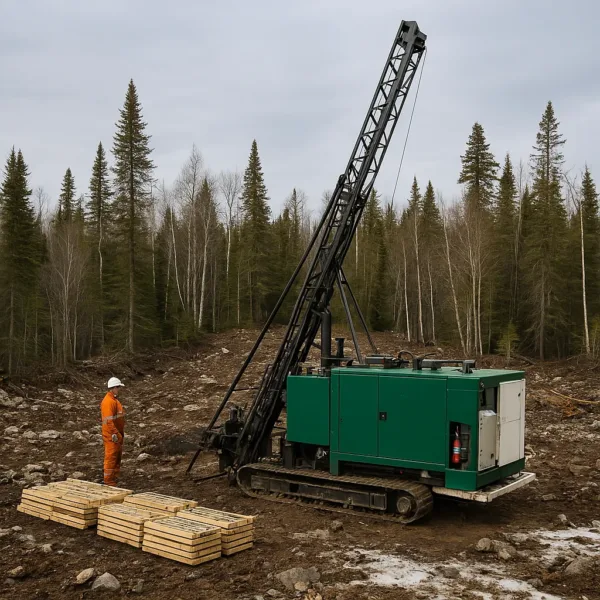



Quantum Graphite Limited (ASX: QGL), the South Australian flake graphite developer behind the Uley 2 project, reported a net loss of A$2.17 million for the six months to 31 December 2025, a 50 percent improvement on the A$4.36 million loss recorded in the prior corresponding period. Revenue from ordinary activities rose 32 percent to A$235,923, driven largely by an accrued research and development tax incentive and a gain on share issuances. The result arrives as the company and its downstream processing partner Sunlands Pure finalise the financing structure for the Southern Eyre Peninsula Graphite Hub, a vertically integrated supply chain spanning mine, processing, and a planned graphite refinery in Oman that, if completed, would represent one of the few end-to-end Western-aligned flake graphite operations in the world. QGL shares were trading near A$0.41 at the time this report was lodged, within a 52-week range of A$0.32 to A$0.50, and are down roughly 14 to 15 percent over the past year, reflecting investor caution ahead of a funding close that has yet to materialise.
How does Quantum Graphite’s half-year loss reduction compare to the strategic progress needed to unlock project funding?
The headline improvement in Quantum Graphite’s financial position is real but needs careful contextualisation. The prior period’s A$4.36 million loss was inflated by A$2.24 million in consultancy fees paid to a director-related entity, Markets Nominees Pty Ltd, for corporate finance services. With that one-off absent from the current period, the like-for-like reduction in underlying operating costs is more modest than the 50 percent headline figure implies. Consultant fees still totalled A$1.16 million in the December 2025 half, down from A$2.71 million, which continues to represent the single largest expense category for a company with minimal revenue. Director salaries of A$120,000, office rent of A$112,200, sundry service fees of A$102,000, and tenement administration charges of A$102,000 are consistent across both periods, reflecting the relatively fixed overhead structure of a company in development rather than production mode.
What matters more to the investment thesis is whether the narrative shift from a simple mine development story to a fully integrated supply chain structure is being backed by funding commitments. The directors’ report acknowledges that the complexity introduced by integrating mining, processing, refining, and logistics into a single fundable structure has created financing challenges that a straightforward project finance arrangement would not face. That is an honest assessment. The resolution of the funding roadmap is described as a pleasing outcome of the period, yet due diligence remains incomplete, and no binding financing commitments have been disclosed. For a company with only A$1.70 million in cash at period end, A$7.53 million in borrowings from a director-related entity, and total liabilities exceeding A$10.2 million, the pace of funding close carries genuine urgency.
What is the Southern Eyre Peninsula Graphite Hub and why does its Oman refinery component matter for Western supply chain resilience?
The Hub concept positions Quantum Graphite not as a standalone mine, but as the upstream anchor of a broader supply chain designed to service Western battery anode and thermal management markets. The mine itself, the Uley 2 project, carries a JORC 2012 resource base and received Major Project Status from the Australian Commonwealth Government in a prior period, acknowledging its national strategic significance. Located south-west of Port Lincoln, the project’s proximity to the Port Lincoln District logistics corridor is presented as an operational advantage over competing large-scale flake graphite developments.
The downstream processing and Hub facility will be developed jointly with Sunlands Pure, with site selection on the Southern Eyre Peninsula finalised and negotiations with landowners and government stakeholders now underway. What distinguishes this structure is the proposed Omani refinery. Sunlands Pure has concluded a Memorandum of Understanding with the Al Buraimi Governorate in Oman covering site acquisition and support arrangements for the development of an integrated graphite purification and packaging facility. The stated initial refinery capacity is more than 100,000 tonnes of purified flake graphite per annum. Al Buraimi is a strategically positioned inland governorate bordering the UAE, offering access to Gulf logistics networks without the port constraints of alternative Omani locations.
The case for a Western-aligned supply chain is well understood in the context of ongoing market disruptions. China has historically accounted for the overwhelming majority of natural flake graphite processing and anode material production globally. Export restriction announcements, geopolitical tensions, and the scramble by battery manufacturers in Japan, South Korea, and the European Union to diversify their critical mineral supply chains have all kept flake graphite supply security on the strategic agenda of downstream manufacturers. Japan and South Korea, both explicitly identified by Quantum Graphite as target markets, have invested significant government resources into critical mineral supply diversification frameworks precisely because of these dependencies. An Omani processing node offering purified product at commercial scale would be genuinely differentiated, assuming it can be built and financed.
What are the execution and funding risks facing the Quantum Graphite-Sunlands Pure integrated supply chain model?
The ambition of the Sunlands Hub model is matched by its complexity, and Quantum Graphite’s own directors are candid about this. Integrating the interdependencies of four discrete operational stages, mining at Uley, processing on the Eyre Peninsula, refining in Oman, and logistics across three geographies, into a single fundable structure has required extensive due diligence and has extended the financing timeline considerably. The directors note that discussions with funding partners are now focused on a workable structure, language that suggests the shape of the deal is coming into view without a close being imminent.
The balance sheet context is worth examining carefully. Borrowings from Pershing Nominees Pty Ltd, a director-related entity that replaced Chimaera Capital Limited as the primary lender during the period, stood at A$7.53 million at December 2025, up from A$5.19 million at June 2025. The facilities are repayable on the earlier of 31 December 2027 or the completion of the company’s next capital raise, which places the effective funding runway at just under two years. The undrawn capacity under the combined Pershing and Chimaera facilities totals A$5 million. That buffer is meaningful but not large relative to the scale of development capital ultimately required to bring Uley 2 into production and construct the Hub infrastructure.
The related-party concentration in both the company’s funding and its service arrangements also warrants attention. Chimaera Capital Limited is both a substantial shareholder and the provider of corporate and asset management services, office rent, tenement administration, IT services, accounting, and corporate administration. A further A$1.70 million of the company’s cash is held with Chimaera Custody Services. SC Capital Pty Ltd, a director-related entity, charged A$150,000 for consultancy services. These arrangements are disclosed transparently, reviewed under AASB 124 related party standards, and common in junior resource companies that rely on closely aligned networks to operate cost-effectively at a development stage. However, they limit the independence of governance structures and warrant scrutiny by any new institutional funding partner conducting due diligence.
Why are the 21-year renewals of Uley mining leases ML5561 and ML5562 significant for the long-term project economics of Uley 2 and Uley 3?
A development-stage resource company’s most foundational asset is tenure security, and the notification of 21-year renewals for ML5561 and ML5562 during the period is a meaningful positive. The renewed titles underpin not only the Uley 2 project currently in the funding and permitting pipeline, but also the Uley 3 mineralisation, which represents the next phase of resource development beyond Uley 2’s current mine plan. A 21-year term provides a project life horizon that is credible for project finance purposes and signals confidence from the South Australian Department for Energy and Mining in the standing of the company’s exploration and development work.
The company also holds a security deposit of A$1.10 million with the Department for Energy and Mining, unchanged across both periods, which represents a cash commitment against rehabilitation obligations. The capitalised development asset balance grew to A$16.20 million from A$15.99 million at June 2025, with the period’s development expenditure of A$212,175 reflecting ongoing Uley 2 project work. Exploration and evaluation assets rose to A$3.53 million as the company continued work on the Uley Region and District Exploration Plans, which the directors note consumed more resources than planned and contributed to the period’s loss exceeding budget. No impairment indicators were identified across either asset category, consistent with the directors’ view that the recoverable amount of the Uley 2 cash-generating unit is not exceeded by its carrying value.
How does Quantum Graphite’s market position compare to other ASX-listed flake graphite developers competing for the same supply chain mandates?
Quantum Graphite operates in an ASX graphite development peer group that has seen sustained pressure over the past two years as Chinese graphite export restrictions disrupted near-term supply assumptions, battery manufacturers prioritised inventory drawdowns over new long-term supply agreements, and project finance for critical minerals outside established production regions remained constrained. Peers including Syrah Resources, which operates the Balama mine in Mozambique and an anode active material processing facility in Louisiana, have faced their own operational and funding challenges. Smaller ASX-listed flake graphite developers have largely struggled to achieve project financing without offtake agreements from major battery cell manufacturers or strategic equity from downstream or government-aligned investors.
Quantum Graphite’s strategic differentiation lies in the combination of the Uley deposit’s scale and grade, its Major Project Status, the integrated supply chain model with Sunlands Pure, and the Omani refinery node that provides geographic positioning outside China and closer to target markets in the Gulf, Europe, and Northeast Asia. Whether that differentiation is sufficient to attract the calibre of funding partner required to advance a vertically integrated supply chain of this complexity at current graphite market prices is the central question the company faces in calendar 2026. The 52-week trading range of A$0.32 to A$0.50 and the roughly 15 percent annual decline in QGL’s share price suggest the market is reserving judgment.
What does Quantum Graphite’s cash flow position and going concern assessment signal about near-term funding requirements and dilution risk?
The going concern note in the financial statements is a standard but important disclosure for investors in development-stage companies. Quantum Graphite generated net cash outflows from operating activities of A$1.53 million in the period, up from A$1.16 million in the prior corresponding period, and invested A$346,822 across exploration and development activities. The financing of operations relied entirely on A$2 million in borrowings, with no equity raised during the period compared with A$1.5 million raised in the prior half.
Directors have concluded there are reasonable grounds to support the going concern basis given the undrawn A$5 million in facilities repayable by December 2027 and the absence of significant operational commitments beyond exploration licence conditions. That assessment is credible within its stated parameters, but investors should note that the facilities are director-related party arrangements rather than arms-length institutional debt, and that the company’s ultimate capital requirement for the Uley 2 mine, the Hub processing facility, and the Omani refinery will be orders of magnitude larger than the current facility pool. The resolution of the Hub’s financing structure is not just an operational milestone: it is an existential one for the current development timeline. Every half-year that passes without a funding close also consumes liquidity and increases the quantum of equity or debt that will ultimately be required.
Director remuneration during the period was settled through the issue of options as quarterly fees, totalling A$60,000 across the four-member board. The issuance of 864,866 shares at A$0.37 for service fees and 1,150,747 shares at approximately A$0.37 for consultancy fees in late December 2025, plus 576,000 shares upon exercise of options for directors’ and company secretary fees, resulted in a total share count of 352,600,000 at period end. The dilution trajectory is gradual but should be monitored against the company’s stated equity capitalisation assumptions when Hub financing documentation eventually becomes public.
Key takeaways on what Quantum Graphite’s half-year results mean for QGL, its peers, and the flake graphite supply chain sector
- QGL’s 50 percent reduction in net loss to A$2.17 million overstates operational improvement; the prior period included a one-off A$2.24 million corporate finance fee to a director-related entity that has not recurred.
- Revenue growth of 32 percent to A$235,923 reflects an accrued R&D tax incentive and share issuance gains, not commercial operations; Quantum Graphite remains pre-revenue from its core graphite business.
- The resolution of the Southern Eyre Peninsula Graphite Hub’s financing roadmap is the period’s most strategically significant outcome, but binding commitments remain absent and due diligence is ongoing.
- Sunlands Pure’s site acquisition and MOU with Oman’s Al Buraimi Governorate for a 100,000-tonne-plus graphite refinery advances the supply chain geography meaningfully and differentiates the Hub from purely Australian-based processing proposals.
- The 21-year renewals of ML5561 and ML5562 extend the project life horizon to encompass both Uley 2 and Uley 3 mineralisation, strengthening the tenure foundation for project finance.
- With A$7.53 million in director-related party borrowings, A$1.70 million in cash held with a related-party custodian, and most service contracts with related entities, governance concentration is a material consideration for prospective institutional funding partners.
- QGL shares are trading near A$0.41, approximately 18 percent below the 52-week high of A$0.50, consistent with market pricing that reflects development risk rather than any near-term production or cash flow catalyst.
- Western markets including Japan, South Korea, and the European Union remain structurally dependent on Chinese graphite processing; QGL’s integrated model targets this gap but requires a funding close in calendar 2026 to remain competitive with peers advancing similar supply chain narratives.
- Quarterly director fees settled in options rather than cash reflect ongoing efforts to conserve liquidity, but the pattern of service and consulting fees paid to director-related entities warrants arm’s-length benchmarking as the Hub financing process engages institutional partners.
- The path to a funded, construction-ready project requires resolution of an unusually complex multi-geography capital structure; success would position QGL as a rare Western-aligned end-to-end flake graphite supplier at a scale relevant to battery and thermal markets.
Discover more from Business-News-Today.com
Subscribe to get the latest posts sent to your email.