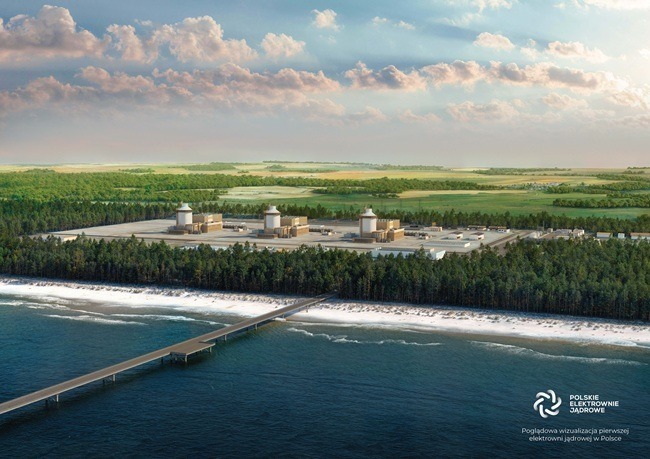
Poland has received formal approval from the European Commission to provide state aid for the construction and operation of its first nuclear power plant—a landmark €42 billion project that marks the country’s most ambitious energy infrastructure investment to date. The approval paves the way for full-scale project financing and reinforces nuclear power as a core pillar of Poland’s future energy mix, aligned with both energy security and decarbonisation goals.
The nuclear power plant, to be built in Lubiatowo-Kopalino on the Baltic coast, will consist of three AP1000 reactors with a total capacity of 3,750 megawatts. Operated by the fully state-owned Polskie Elektrownie Jądrowe sp. z o.o. (PEJ), the plant is expected to enter commercial operation in the second half of the 2030s.
Poland notified Brussels of its state aid plan in September 2024, and the European Commission delivered its approval in under 12 months—nearly twice as fast as previous nuclear project clearances in the EU. Officials in Warsaw described the decision as a validation of both the project’s compliance with EU rules and the effectiveness of the government’s energy strategy.
What did the European Commission approve and how will Poland fund the nuclear project?
The European Commission’s decision authorizes one of the largest state aid packages in EU history for a single project. It includes three key pillars: an equity injection of around 30% of the project’s capital expenditure, 100% state guarantees on all debt financing, and a 40-year two-way Contract for Difference (CfD) to stabilize revenues for the plant once operational.
The CfD model guarantees a strike price for electricity generated by the plant. If market prices fall below that level, the Polish state compensates the operator; if prices exceed the strike price, the operator pays the difference back to the state. According to the Polish Ministry of Energy, the strike price is expected to be below PLN 500 per megawatt hour, with cost reviews and control mechanisms in place to prevent overcompensation.
Notably, the contract duration was revised down from 60 to 40 years during negotiations with the Commission, aligning the support term with the debt repayment schedule and ensuring a market-based return structure. Poland also committed to strong anti-monopoly safeguards, including open market trading of 70% of the plant’s electricity and legal separation of PEJ from other large market players.
How did the European Commission assess Poland’s nuclear aid package?
The Commission launched an in-depth investigation in December 2024 to scrutinize the potential impact of the aid on market competition and its alignment with Article 107(3)(c) of the Treaty on the Functioning of the European Union (TFEU). The clause permits aid for economic development under strict proportionality and necessity conditions.
The probe concluded that Poland’s package meets all legal and economic criteria. Brussels cited the strategic importance of the project for energy transition, noting its contribution to EU decarbonisation goals and regional energy independence.
Poland addressed the Commission’s concerns by refining the CfD formula, anchoring the strike price to actual funding gaps, and introducing a profit-sharing mechanism. Any extraordinary profits earned by PEJ beyond market-based expectations will be returned to the state and potentially redirected to public projects.
What is the role of Westinghouse and Bechtel in the project’s execution?
With regulatory approval secured, the next phase involves finalizing contracts with the American nuclear consortium comprising Westinghouse Electric Company and Bechtel. Westinghouse will supply the AP1000 reactor technology, while Bechtel will lead construction efforts.
Both firms are deeply involved in U.S. and international nuclear deployments and bring critical technology and project management expertise. Their participation also signals strong transatlantic cooperation on energy security and diversification—especially relevant in the context of Europe’s broader energy strategy following the Russia-Ukraine conflict.
How does this fit into Poland’s long-term energy and industrial strategy?
According to Energy Minister Miłosz Motyka, the project is not just an energy milestone but a strategic lever to elevate Poland’s global economic standing. He emphasized that nuclear power would become a foundational component of Poland’s future energy mix, enabling industrial growth and carbon emissions reduction at scale.
Wojciech Wrochna, Secretary of State for Energy Infrastructure, described the approval as a turning point for project execution. With state budget funds now ready for disbursement to PEJ, construction is expected to proceed in line with the pre-approved project timeline.
President of PEJ Marek Woszczyk highlighted that the aid model is both investor-friendly and consumer-protective, incorporating safeguards such as transparent PPA auctions, regulated margins, and forward-looking capacity planning. Up to 30% of the power plant’s generation will be sold through long-term PPAs, while the remaining output will be traded on exchanges to ensure price transparency and market discipline.
What safeguards are in place to avoid market distortions or consumer impact?
To reduce the risk of unfair advantages or price distortions in the electricity market, the European Commission required Poland to ensure at least 70% of annual output is traded on open exchanges—including day-ahead, intraday, and futures markets. The remainder can be sold through non-discriminatory PPAs.
Poland also committed to cost reviews at regular intervals, ensuring the financial model used to determine the strike price remains aligned with actual capital and operating costs. Additionally, the CfD will reward PEJ for capacity availability rather than pure output, reducing the risk of crowding out renewable energy and incentivizing operational flexibility.
Why is the European Commission’s fast-track approval being seen as a precedent?
Poland’s success in obtaining approval in under 12 months is being hailed as a case study in efficient state–EU collaboration. Analysts note that it contrasts with previous nuclear approvals in the bloc, which have often taken several years due to legal complexity and political sensitivity.
The decision is also seen as a bellwether for similar state-backed nuclear projects across Europe. Countries such as the Czech Republic, France, Sweden, Belgium, the Netherlands, and Bulgaria are exploring similar CfD-based frameworks to support their next-generation nuclear infrastructure.
The Commission confirmed that its decision is consistent with new EU electricity market design principles introduced in July 2024 under Regulation 2024/1747, which formalizes the framework for CfD use in strategic energy projects.
What is the projected impact on Poland’s energy landscape and emissions?
The 3,750 MW plant will significantly alter Poland’s generation mix, which is currently dominated by coal. By 2040, the plant is expected to operate with a capacity factor of around 88.5%, providing reliable base-load power and reducing dependence on volatile fossil fuel imports.
Industrial users will benefit from long-term energy contracting options, while emissions from the power sector are projected to fall sharply as nuclear power scales. The Polish government sees the project as essential not only for energy security but also for meeting EU climate goals under the Fit-for-55 framework.
Key takeaways from the Commission’s approval of Poland’s nuclear project
- The European Commission has approved a €42 billion state aid package for Poland’s first nuclear power plant
- The project will use AP1000 reactors supplied by Westinghouse and constructed by Bechtel
- A 40-year Contract for Difference (CfD) will ensure revenue stability while including profit-sharing mechanisms
- State guarantees will cover 100% of the debt and 30% of the project will be equity-funded
- At least 70% of electricity output will be traded on open power exchanges to prevent market distortion
- The plant is expected to reach a capacity factor of 88.5% by 2040 and play a critical role in Poland’s energy transition
- The aid approval process was completed in under 12 months, setting a new speed record for EU nuclear project clearance
- The strike price is projected below PLN 500 per MWh, and revenue excesses will return to the state
- This model could influence other EU member states planning new nuclear facilities
- Contracts with Westinghouse and Bechtel are expected to proceed, moving the project closer to groundbreaking
Discover more from Business-News-Today.com
Subscribe to get the latest posts sent to your email.