




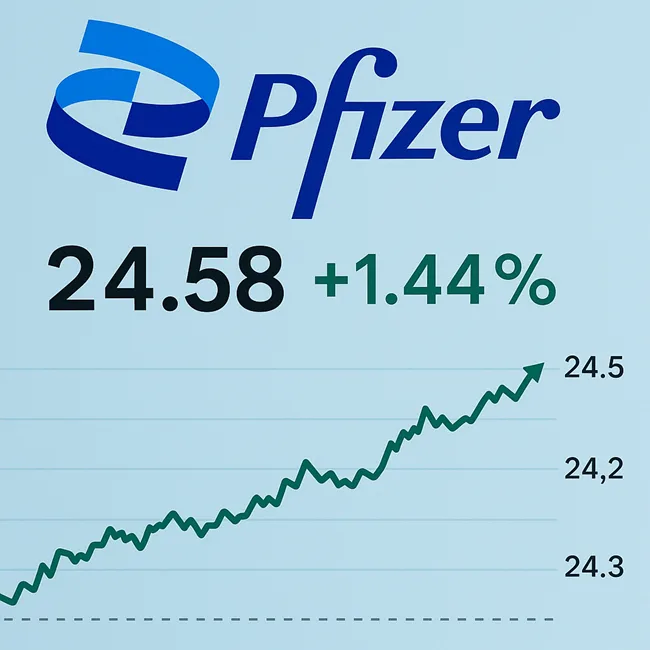
Pfizer Inc. (NYSE: PFE) reported stronger-than-expected financial results for the second quarter of 2025, delivering a clear beat on both earnings and revenue while raising its full-year profit forecast. The American multinational pharmaceutical and biotechnology corporation saw its stock close at USD 24.58 on August 8, up 1.44 percent from the previous session, before adding another 0.24 percent in pre-market trading to reach USD 24.64. While the performance provided a welcome lift to investor sentiment, analysts stressed that long-term structural challenges—particularly patent expirations and pricing pressures—remain unresolved.
How did Pfizer’s Q2 2025 financial performance compare to market expectations and past results?
For the quarter ended June 30, 2025, Pfizer posted adjusted earnings per share of approximately USD 0.78, significantly ahead of consensus estimates of USD 0.58. Revenue came in between USD 14.65 billion and USD 14.7 billion, outpacing the USD 13.56 billion analysts had expected. The earnings beat was largely driven by continued contributions from its COVID-19 vaccine Comirnaty and antiviral treatment Paxlovid, alongside solid growth in other flagship therapies such as Vyndaqel and Padcev. However, performance from migraine drug Nurtec fell short of internal targets, tempering the overall product portfolio momentum.
Compared with the same period in 2024, Pfizer’s results reflected both operational improvements and disciplined cost control. The company has been executing on a multi-year savings program aimed at offsetting declining pandemic-era sales and freeing up resources for its oncology, immunology, and rare disease pipelines.
What strategic changes did Pfizer announce in its updated full-year 2025 guidance?
Following the earnings beat, Pfizer raised its 2025 adjusted EPS guidance to a range of USD 2.90–USD 3.10, up from the earlier USD 2.80–USD 3.00 range. Management reaffirmed its revenue forecast of USD 61–USD 64 billion, indicating confidence in its cost-reduction strategy and stable demand across key brands. The company continues to target cumulative cost savings of USD 7.2–USD 7.7 billion by 2027, supported by supply chain efficiencies, reduced SG&A spending, and portfolio prioritization.
Executives attributed the improved profitability outlook to a combination of favorable tax conditions, streamlined operations, and resilience in non-COVID revenue streams. They also highlighted that the recent integration of acquired assets and partnerships is progressing on schedule, contributing to incremental revenue opportunities in late 2025 and 2026.
How are analysts interpreting Pfizer’s stock movement and valuation after the Q2 update?
Shares of Pfizer have rebounded modestly in recent weeks, but the stock remains down roughly 58 percent from its 2022 highs. Institutional investors noted that the Q2 results, while encouraging, do not yet resolve concerns about the company’s long-term growth trajectory. Analysts pointed out that the current valuation—trading at a price-to-earnings ratio below historical averages—may attract value-oriented investors seeking defensive healthcare exposure. However, they also stressed that sustainable upside will require tangible progress in replenishing the company’s patent-protected product base.
Price target projections among market watchers range from the low USD 24s to the mid-USD 30s, with a consensus clustered around USD 28–USD 29. This suggests potential for mid-single-digit percentage gains over the next 12 months if Pfizer can demonstrate execution on its pipeline and navigate near-term regulatory and market risks.
What long-term challenges could impact Pfizer’s growth and investor confidence despite short-term gains?
Beyond the headline earnings beat, Pfizer continues to face significant strategic headwinds. Several key revenue drivers—most notably blood thinner Eliquis, prostate cancer therapy Xtandi, and breast cancer drug Ibrance—are approaching loss of market exclusivity in major markets. The anticipated entry of generics and biosimilars could materially erode revenue from these products over the next three to five years.
Additionally, ongoing regulatory scrutiny of U.S. drug prices, including policies advanced under the Inflation Reduction Act and other federal initiatives, may compress margins on Medicare-covered drugs. Analysts noted that any shift toward international reference pricing or broader reimbursement reform could further impact the company’s top line.
How is Pfizer positioning its pipeline and R&D investments to address patent expirations and revenue pressures?
Pfizer has been reallocating resources toward high-growth therapeutic areas, with oncology, rare diseases, and immunology at the forefront. Upcoming late-stage trial readouts in breast, prostate, and blood cancers are viewed as pivotal in determining the company’s ability to offset revenue losses from patent cliffs. The drugmaker is also advancing a next-generation RSV vaccine candidate and expanding its gene therapy portfolio through strategic acquisitions and licensing agreements.
Management has indicated that select in-licensing opportunities, particularly in oncology and immunology, will continue to play a role in pipeline expansion. While some of these assets are still in early development, successful trial outcomes could support a revenue inflection point later in the decade.
What role do cost savings and operational discipline play in Pfizer’s medium-term outlook?
Pfizer’s cost-reduction initiatives remain a critical component of its financial strategy. By streamlining manufacturing, optimizing supply chains, and consolidating overlapping operations from recent acquisitions, the company aims to improve operating margins despite flat to modest revenue growth in the near term. The USD 7.2–USD 7.7 billion cost-savings target by 2027 is seen by institutional investors as a realistic, though ambitious, benchmark.
If fully achieved, these efficiencies could help maintain adjusted EPS stability even as top-line growth moderates. However, analysts cautioned that execution risk—particularly in managing integration timelines and preserving product quality—should not be underestimated.
What is the overall sentiment among institutional investors and what developments will they watch next?
Institutional sentiment toward Pfizer is cautiously constructive. The Q2 performance and raised guidance have improved confidence in near-term earnings stability, but many investors remain focused on the longer-term innovation pipeline. Upcoming catalysts include Phase III data from key oncology trials, potential regulatory approvals in rare disease treatments, and any new cost-reduction measures.
Investors will also be watching developments in Washington, D.C., where potential changes to drug pricing policy under the current U.S. administration could alter market dynamics for large pharmaceutical manufacturers. In parallel, international market expansion, particularly in emerging markets, is expected to provide incremental growth opportunities.
What does the future look like for Pfizer’s stock performance in the context of the broader pharmaceutical sector?
Pfizer’s ability to balance immediate cost discipline with sustained innovation investment will likely determine its positioning within the global pharmaceutical sector over the next three to five years. Competitors in the large-cap pharma space are similarly facing patent expirations, but some are perceived as having deeper late-stage pipelines. For Pfizer to reclaim valuation multiples closer to historical levels, analysts suggest it must deliver both consistent earnings and clear evidence of new blockbuster potential.
Given the current macroeconomic environment and healthcare policy landscape, the stock may remain range-bound in the near term. Nonetheless, for dividend-oriented investors, Pfizer’s relatively high yield and defensive sector exposure could provide portfolio stability during periods of broader market volatility.
Discover more from Business-News-Today.com
Subscribe to get the latest posts sent to your email.

