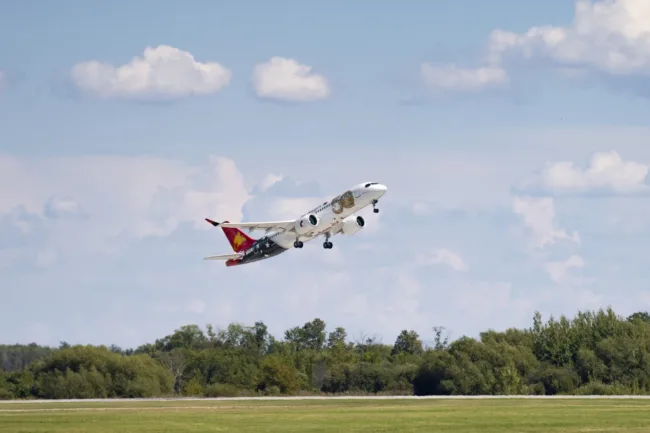
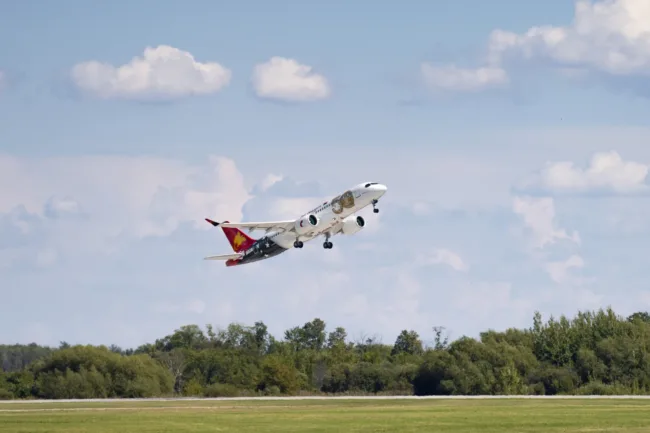
Air Niugini, the national carrier of Papua New Guinea, has officially taken delivery of its first Airbus A220-300 aircraft. The delivery, finalized at Airbus’ Final Assembly Line in Mirabel, Canada, marks the beginning of a sweeping fleet modernization program that has been years in the making. Dubbed “People’s Balus” — a phrase deeply tied to the Tok Pisin word for “airplane” — the aircraft symbolizes both technological progress and cultural heritage.
This particular A220-300 is leased from U.S. lessor Azorra and makes Air Niugini the 25th operator globally to introduce the A220 series into its fleet. The jet departed Mirabel on a ferry flight routed through Vancouver, Honolulu, and Fiji before arriving at its new home base in Port Moresby. The aircraft also carries a special commemorative livery celebrating Papua New Guinea’s 50th year of independence, a design executed by 120 Airbus painters using 11 colors in a precision airbrushing process.
How does this delivery align with Air Niugini’s wider fleet modernization and growth strategy?
The introduction of the Airbus A220 is only the first step in a broader renewal program for Air Niugini. The carrier has eight A220-100s on firm order with Airbus, complemented by three larger A220-300s being leased from Azorra. This dual-variant strategy enables the airline to right-size its operations across both regional and medium-haul routes, positioning itself for operational efficiency while boosting passenger comfort.
The A220-300 that has entered service will accommodate 138 passengers, balancing efficiency and capacity for a carrier that serves diverse markets across Oceania and Southeast Asia. Airbus designed the A220-100 to address the 100–135 seat market, while the A220-300 fits the 120–160 seat segment. For Air Niugini, this split perfectly matches its network requirements, ranging from domestic services across Papua New Guinea’s rugged terrain to international links with Australia, Singapore, and the Pacific Islands.
The airline has signaled its intent to make the A220 the backbone of its regional and international fleet, allowing it to phase out aging Fokker and Boeing aircraft. This transition is expected to lower maintenance costs, reduce fuel consumption, and improve customer service standards — key factors in building competitiveness in a challenging regional market.
What makes the Airbus A220 an attractive choice for smaller national carriers like Air Niugini?
The Airbus A220 has established itself as one of the most compelling aircraft in the small single-aisle category since its launch. Developed originally as the Bombardier CSeries before Airbus acquired majority control in 2018, the aircraft has steadily gained traction among airlines seeking a balance between efficiency and flexibility.
Technically, the A220 integrates 40% advanced materials, including composites and aluminum-lithium alloys, which reduce overall weight. The aircraft’s fuselage is designed with the lowest wetted area in its class, minimizing drag, while its optimized nose and tail cone add further aerodynamic efficiency.
Performance figures reinforce its appeal. With a maximum range of 6,700 kilometers, the A220 offers 25% lower fuel burn compared with older narrowbodies of similar size. Powered by Pratt & Whitney’s geared turbofan (GTF) engines, it also achieves a 25% reduction in carbon emissions per seat and significantly lower noise levels, an increasingly critical metric for regulatory approvals in environmentally sensitive regions.
Air Niugini’s selection of this aircraft reflects a global trend: smaller and mid-sized carriers are gravitating toward fuel-efficient, right-sized jets that can open thinner routes profitably while maintaining comfort standards associated with larger aircraft.
How does the A220 support sustainability goals in the aviation industry?
Sustainability is now central to aircraft procurement decisions, and the Airbus A220 is aligned with this transition. The aircraft is certified to operate with up to 50% sustainable aviation fuel (SAF) today, with Airbus targeting full 100% SAF compatibility by 2030.
For Air Niugini, the adoption of the A220 will cut per-seat emissions dramatically compared with the Fokker F100s and Boeing 737s it is replacing. In a country like Papua New Guinea, where geography makes air travel essential for connectivity, adopting more efficient aircraft is both an environmental and economic imperative.
Globally, Airbus has reported over 940 firm orders for the A220 family from more than 30 airlines, with 440 aircraft already delivered by August 2025. The type is now flying on 1,800 routes to 480 destinations, underscoring its role as a central player in the decarbonization roadmap of airlines across five continents.
How does this delivery connect to wider trends in Asia-Pacific aviation?
The Asia-Pacific region has emerged as one of the most promising growth markets for narrowbody aircraft, driven by rising middle-class demand, regional tourism, and fragmented geographies that necessitate frequent flights between medium-sized cities.
Air Niugini’s modernization mirrors similar strategies across the Pacific. Fiji Airways, Solomon Airlines, and Air Vanuatu have all pursued narrowbody and regional jet upgrades to meet connectivity demands. In Southeast Asia, airlines such as Thai AirAsia and Cebu Pacific are betting on modern, fuel-efficient jets to keep pace with rapidly growing passenger volumes.
The A220’s competitive advantage lies in its ability to open new point-to-point connections, bypassing traditional hubs and enabling smaller carriers to capture demand profitably. For Papua New Guinea, where the rugged interior and island geography present logistical challenges, the range and efficiency of the A220 could transform both domestic and regional air travel economics.
What are the implications for Airbus in the competitive aircraft manufacturing market?
For Airbus, each delivery of the A220 consolidates its position in a fiercely contested segment long dominated by Embraer and Boeing’s now-retired 717. The European manufacturer has steadily increased production rates at its Mirabel and Mobile, Alabama facilities, aligning output with rising demand.
The order book of 940 aircraft may still be smaller than the A320neo family’s 10,000-plus, but the A220 targets a distinct niche. Airlines worldwide are recognizing the cost advantage of operating smaller narrowbodies alongside their larger fleets, especially as oil prices and environmental compliance costs rise.
The successful entry of Air Niugini as the 25th operator further validates Airbus’ strategy to expand into markets traditionally served by regional jets. By demonstrating the A220’s utility in geographies like the Pacific Islands, Airbus strengthens its argument that the aircraft is not only a feeder jet but also a backbone solution for national carriers.
Could this fleet upgrade reshape investor and passenger sentiment toward Air Niugini?
While Air Niugini is not a publicly traded airline, the delivery still carries broader economic and reputational implications. For Papua New Guinea’s government, which owns the airline, the modernization program reflects a commitment to international standards and sustainability goals. Improved operational reliability may also boost foreign investor confidence in the country’s aviation and tourism sectors.
From a passenger perspective, the A220’s spacious 3-2 seating layout, larger windows, and quieter cabin are expected to improve the travel experience significantly. These elements could encourage more regional travel and tourism, especially in anticipation of Papua New Guinea’s 50th independence anniversary celebrations.
How might this milestone influence the future direction of Papua New Guinea’s aviation landscape?
Air Niugini’s first Airbus A220 delivery represents more than a fleet upgrade; it is a statement of intent. The aircraft is set to become the core of its regional and international operations, enabling the airline to cut costs, meet sustainability targets, and provide better service to passengers.
The A220 program itself has faced challenges, including early production delays and questions about scale economics, but the continued expansion of its operator base and steady order intake reinforce its long-term relevance. For Papua New Guinea, its adoption signals a leap forward, embedding modern aviation standards into a national carrier that must serve both commercial and developmental goals.
As Airbus continues to expand its presence in Asia-Pacific and airlines pursue greener, more flexible fleets, the Air Niugini milestone highlights how even smaller carriers in emerging markets are shaping the next chapter of global aviation.
Discover more from Business-News-Today.com
Subscribe to get the latest posts sent to your email.