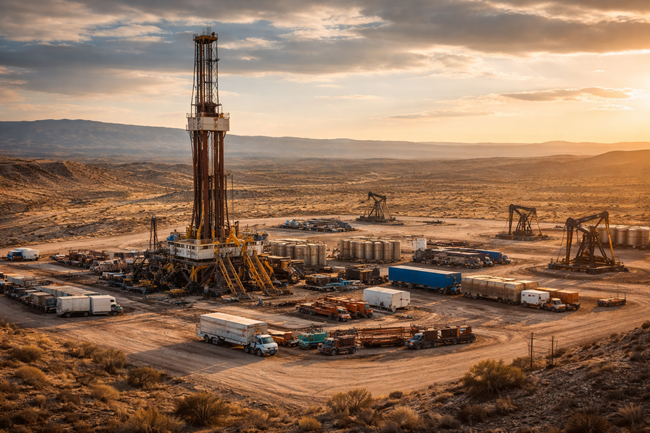
Pampa Energía S.A. (NYSE: PAM) has outlined a $1.1 billion capital expenditure program aimed at accelerating upstream oil development and reaching a production plateau of 28,000 barrels per day by mid-2026 at its Rincón de Aranda block in Argentina’s shale heartland. The announcement signals a decisive tilt toward oil growth within the company’s broader energy portfolio, historically anchored in power generation and natural gas. By concentrating capital into a single scalable asset, Pampa Energía S.A. is attempting to reshape its production mix and potentially its market perception. For investors tracking PAM, the move reframes the company less as a diversified domestic utility player and more as a leveraged participant in Argentina’s unconventional oil expansion.
According to company disclosures, the CapEx plan is tightly linked to the ramp-up trajectory at Rincón de Aranda, with infrastructure and drilling programs aligned to achieve a stable 28,000 barrel per day plateau within roughly 18 months. That target is not symbolic. It represents scale, operational confidence, and an implied belief that the geology and well performance justify concentrated capital deployment.
How does Pampa Energía’s $1.1B CapEx plan reshape its strategic positioning within Argentina’s Vaca Muerta shale basin?
Rincón de Aranda sits within the broader Vaca Muerta formation, one of the most closely watched unconventional basins outside North America. The basin has attracted both domestic champions and international oil majors seeking long-life shale inventory with competitive break-even economics.
By allocating $1.1 billion primarily toward upstream oil expansion, Pampa Energía S.A. is signaling three things simultaneously. First, management believes the block can sustain repeatable well productivity. Second, oil margins currently offer stronger capital returns relative to incremental investments in other segments. Third, scale is necessary to compete for infrastructure access, export optionality, and potentially future midstream leverage.
The 28,000 barrel per day plateau is not transformational on a global scale, but in the Argentine context it meaningfully shifts Pampa Energía S.A.’s production profile. It moves the company toward being a more oil-weighted producer at a time when export pipelines and LNG ambitions are reshaping Argentina’s external energy narrative.
If execution is disciplined, this CapEx program could position Pampa Energía S.A. as a mid-tier unconventional growth operator rather than a diversified energy conglomerate with modest upstream exposure.
Why does the 28,000 barrel per day plateau matter for cash flow, capital discipline, and valuation?
Production plateaus are strategic inflection points. They define not just output but capital intensity. If Pampa Energía S.A. can reach 28,000 barrels per day and sustain it with manageable decline rates, the conversation shifts from growth spending to cash harvesting.
A plateau implies repeatable drilling cadence, predictable well performance, and a transition from heavy development capital toward maintenance capital. That transition is critical. It determines whether the $1.1 billion investment becomes a recurring capital drain or a cash flow engine.
From a valuation standpoint, equity markets typically reward companies that demonstrate visible, scalable production growth tied to disciplined capital allocation. However, the reward only materializes if free cash flow conversion follows.
If oil prices remain supportive and operational execution remains steady, the plateau could expand operating cash flow and reduce balance sheet pressure. If prices weaken or drilling performance underwhelms, the capital intensity could weigh on investor sentiment.
What operational and execution risks could challenge Pampa Energía’s Rincón de Aranda ramp-up?
Shale development is unforgiving when it comes to execution. The difference between a successful plateau and a disappointing one often lies in drilling efficiency, completion design, infrastructure synchronization, and logistics reliability.
Argentina adds an additional layer of complexity. Regulatory frameworks, currency dynamics, and export controls have historically introduced unpredictability for operators. While policy direction has increasingly supported hydrocarbon exports, execution risk remains tied to infrastructure build-out and macroeconomic stability.
Pampa Energía S.A. must also balance capital deployment with balance sheet resilience. A $1.1 billion CapEx program is substantial relative to domestic peers. The company’s ability to self-fund without materially stressing leverage ratios will be closely watched by institutional investors.
Operationally, sustaining a 28,000 barrel per day plateau requires more than just initial well performance. It requires continuous drilling to offset decline curves. If decline rates prove steeper than modeled, sustaining the plateau may demand higher maintenance capital than currently assumed.
How does this move affect competitors and Argentina’s broader energy export ambitions?
Argentina’s energy strategy increasingly hinges on turning Vaca Muerta into a consistent export platform. Incremental oil volumes from operators like Pampa Energía S.A. support pipeline utilization and export terminal economics.
For competitors, the CapEx plan raises the competitive bar. If Pampa Energía S.A. successfully demonstrates that a domestic company can scale an unconventional block efficiently, it strengthens the case for continued domestic capital recycling into shale rather than relying exclusively on foreign majors.
Second-order effects include midstream leverage. Greater oil volumes can support long-term infrastructure commitments. Companies that reach scale first often secure better transport terms and export optionality.
At a national level, incremental oil output strengthens Argentina’s balance of payments profile. That macro dimension may indirectly support regulatory stability if energy exports become increasingly central to fiscal planning.
Does the market reaction align with the strategic weight of the announcement?
For publicly listed companies like Pampa Energía S.A., the equity market response provides a real-time stress test of credibility. Investors will evaluate whether the $1.1 billion commitment signals disciplined growth or aggressive risk-taking.
Short-term price movements should not be over-interpreted. What matters more is whether analysts revise forward production forecasts and cash flow models upward. If the market begins modeling Pampa Energía S.A. as a scaled oil growth story rather than a mixed energy portfolio, the valuation multiple framework may evolve accordingly.
However, markets typically demand evidence. Initial enthusiasm may fade if quarterly production updates do not track toward the mid-2026 plateau target. Execution transparency will be critical.
What happens next if the Rincón de Aranda ramp succeeds or falls short?
If Pampa Energía S.A. successfully reaches and sustains the 28,000 barrel per day plateau, the company gains optionality. It could pursue incremental drilling to lift the plateau further, recycle cash into dividends or debt reduction, or consider strategic partnerships to de-risk future phases. A successful ramp also strengthens negotiating power with infrastructure providers and export partners. Scale creates leverage.
If the ramp falls short, capital allocation discipline will come under scrutiny. Investors may question reservoir assumptions or drilling economics. In that scenario, management credibility becomes central.
The next 12 to 18 months will therefore determine whether this CapEx plan is remembered as a disciplined expansion into shale scale or an over-ambitious capital push.
What are the key takeaways for executives, investors, and energy market watchers assessing Pampa Energía’s $1.1B oil expansion strategy?
- Pampa Energía S.A. is making a clear strategic pivot toward upstream oil scale with a concentrated $1.1 billion investment.
- The 28,000 barrel per day plateau target by mid-2026 serves as a measurable execution benchmark.
- Successful ramp-up could materially improve cash flow visibility and reshape valuation narratives for PAM.
- Execution risk remains significant, particularly around well performance, decline rates, and infrastructure timing.
- Argentina’s regulatory and macroeconomic environment adds an additional layer of uncertainty.
- Achieving scale strengthens export optionality and midstream bargaining power.
- The move positions Pampa Energía S.A. more directly within the competitive dynamics of Vaca Muerta oil development.
- Investors will closely monitor quarterly production updates for alignment with the plateau roadmap.
- If sustained, the plateau could transition the company from heavy growth CapEx to cash flow optimization mode.
- Failure to deliver would likely intensify scrutiny on capital allocation discipline and balance sheet resilience.
Discover more from Business-News-Today.com
Subscribe to get the latest posts sent to your email.