




Why is Pacifico Energy’s GW Ranch project being seen as a breakthrough in off-grid power for hyperscale AI data centers?
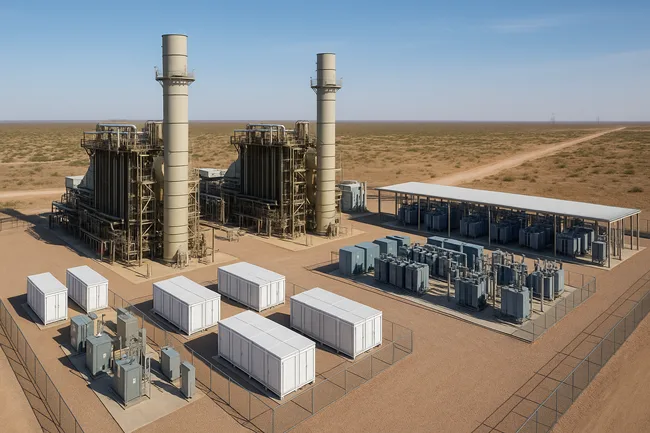
Pacifico Energy has announced one of the largest dedicated off-grid power generation projects in the United States, unveiling plans for GW Ranch, a multi-gigawatt campus in Pecos County, Texas, that will directly power hyperscale data centers and artificial intelligence (AI) infrastructure. The project, which began development in early 2024, will combine advanced natural gas turbines with large-scale battery storage to deliver 5 gigawatts (GW) of reliable capacity by 2030.
Unlike conventional projects that rely on grid interconnection, GW Ranch will operate entirely off-grid, allowing Pacifico Energy to bypass delays associated with grid congestion, permitting, and interconnection bottlenecks. The design promises “five nines” reliability (99.999% uptime), making it a cornerstone solution for data center operators requiring continuous, low-latency power. The site spans over 8,000 acres and will bring the first 1 GW of capacity online in 2028, scaling to full capacity two years later.
Pacifico Energy has filed permits with the Texas Commission on Environmental Quality (TCEQ) and is working with local officials to expedite approvals. Institutional observers noted that the project highlights how private developers are rethinking energy delivery models to meet the surging demand for AI-driven digital infrastructure.
How does GW Ranch address the power and reliability challenges facing AI-driven digital infrastructure today?
The rapid expansion of AI and hyperscale computing has created unprecedented demand for electricity infrastructure. Traditional models tied to regional transmission grids such as ERCOT often face years-long interconnection queues, delaying project deployment. Pacifico Energy’s GW Ranch sidesteps these issues by creating a closed, independent power ecosystem built specifically for mission-critical data centers.
According to Pacifico Energy Vice President Constantyn Gieskes, the project is about more than scale—it is designed for certainty. Every aspect of GW Ranch, from dual natural gas pipelines to modular storage integration, has been planned to remove vulnerabilities associated with grid-based supply. The inclusion of 1.8 GW of advanced energy storage provides resilience against demand fluctuations, ensuring uninterrupted service.
Industry specialists note that this model could become a blueprint for future AI-focused infrastructure, particularly as sovereign AI systems demand localized, auditable power sources. By anchoring directly to natural gas and batteries, GW Ranch creates a predictable, scalable environment that analysts believe may prove attractive to institutional investors and technology firms alike.
What are the economic and employment benefits expected from Pacifico Energy’s GW Ranch project in Pecos County?
Local officials have welcomed the development as a major contributor to West Texas’s economic diversification. Pecos County Economic Development Director Remie Ramos explained that GW Ranch will expand the local tax base while conserving water and limiting strain on existing infrastructure. Thousands of construction jobs are expected to be created during the buildout phase, with long-term employment tied to operations, maintenance, and ancillary services.
Joe Shuster, Judge of Pecos County, also emphasized that the off-grid design would minimize stress on the state’s electricity system while delivering clear benefits to local communities. The region, already a hub for natural gas production, stands to gain from new demand for fuel supply as GW Ranch creates direct offtake channels. Analysts suggest that this could strengthen the resilience of Texas’s energy industry by creating new downstream markets tied to digital infrastructure growth.
How is Pacifico Energy positioning GW Ranch within the broader context of AI innovation and U.S. energy leadership?
The GW Ranch project is being framed as a direct response to America’s race to secure leadership in AI infrastructure. The off-grid campus is explicitly designed to serve hyperscale operators that are building next-generation AI models requiring continuous power at enormous scale. By guaranteeing predictable power delivery, Pacifico Energy positions itself as a strategic enabler of the AI economy.
Institutional investors and industry observers see the model as part of a growing shift where energy development and digital infrastructure converge. Instead of relying on conventional utilities, developers are moving toward vertically integrated, purpose-built energy campuses. Analysts believe this approach could gain traction globally, particularly in jurisdictions where power grid limitations are constraining AI adoption.
Pacifico Energy’s timeline of 1 GW operational by 2028 and 5 GW by 2030 reflects both the urgency of demand and the ability of modular design to scale as needed. This balance between near-term deliverability and long-term scalability is being described as a differentiator in securing partnerships with hyperscale customers.
How does the sustainability design of GW Ranch mitigate environmental and community concerns in West Texas?
Pacifico Energy has emphasized sustainability as a cornerstone of the project. The design requires no external water sourcing, a crucial factor in arid West Texas, thereby avoiding stress on already scarce regional supplies. Advanced emissions control technology and careful site planning aim to minimize noise, air quality, and visual impacts.
By remaining independent from the ERCOT grid, GW Ranch also avoids pushing up consumer electricity costs or destabilizing grid reliability—concerns that often accompany large industrial power users. For local communities, this ensures that the growth of AI infrastructure will not come at the expense of household or business power affordability.
From an institutional perspective, sustainability safeguards help de-risk the project for potential financing and partnerships. The combination of environmental compliance, grid independence, and job creation strengthens the project’s social license to operate, which has become increasingly critical in large-scale energy development.
What is the investor and institutional sentiment around large-scale off-grid projects like GW Ranch?
Market observers suggest that Pacifico Energy’s strategy aligns with growing institutional interest in infrastructure investments that combine technology enablement with energy security. Analysts describe sentiment as cautiously optimistic, noting that off-grid developments can reduce regulatory risk and accelerate returns by bypassing conventional permitting backlogs.
For publicly traded energy firms and infrastructure investors, such projects provide diversification into high-margin digital infrastructure markets. Institutional investors are increasingly considering these projects as part of ESG-compliant strategies, given their ability to combine economic development, renewable integration potential, and AI-focused growth.
Although Pacifico Energy itself is not a publicly listed entity, investor sentiment toward the sector has been shaped by rising valuations of firms engaged in AI infrastructure development. Analysts highlight that capital flows into private equity and infrastructure funds are creating favorable conditions for large-scale financing of projects such as GW Ranch.
What does the GW Ranch project mean for the future of U.S. AI infrastructure and global energy strategy?
The GW Ranch campus represents a broader trend where energy development is being redesigned to serve AI as a core industry vertical. By decoupling from conventional grids, Pacifico Energy is creating a scalable template for AI-ready campuses that could replicate in other regions facing grid congestion.
Observers expect similar models to emerge in states with abundant natural gas or renewable resources, where off-grid approaches can guarantee uptime while minimizing external dependencies. As AI adoption accelerates globally, the U.S. model could shape international standards for infrastructure deployment.
For Texas, GW Ranch strengthens its position as both an energy hub and an emerging digital infrastructure powerhouse. For the United States, it underlines how private energy developers are stepping in to ensure that the growth of AI innovation is not constrained by legacy power systems.
Discover more from Business-News-Today.com
Subscribe to get the latest posts sent to your email.

