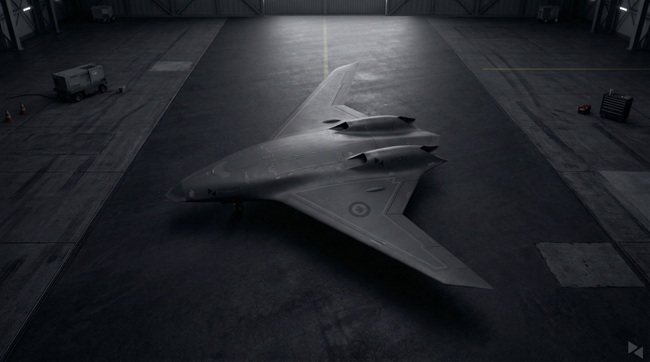
Dominion Dynamics, an Ottawa-based defence technology startup, announced on 5 March 2026 that it will commit an initial $50 million CAD (approximately $36.7 million USD) to develop a sovereign Autonomous Collaborative Platform (ACP), an uncrewed aircraft purpose-built to fly alongside crewed fighters in high-risk combat environments. The investment, which will be drawn from the company’s existing capital base and planned future financing, targets engineering, prototyping, and simulation work over a multi-year programme horizon. The announcement arrives as Canada’s fighter jet procurement remains unresolved, with the federal government committed to 16 Lockheed Martin F-35A Lightning IIs but the broader 88-aircraft fleet still under active political review. Dominion is positioning the ACP not as a replacement for crewed platforms but as the autonomous complement that transforms those jets into a networked, human-machine combat system. For a country that has debated fighter procurement for decades, the company is making a pointed argument: Canada should build the next layer of air power rather than simply buy it.
Why is Canada building an autonomous wingman drone now rather than buying one from the United States or Australia?
The timing of the Dominion announcement is not coincidental. Allied militaries have already moved decisively into the autonomous collaborative platform space. The United States Air Force is developing its Collaborative Combat Aircraft programme, for which Anduril Industries, the defence technology firm where Dominion founder and Chief Executive Officer Eliot Pence previously led the international team, is an active competitor. Australia has invested in Boeing’s MQ-28A Ghost Bat, which completed its first flight in 2021 and has since advanced through test phases designed to validate human-machine teaming doctrine at scale. Canada, by contrast, has no equivalent programme and no funded sovereign development pathway for this class of system.
The geopolitical context adds another layer of urgency. Canada’s defence relationship with the United States has grown considerably more complicated under the Carney government, which has been navigating trade disputes, tariff pressures, and the political sensitivity of being heavily dependent on American platforms for continental defence. Purchasing an ACP from a US supplier would replicate the same dependency that Ottawa is currently trying to manage with the F-35 decision. Building one domestically, as Dominion argues, creates sovereign capability, a domestic supply chain, and optionality that purchased foreign systems cannot provide.
Dominion’s argument is structurally coherent but carries considerable execution risk. The company was founded in June 2025 and has raised a total of $26 million CAD since launching. The $50 million ACP commitment is therefore larger than the company’s total capital raised to date. Pence acknowledged in comments to BetaKit that the investment will come from the company’s capital base and planned financing, with potential for additional partners as the programme matures. That language suggests the funding path is not yet fully secured, and the programme will require further capital raises, government contracts, or industrial partnership agreements to reach a demonstrated prototype.
What is Dominion Dynamics’ Autonomous Collaborative Platform and how does it compare to the US Air Force’s Collaborative Combat Aircraft programme?
An Autonomous Collaborative Platform is an uncrewed aircraft designed to operate as a tactical teammate within a broader manned-unmanned teaming architecture. Unlike traditional remotely piloted systems, which depend on a continuous human control link, ACPs are built to execute mission segments autonomously while remaining subordinate to a crewed commander aircraft. The operational logic is straightforward: send the machine into threat envelopes that no government or commander would risk a pilot in, while retaining human authority over the final use-of-force decision.
The mission sets being explored in allied programmes span persistent surveillance, electronic warfare, suppression of enemy air defences, and strike support. In the context of Arctic operations, where threat distances are vast, infrastructure is minimal, and adversary detection windows are narrow, the value proposition of a low-cost, risked, expendable aircraft is particularly acute. Dominion is building on prior work with its Auranet sensor network, which has already been deployed in the Yukon as part of Operation Nanook field trials. The ACP is designed as the kinetic and sensing extension of that networked architecture.
The US Collaborative Combat Aircraft competition involves some of the most sophisticated autonomous systems developers in North America, including Anduril, General Atomics, and Northrop Grumman. These programmes are funded at a scale orders of magnitude larger than what Dominion has committed. The relevant comparison for Dominion is therefore not whether it can match US capability immediately, but whether it can demonstrate a credible sub-scale prototype within the 24 to 36 months Pence has targeted, attract government and NATO interest on the back of that demonstration, and position the company for follow-on defence contracts as Canada accelerates its $81.8 billion five-year defence spending programme.
How does the $50 million ACP investment fit within Dominion Dynamics’ broader strategy to become Canada’s first sovereign defence prime contractor?
Dominion’s stated ambition is to become a prime defence contractor, meaning an entity that holds primary government contracts and manages a constellation of subcontractors across hardware, software, and systems integration. That is a long-term organisational aspiration that requires far more than a single platform announcement. The company’s current product portfolio consists of Auranet, the sensor and data fabric layer for Arctic monitoring, and the procurement transparency tool AURION, which was announced in February 2026 to help Canadian small and mid-sized defence firms navigate federal contracting. The ACP adds a third pillar: uncrewed combat systems.
The strategic architecture Dominion is constructing maps onto the layered requirements of modern contested-environment operations. Auranet provides the sensing substrate and data fusion layer. AURION helps Dominion and allied firms navigate procurement channels efficiently. The ACP provides the delivery mechanism for lethal and non-lethal effects in denied or high-threat airspace. If successfully integrated, these three elements would position Dominion not as a hardware vendor but as a systems-level architecture provider, which is the category that commands the highest contract values and deepest institutional relationships in defence procurement.
The company’s $21 million CAD seed round, closed in January 2026 and led by Georgian with participation from Bessemer Venture Partners and British Columbia Investment Management Corporation, reflects institutional investor confidence in that thesis. Georgian, a growth-stage investor with a technology and AI focus, framed the investment explicitly in terms of Dominion representing the future of Canada’s deep-tech defence ecosystem. That framing matters because it signals that Dominion’s early backers are underwriting a platform company aspiration rather than a single-product hardware play. The risk, as always with dual-use deep-tech startups, is that the distance between an ambitious architectural vision and fielded, funded, government-certified hardware is measured in years and capital requirements that routinely exceed initial estimates.
What does Canada’s $81.8 billion five-year defence commitment mean for domestic companies like Dominion Dynamics trying to enter the prime contractor market?
Canada’s 2025 federal budget committed $81.8 billion over five years to rebuild, rearm, and reinvest across the Canadian Armed Forces. That envelope is the largest sustained defence spending increase in Canadian history and creates a procurement pipeline that domestic companies have not had access to at this scale in decades. The release of Canada’s Defence Industrial Strategy earlier in 2026 added a policy framework designed to channel a portion of that spending toward domestic capability development, industrial sovereignty, and reducing dependence on single-country suppliers.
For a company like Dominion, that environment is simultaneously opportunity and trap. The opportunity is obvious: a government actively looking for domestic defence suppliers, combined with a growing political aversion to total US platform dependency, creates a window for a Canadian autonomous systems company to enter procurement conversations early and shape requirements rather than respond to fixed tenders. The trap is equally familiar to observers of Canadian defence procurement: the gap between policy intent and contract execution is historically wide, government timelines routinely extend, and the capital requirements for a startup to sustain development and certification through those cycles can exhaust early-stage funding well before a first contract is signed.
Dominion has moved to de-risk the institutional relationship risk by establishing the Autonomous Systems Advisory Council, a body of senior defence, aerospace, and AI leaders that will guide the ACP programme and align it with NATO and Five Eyes requirements. This council structure serves multiple functions beyond technical guidance. It seeds Dominion’s network inside defence institutions, builds familiarity with the programme before formal procurement processes begin, and creates alignment with allied interoperability standards that Canadian government procurement evaluators will assess. Further details on the council’s membership are expected in the coming months.
What execution risks does Dominion Dynamics face in developing a prototype ACP within 24 to 36 months on current funding levels?
The hardest part of the Dominion story is not the concept. The concept is sound, the market context is real, and the team’s pedigree, particularly Pence’s background at Anduril Industries, adds credibility to the claim that the company understands how to build autonomous systems that survive contact with actual defence procurement requirements. The hard part is the math. The company has raised $26 million CAD total. It is committing $50 million to a single programme. The delta must come from future financing, government grants, or strategic partnerships that have not yet been announced.
Aerospace prototyping is notoriously capital-intensive. The sub-scale prototype target Pence cited, which leverages simulation engines, materials testing, and existing data sets, is a deliberate choice to compress development cost in the early phase. Software-first development, where simulation environments validate autonomy algorithms and sensor fusion architectures before hardware is fabricated, is consistent with how next-generation defence technology companies including Anduril and Shield AI have approached comparable programmes. It is also a methodology that Dominion’s seed investors from the technology sector are likely to understand and fund through early milestones.
The bigger execution challenge is certification and integration. A sub-scale prototype that flies in a demonstration environment is not a fielded military system. Moving from prototype to a system that Canadian Forces or allied militaries can actually operate in contested airspace requires airworthiness certification, secure communications architecture validated against NATO standards, and integration with the command and control systems of crewed fifth-generation platforms. Each of those steps adds years and capital. The 24 to 36 month sub-scale prototype target is realistic as a milestone. The distance from that milestone to a fielded, government-funded operational platform is where most programmes of this type face their most serious attrition.
Key takeaways: what the Dominion Dynamics ACP announcement means for Canadian defence, autonomous systems investment, and allied air power strategy
- Dominion Dynamics is the first Canadian company to publicly commit development capital to a sovereign ACP programme, filling a capability gap that allied militaries including Australia and the United States have already begun to close with funded, fielded programmes.
- The $50 million commitment exceeds the company’s total capital raised to date ($26 million CAD), which means the funding path remains partially dependent on future financing, government grants, or strategic partners that have not yet been announced.
- The sub-scale prototype target of 24 to 36 months, achieved through simulation-led development, is credible as a near-term milestone but represents only the first step toward a fielded military system requiring airworthiness certification and NATO-standard integration.
- Pence’s background leading Anduril Industries’ international team gives Dominion direct insight into how allied governments evaluate autonomous systems procurement, and how to align development programmes with the institutional requirements that determine contract outcomes.
- Canada’s $81.8 billion five-year defence commitment and the new Defence Industrial Strategy create a procurement environment that actively incentivises domestic capability development, reducing the historical barrier for a startup to enter serious government contracting conversations.
- The Autonomous Systems Advisory Council is as much a relationship-building instrument as a technical guidance body, designed to seed Dominion’s credibility inside defence institutions before formal procurement evaluations begin.
- The ACP announcement is the third major product pillar Dominion has introduced alongside Auranet and AURION, suggesting the company is assembling a systems-level architecture rather than building a single-platform vendor, which is the structural requirement for a prime contractor aspiration.
- Allied ACP programmes are moving rapidly; the US CCA competition involves Anduril, General Atomics, and Northrop Grumman at Pentagon-scale funding. Dominion’s credible path forward likely involves becoming an interoperable Canadian node in allied architectures rather than a direct competitor to those programmes.
- Canada’s unresolved F-35 fleet decision, with 16 aircraft confirmed but the remaining 72 still under political review amid US-Canada trade tensions, creates precisely the environment in which a domestic autonomous systems alternative gains institutional appeal as a sovereignty-compatible complement to whatever crewed platform Ottawa ultimately selects.
- Investor composition matters: Bessemer Venture Partners and British Columbia Investment Management Corporation alongside Georgian signals that Dominion’s backers include both growth-technology capital and institutional infrastructure investors, a combination consistent with a long-duration defence technology play rather than a near-term exit strategy.
Discover more from Business-News-Today.com
Subscribe to get the latest posts sent to your email.