




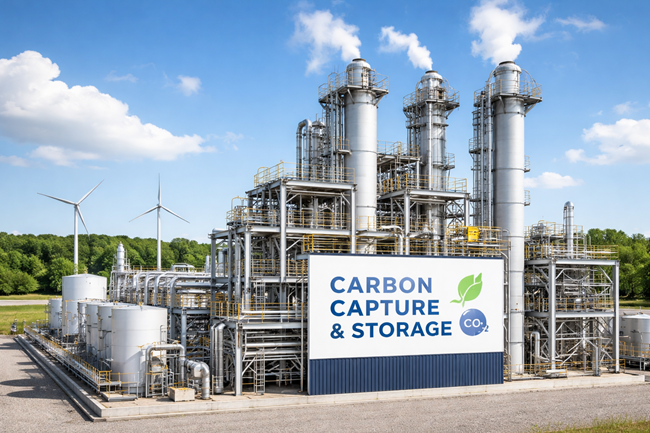
The Ørsted Kalundborg Hub is Denmark’s first large-scale, full-chain carbon capture and storage (CCS) project, positioned as a cornerstone of the nation’s climate infrastructure strategy. Located across two biomass-fired combined heat and power (CHP) plants—Asnæs Power Station in Kalundborg and Avedøre Power Station near Copenhagen—the project is designed to capture and permanently store 430,000 tonnes of biogenic CO₂ per year from sustainable straw and wood chip combustion. The initiative is spearheaded by Ørsted and backed by a 20-year carbon removal contract from the Danish Energy Agency, awarded through Denmark’s inaugural CCS subsidy tender in 2023.
As a climate mitigation solution, the Kalundborg Hub enables industrial-scale negative emissions, an increasingly essential component of the European Union’s decarbonization agenda. By targeting biomass emissions, the project validates the climate value of bioenergy with carbon capture and storage (BECCS), enabling Denmark to exceed its 2030 CO₂ reduction targets while establishing new carbon infrastructure and export corridors. It also exemplifies a growing convergence of energy, infrastructure, and environmental goals through public–private capital alignment.
Who operates Ørsted Kalundborg Hub and how is it structured?
The Kalundborg Hub is fully developed and operated by Ørsted, Denmark’s largest energy utility and one of Europe’s most advanced renewable energy firms. The project was secured via a competitive government tender issued by the Danish Energy Agency in early 2023, which selected Ørsted’s bid to capture and store biogenic CO₂ from its CHP fleet under a 20-year public subsidy arrangement. The contract became effective in June 2023 and remains one of the longest-duration CCS agreements awarded in Europe.
Two key infrastructure partners support Ørsted’s execution model. Aker Carbon Capture was selected as technology provider and systems integrator, delivering modular Just Catch units and liquefaction systems across both sites. On the logistics and storage side, Ørsted signed a cross-border CO₂ Transport and Services Agreement (TSA) with Northern Lights Joint Venture—a partnership between Equinor, Shell, and TotalEnergies—which will manage maritime shipping and offshore injection of captured CO₂.
The project is also monetized through private sector offtake agreements. In 2021, Ørsted, Aker Carbon Capture, and Microsoft signed an MoU to explore large-scale carbon removal at Danish biomass plants. That arrangement matured in 2024 into a binding agreement for Microsoft to purchase 2.76 million tonnes of durable carbon removal over 11 years from the Asnæs facility, making it one of the world’s largest carbon removal purchases by volume.
What is the capacity of Ørsted Kalundborg Hub and how has it evolved?
The Ørsted Kalundborg Hub is designed with a steady-state annual capture capacity of 430,000 tonnes of CO₂, starting in 2026. Of that, 280,000 tonnes will be captured from the wood chip-fired Asnæs Power Station and 150,000 tonnes from the straw-fired unit at Avedøre Power Station. Both facilities already operate as base-load CHP plants supplying electricity, district heat, and industrial steam to local grids and industrial clusters, making them well-suited for integrated CCS retrofits.
Each site will host modular capture units based on Aker Carbon Capture’s Just Catch platform, designed for high energy efficiency and standardized deployment. The capture system is heat-integrated with the CHP units, enabling regeneration of 50MW of surplus heat at Asnæs and 35MW at Avedøre—sufficient to supply approximately 31,000 Danish households with annual district heating. This synergy supports local energy resilience and reduces waste heat loss.
Construction began in 2023, with staged component delivery and installation scheduled through 2025. While full commercial operations are expected in early 2026, phased commissioning will commence by late 2025, particularly at the Asnæs site which also functions as the central shipping terminal and CO₂ handling hub.
How does Ørsted Kalundborg Hub manage infrastructure and logistics?
The project’s logistics model combines point-source capture with centralized liquefaction, interim storage, and maritime export. Captured CO₂ from Avedøre will initially be transported by truck to Asnæs, pending the completion of a shared pipeline network across Zealand. At Asnæs, liquefied CO₂ is stored in insulated tanks before being loaded onto specially designed CO₂ carriers.
These carriers will transport the CO₂ to Northern Lights’ terminal in Øygarden, Norway, where it will be temporarily stored onshore before being injected via a 100-kilometer subsea pipeline into a permanent geological storage reservoir located 2,600 meters beneath the North Sea. This offshore saline formation provides stable, high-integrity storage in accordance with EU and Norwegian CCS regulations. The entire transportation and injection process is governed by the TSA between Ørsted and Northern Lights, effective from January 2026 and covering a 10-year baseline term.
This cross-border model showcases how regional CCS ecosystems can be developed through industrial cooperation, shared infrastructure, and bilateral regulatory alignment.
What was the development timeline of Ørsted Kalundborg Hub?
Ørsted’s concept for the Kalundborg Hub took shape in the early 2020s, as Denmark advanced a national strategy for CCS deployment. The Danish Energy Agency issued a call for proposals in late 2022 under the CCUS subsidy program, selecting Ørsted as the contract winner in May 2023. The contract was formalized in June 2023, covering 20 years of carbon removal delivery under a pay-per-tonne model backed by public funds and private offtake revenue.
By the end of 2023, site preparation and civil works were underway at both facilities. In 2024, fabrication of the Just Catch units began at Aker Carbon Capture’s manufacturing centers in Norway and Europe. Component delivery, installation, and mechanical integration progressed into early 2025, with liquefaction systems, absorbers, desorbers, and CO₂ compression modules installed sequentially. Integration with existing CHP units was coordinated to minimize downtime and maintain energy supply to surrounding communities.
Ørsted has reported that as of Q1 2025, the project remains on track for commissioning by year-end, with all core mechanical components delivered and in final installation stages.
Which companies won contracts for Ørsted Kalundborg Hub?
The project’s largest contract was awarded to Aker Carbon Capture, valued at over €200 million and covering the supply of five Just Catch units, liquefaction modules, and offloading infrastructure. Each Just Catch unit is pre-engineered for rapid deployment and can be configured for 40,000 to 100,000 tonnes of annual capture per module.
Northern Lights JV holds the TSA contract for CO₂ shipping and permanent storage. The agreement ensures a secure offtake route for the full 430,000 tonnes annually, using newly constructed CO₂ tankers and injection wells located offshore Øygarden.
Additional contracts are believed to include EPC and civil engineering scopes for infrastructure installation, modular construction, process integration, and environmental compliance, although many of these have not been publicly disclosed.
Microsoft serves as the lead carbon removal offtaker, with its 2.76 million tonne contract providing critical long-term monetization visibility for Ørsted and the project’s financial partners.
What are the regulatory, geopolitical, and environmental factors?
The Ørsted Kalundborg Hub operates within a tightly regulated European and Nordic framework for carbon capture, transport, and storage. The project is subject to Danish climate law, EU CCS directives, and bilateral coordination with Norway for cross-border carbon export and sequestration. Ørsted also follows EU ETS carbon accounting rules and must ensure that captured and stored CO₂ is not double-counted or otherwise disqualified under environmental integrity protocols.
Environmentally, the project is positioned as a net-negative emitter. The use of biogenic fuel sources—agricultural straw and sustainable forest biomass—combined with permanent offshore storage, allows for durable removal of atmospheric CO₂. Lifecycle analysis supports the classification of such projects as contributing to long-term climate goals, although debates persist regarding the scalability of biomass and long-term feedstock sustainability.
Public engagement has remained relatively low-profile, with no major opposition campaigns recorded, in part due to Ørsted’s long-standing reputation as a green energy leader and the project’s use of existing plant sites rather than greenfield development.
How does the project affect operators, national strategy, and supply chains?
For Ørsted, the Kalundborg Hub unlocks a new carbon management business vertical with long-term revenue potential, state support, and downstream value from CO₂ offtake sales. The project expands Ørsted’s decarbonization footprint beyond power generation and into negative emissions, a highly scarce and valuable commodity in future carbon-constrained markets.
At the national level, the Kalundborg Hub supports Denmark’s commitment to reduce CO₂ emissions by 70 percent by 2030, while seeding the technical and logistical capacity to scale CCS across other emitters. The project’s alignment with Norway’s Northern Lights network creates a North Sea CCS corridor with repeatable use cases across the EU, offering regional industrial hubs a model for biogenic and industrial CCS adoption.
Internationally, the project is viewed as a proof point for BECCS deployment at scale in democratic, regulatory-heavy markets, helping to de-risk the business case for similar projects across the UK, Germany, and the Netherlands.
What were the latest developments at Ørsted Kalundborg Hub as of the end of 2025?
By the end of 2025, the Ørsted Kalundborg Hub entered its final construction and commissioning phase in preparation for full-scale operations scheduled to begin in early 2026. In February 2025, Ørsted completed installation of the major carbon capture components at the Asnæs Power Station, including absorber towers, desorbers, liquefaction modules, and related internals. These components were successfully integrated into the facility’s existing power and thermal infrastructure, marking a critical mechanical completion milestone.
At the Avedøre Power Station, Ørsted finalized the thermal integration between the combined heat and power unit and the Just Catch carbon capture system. This configuration enables captured heat from the CO₂ separation process to be recycled back into the district heating network, enhancing overall plant efficiency and demonstrating the circular energy potential of heat-integrated CCS deployment.
Throughout 2025, the Danish Energy Agency maintained oversight of the CCS subsidy contract, confirming that Ørsted remained compliant with project timelines and milestone obligations under the 20-year agreement. No material delays or technical deviations were reported during the year, keeping the project aligned with Denmark’s 2030 industrial decarbonization objectives.
On the commercial side, Ørsted and Microsoft amended their 2021 carbon removal offtake agreement, expanding contracted volume by an additional one million tonnes through 2037. The updated agreement increased Microsoft’s total commitment to 3.67 million tonnes of biogenic CO₂ removals sourced from the Kalundborg Hub, further anchoring the project’s long-term monetization strategy.
In parallel, engineering studies were launched to evaluate potential expansion of local CO₂ pipeline infrastructure. These studies are intended to inform future build-out scenarios that could connect the Kalundborg Hub to third-party emitters and regional collection points across Zealand, enabling broader participation in Denmark’s emerging carbon capture economy.
What is the long-term outlook for Ørsted Kalundborg Hub?
With 20 years of guaranteed capacity, export infrastructure in place, and growing private demand for verified carbon removals, Ørsted Kalundborg Hub is expected to play a foundational role in Denmark’s net-zero strategy. It may also serve as a launchpad for future regional CCS expansion, including integration with other emitters, pipeline networks, and potential CO₂ hubs in Scandinavia.
Further developments may include efficiency upgrades to the capture units, expansion of pipeline logistics from Avedøre to Asnæs, and longer-term contracts with additional offtakers in aviation, technology, and heavy industry.
As of 2025, the Ørsted Kalundborg Hub is one of the few commercial-scale CCS projects in Europe with a full capture-to-storage chain under contract, placing Denmark among the first movers in the biogenic carbon removal economy.
What are the key takeaways from the Ørsted Kalundborg Hub carbon capture and storage project?
- The Ørsted Kalundborg Hub is Denmark’s first full-scale CCS project, targeting the capture and offshore storage of 430,000 tonnes of biogenic CO₂ per year from biomass-fired power stations at Asnæs and Avedøre.
- The project is operated by Ørsted under a 20-year carbon removal contract awarded by the Danish Energy Agency through the country’s first CCS subsidy tender in May 2023.
- Aker Carbon Capture is delivering modular Just Catch carbon capture units and liquefaction systems, while Northern Lights JV is contracted to ship and store the captured CO₂ beneath the North Sea from 2026.
- Microsoft has committed to purchasing 3.67 million tonnes of high-quality biogenic carbon removals from the project through 2037, reinforcing commercial demand and long-term monetization.
- As of the end of 2025, all major capture components had been installed at both sites, with integration completed and commissioning underway for a full operational launch in early 2026.
- CO₂ captured at Avedøre will initially be trucked to Asnæs before being shipped to Øygarden, Norway for permanent offshore injection 2,600 meters beneath the seabed.
- The project integrates surplus heat capture into Denmark’s district heating networks, enabling heat regeneration of 35MW at Avedøre and 50MW at Asnæs—supporting up to 31,000 households.
- Ørsted remains on schedule and compliant with all CCS contract milestones, according to Danish Energy Agency oversight as of late 2025.
- The Kalundborg Hub is expected to anchor future regional CCS infrastructure in Denmark and enable connection to third-party emitters through proposed pipeline expansions.
- The project positions Denmark as a leader in biogenic CCS and cross-border CO₂ transport, leveraging shared climate infrastructure with Norway’s Northern Lights network.
Discover more from Business-News-Today.com
Subscribe to get the latest posts sent to your email.