


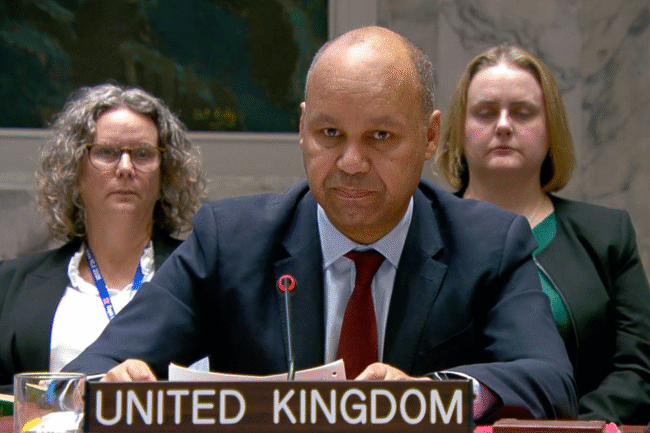
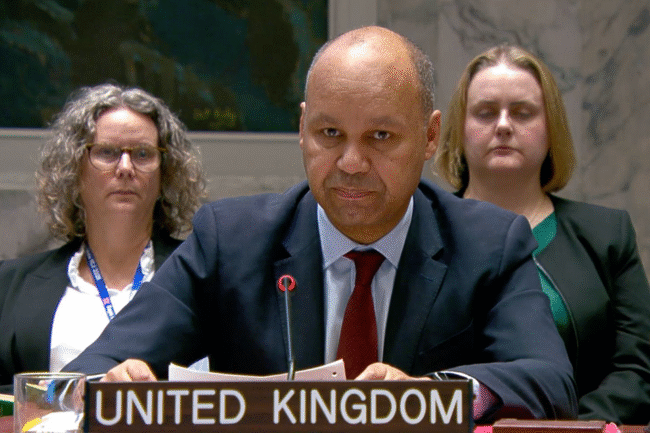
The United Kingdom has issued a formal diplomatic condemnation of the Russian Federation’s deployment of a hypersonic ballistic missile near the border of the Republic of Poland during its latest large-scale military assault on Ukrainian territory. Speaking at the United Nations Security Council on 12 January 2026 in New York, Ambassador James Kariuki, who serves as the Chargé d’Affaires of the United Kingdom to the United Nations, accused Russia of escalating the conflict with a highly destabilizing weapons system while simultaneously making disinformation claims about the strike’s justification.
According to Ukrainian authorities, the overnight attack on 8 January 2026 involved 242 drones and 36 missiles targeting critical civilian and energy infrastructure across Ukraine. Among the weapons used was the Oreshnik intermediate-range ballistic missile, which Ukrainian officials reported struck in the Lviv region in western Ukraine. The United Kingdom emphasized that the impact site lay approximately 50 miles from the Polish border, raising alarms across European security establishments and NATO member states.
The British envoy called the missile strike reckless and dangerous to both regional and international security. He stated that the use of the Oreshnik missile, which is understood to be capable of traveling at speeds exceeding Mach 10, represented a significant risk of miscalculation and escalation within a region where military tensions are already elevated.
Why the proximity to NATO territory marks a critical security threshold for Europe
The Oreshnik missile strike near Lviv marked one of the closest incidents to NATO territory involving Russia’s advanced missile systems in 2026. The city of Przemyśl in eastern Poland lies fewer than 60 miles from the Ukrainian city of Lviv, making the incident highly sensitive from a NATO threat detection perspective. Although the missile strike occurred inside Ukrainian territory, its trajectory, range, and proximity to a North Atlantic Treaty Organization border were seen by Western governments as a potential flashpoint.
The United Kingdom’s statement at the United Nations Security Council placed the strike in the context of broader European security risks. Ambassador Kariuki said the incident was not only a direct threat to Ukraine but also to NATO’s eastern flank. Military analysts in the region have warned repeatedly about the destabilizing potential of hypersonic missile systems such as the Oreshnik, which are difficult to intercept and reduce decision-making timeframes for both defensive and retaliatory responses.
By citing the missile’s range and the missile’s Mach 10-class speed, the United Kingdom drew attention to how the technological characteristics of the Oreshnik complicate early warning protocols and may compromise the integrity of integrated air defence systems across Eastern Europe. Although there were no reports of impact on Polish soil, the British delegation underscored the importance of deterrence stability in high-risk areas and pointed to the role of formal institutional channels like the United Nations in calling out these threats.
How the United Kingdom countered Russia’s justification using formal diplomatic language
The United Kingdom also challenged the Russian Federation’s official explanation for the strike. Russia claimed that the missile launch was in retaliation for an alleged attack on one of President Vladimir Putin’s residences. Ambassador Kariuki said that no such attack had taken place and that the claim was false. He described it as part of an ongoing pattern of disinformation deployed by the Russian government to rationalize its offensive actions in Ukraine.
This use of misinformation as a pretext for kinetic escalation was described by the United Kingdom as unjustified and contrary to the principles of responsible state behaviour under international law. By invoking a fabricated pretext for launching long-range weapons into Ukraine’s western region, the United Kingdom argued that Russia had further undermined its credibility on the global stage.
The British representative’s remarks were part of a broader pattern of Western diplomatic engagement at the United Nations aimed at countering Russia’s narrative framing of the war. Over the past year, the United Kingdom has used Security Council briefings to document Russia’s military operations and contest claims made by Russian envoys. These engagements are designed not only to influence institutional outcomes but also to shape public understanding of the conflict’s dynamics.
Why the United Kingdom framed the Oreshnik strike as incompatible with peace talks in Paris
The United Kingdom’s statement also emphasized the timing of the attack. It occurred during the same week that President Volodymyr Zelenskyy of Ukraine and senior officials from the United States met with European and international leaders in Paris to explore pathways toward a negotiated peace agreement. The British envoy drew a contrast between these diplomatic efforts and the Russian Federation’s decision to conduct a large-scale missile and drone attack across Ukraine.
According to the United Kingdom, Russia’s deployment of the Oreshnik missile at that moment demonstrated a deliberate attempt to undermine diplomatic momentum and disrupt international peacebuilding efforts. Ambassador Kariuki stated that although President Vladimir Putin has publicly stated a willingness to seek peace, his government’s actions on the ground contradict such declarations.
The United Kingdom reaffirmed that any peace must be grounded in the Charter of the United Nations, which recognizes the sovereignty and territorial integrity of all member states. It welcomed what it described as significant progress made through international coordination and pledged to continue working with its partners to achieve a lasting and just resolution.
Why the United Kingdom reiterated long-term security and reconstruction support for Ukraine
In addition to its condemnation of the missile strike, the United Kingdom used its Security Council platform to restate its long-term support for Ukraine’s defence, sovereignty, and reconstruction. Ambassador Kariuki acknowledged that the missile strikes appeared intended to erode Ukrainian morale by targeting energy and heating infrastructure during winter. However, he noted that Ukrainian resilience remained unshaken after four years of war.
He stated that the Ukrainian people were restoring energy services and rebuilding homes even as bombardments continued. The United Kingdom praised Ukraine’s capacity to absorb and recover from such attacks and reiterated that it would continue to ensure the delivery of military and financial assistance to help Ukraine defend itself.
The statement also rejected the idea that such escalations would deter the West. Ambassador Kariuki said if President Putin believed that his government’s use of advanced weaponry would weaken allied resolve, he was mistaken. The United Kingdom pledged to maintain pressure on the Russian Federation to de-escalate hostilities and to engage in meaningful negotiations under international law.
What the United Kingdom’s United Nations statement signals about multilateral strategy
The United Kingdom’s decision to deliver its condemnation at the United Nations Security Council reflected a deliberate strategy to place the issue within a multilateral and rules-based context. While Russia maintains veto power as a permanent member of the council, the United Kingdom has consistently used Security Council sessions to document violations of international norms and to reinforce institutional mechanisms.
By framing the Oreshnik missile strike as a threat to both Ukrainian civilians and European stability, the United Kingdom sought to remind members of the Security Council and the broader international community of the stakes involved. It argued that for the sake of the integrity of the United Nations Charter and global peace, Ukraine must emerge from the war as a sovereign, secure, and independent state.
This final position served to link battlefield developments, institutional diplomacy, and long-term geopolitical objectives into a unified message. The United Kingdom’s remarks also reaffirmed the country’s commitment to accountability, strategic deterrence, and the preservation of international law through formal mechanisms of the United Nations system.
Key takeaways on what this United Nations Security Council development means for Ukraine, Russia, NATO, and international security
- The United Kingdom formally condemned the Russian Federation’s use of the Oreshnik hypersonic intermediate-range ballistic missile during the 8 January 2026 attack on Ukraine, raising the issue at the United Nations Security Council as a matter of regional and international security concern.
- Ukraine reported that the overnight assault involved 242 drones and 36 missiles, with the Oreshnik missile striking near Lviv, approximately 50 miles from the border with Poland, intensifying concerns about escalation risks near North Atlantic Treaty Organization territory.
- The United Kingdom rejected Russia’s claim that the strike was retaliation for an alleged attack on a residence linked to President Vladimir Putin, stating that no such attack occurred and characterizing the justification as disinformation.
- By highlighting the missile’s reported Mach 10-class speed and proximity to NATO borders, the United Kingdom framed the Oreshnik strike as a destabilizing use of advanced weaponry that increases the risk of miscalculation and unintended escalation in Eastern Europe.
- The UK reaffirmed its continued military, financial, and diplomatic support for Ukraine, stating that Russia’s winter attacks on energy infrastructure would not weaken allied resolve or alter the objective of Ukraine emerging from the war as a sovereign, secure, and independent state under the Charter of the United Nations.
Discover more from Business-News-Today.com
Subscribe to get the latest posts sent to your email.