

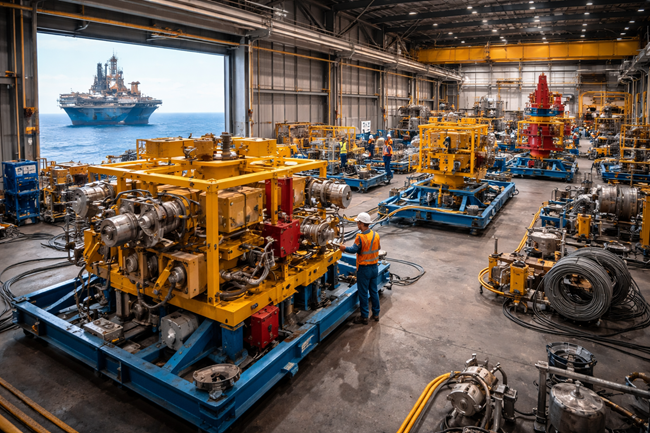
Oil States International, Inc. (NYSE: OIS) reported fourth quarter 2025 revenues of $178 million, adjusted EBITDA of $23 million, and operating cash flow of $50 million, while posting a large GAAP net loss driven almost entirely by non-cash impairments tied to U.S. land restructuring. The results matter less for the headline loss and far more for what they confirm: Oil States International has largely finished dismantling its legacy U.S. land exposure and is now structurally aligned around offshore manufacturing, military contracts, and deepwater technology with improving cash durability.
The quarter effectively closes one chapter and opens another. From an executive or investor standpoint, the key question is no longer whether restructuring pain continues, but whether offshore backlog conversion and capital discipline can deliver sustained returns through the cycle.
Why Oil States International’s fourth quarter numbers are better read as a balance-sheet inflection than an earnings miss
At face value, the fourth quarter looks contradictory. Oil States International reported a GAAP net loss of $117 million, yet generated $50 million in operating cash flow and retired $50 million of convertible debt. The explanation lies almost entirely in the accounting treatment of long-lived assets and inventory tied to the company’s shrinking U.S. land footprint.
Non-cash impairment and restructuring charges exceeded $124 million during the quarter, most of it concentrated in the Downhole Technologies segment and residual U.S. land operations. Once these charges are stripped out, adjusted net income was $8 million, up sequentially, with adjusted EBITDA improving 9 percent quarter over quarter.
From a capital markets lens, this distinction matters. The company did not burn cash to report this loss. It generated cash, reduced leverage, and ended the year with net cash of roughly $15 million. That combination is rare in a quarter that superficially looks disastrous.
The fourth quarter therefore functions less as a profitability snapshot and more as a balance-sheet clean-up event, setting a lower earnings noise floor going into 2026.
How offshore manufactured products quietly became Oil States International’s economic engine
The Offshore Manufactured Products segment is now the core of the company, both operationally and strategically. Segment revenues rose 13 percent sequentially to $123 million, while adjusted segment EBITDA reached $25 million, representing a margin of roughly 20 percent.
More importantly, backlog climbed to $435 million, the highest level since 2015. Quarterly bookings of $160 million produced a book-to-bill ratio of 1.3x, indicating forward demand well in excess of current revenue recognition.
This backlog composition is not generic offshore exposure. A meaningful portion is tied to long-cycle deepwater projects and military equipment contracts, which tend to offer better pricing discipline, longer visibility, and lower customer churn than short-cycle land activity. Management also highlighted incremental long-term military awards during the quarter, reinforcing the segment’s growing defense adjacency.
For investors, this matters because backlog quality often matters more than backlog size. Long-dated offshore and defense manufacturing programs are structurally better suited to smoothing earnings volatility, particularly as global offshore development stabilizes and defense budgets remain politically insulated.
What the completion and production services restructuring tells investors about margin discipline
The Completion and Production Services segment continues to shrink in revenue terms, reporting $23 million in fourth quarter revenues, down sequentially. On the surface, this looks negative. In reality, it reflects deliberate exit from commoditized U.S. land offerings.
Adjusted segment EBITDA margins expanded to 32 percent, up sharply from 12 percent in the prior year period. That margin expansion occurred despite lower revenues, underscoring the effectiveness of facility exits, workforce reductions, and service rationalization executed throughout 2024 and 2025.
This segment now plays a supporting role rather than a growth role. It generates cash, maintains customer relationships, and avoids capital intensity, but it is no longer central to the company’s growth narrative. That is a healthy evolution for a business historically exposed to U.S. shale cyclicality.
Why Downhole Technologies’ impairment may be painful but strategically clarifying
Downhole Technologies recorded over $110 million in non-cash impairments during the quarter, pushing the segment into a reported operating loss that dwarfed all others. While alarming on first read, this move arguably improves transparency.
The impairments reflect management’s conclusion that certain technologies, inventories, and assets will not generate acceptable returns under current market conditions. Rather than drag these assets forward indefinitely, the company chose to reset their carrying value and lower future depreciation and amortization expense.
Adjusted segment EBITDA for Downhole Technologies turned modestly positive in the quarter, suggesting that the remaining asset base can operate near breakeven without further capital infusion. Strategically, this limits downside risk and prevents the segment from consuming disproportionate management attention or cash.
For investors, this is less about recovery upside and more about risk containment.
How Oil States International’s cash generation and debt actions reshape its risk profile
Perhaps the most underappreciated element of the quarter is cash flow. Operating cash flow reached $50 million in the fourth quarter and $105 million for the full year. Free cash flow exceeded $53 million in the quarter.
That cash was deployed decisively. Oil States International retired $50 million of its 4.75 percent convertible senior notes and repurchased approximately 5 percent of outstanding shares during the year. It ended 2025 with $70 million in cash and no borrowings outstanding under its credit facilities.
In January 2026, the company replaced its asset-based revolver with a cash-flow-based credit agreement providing up to $125 million in total capacity. This shift matters. Cash-flow-based facilities are typically granted to businesses with more predictable earnings profiles, reinforcing management’s confidence in the post-restructuring operating model.
The result is a company with lower leverage, greater financial flexibility, and optionality to reinvest selectively in offshore technology or return capital if conditions allow.
What Oil States International’s technology disclosures signal about future positioning
The company’s 2025 technology highlights are not cosmetic additions. They signal where capital and engineering effort are being concentrated.
Managed Pressure Drilling and Riser Gas Handling systems target deepwater efficiency and safety improvements, areas where operators are increasingly willing to pay for reliability. The Low Impact Workover Package expands the company’s subsea intervention toolkit, addressing decommissioning and abandonment demand that is growing globally.
Most strategically intriguing is the Merlin Deepsea Mineral Riser System, deployed at record water depths to support seabed mineral harvesting. While still niche, this technology aligns Oil States International with long-term critical minerals narratives tied to energy transition supply chains.
Taken together, these platforms reinforce the company’s identity as a high-specification offshore engineering provider rather than a general oilfield services vendor.
How investors are likely to interpret Oil States International’s post-restructuring setup
From a sentiment standpoint, Oil States International remains a misunderstood name. The headline GAAP loss obscures improving fundamentals, while historical association with U.S. land services may continue to anchor outdated valuation frameworks.
Institutional investors focused on cash flow durability, backlog quality, and balance-sheet strength are more likely to see the fourth quarter as a clearing event. The company exits 2025 with cleaner assets, lower leverage, and a business mix increasingly aligned with offshore and defense spending rather than shale volatility.
The primary risk remains execution. Offshore backlog must convert into revenue without cost overruns, and technology investments must translate into repeat orders rather than one-off deployments. However, the asymmetry has improved. Downside from restructuring is largely realized, while upside from backlog conversion remains ahead.
What Oil States International’s Q4 2025 reset signals for earnings durability, capital discipline, and investor risk in 2026
The fourth quarter of 2025 does not mark a turnaround in the traditional sense. It marks a reset. Oil States International has accepted the cost of abandoning parts of its past to concentrate on areas where it retains competitive relevance and pricing power.
If offshore manufacturing demand holds and defense contracts continue to accumulate, the company enters 2026 with a more resilient earnings base than at any point in the past decade. If execution falters, the strengthened balance sheet provides time and flexibility that did not exist in prior cycles.
Either way, the company is no longer defined by U.S. land exposure. That alone materially changes how the story should be analyzed.
Key takeaways on what Oil States International’s Q4 2025 results mean for investors and the offshore services market
The headline GAAP loss materially overstates operational weakness, as fourth quarter results were dominated by non-cash impairments tied to U.S. land exits rather than cash burn or demand erosion.
Offshore Manufactured Products has clearly become the company’s economic core, with record backlog levels, a book-to-bill ratio above 1x, and margins that support earnings visibility into 2026.
The company has effectively completed its U.S. land restructuring, removing a structurally volatile earnings drag that historically amplified downside risk during commodity cycles.
Strong operating cash flow enabled Oil States International to retire $50 million of convertible debt and maintain a net cash position, materially improving balance-sheet flexibility.
The transition to a cash-flow-based credit facility signals lender confidence in post-restructuring earnings durability rather than reliance on asset values.
Completion and Production Services is no longer a growth engine but now functions as a higher-margin, lower-risk cash contributor after aggressive cost and footprint rationalisation.
Downhole Technologies impairments compress near-term reported results but reduce future earnings noise and cap ongoing capital exposure to underperforming assets.
Technology investments increasingly align with deepwater, military, and critical-minerals-adjacent demand, positioning the company away from short-cycle shale volatility.
Investor focus in 2026 is likely to shift from restructuring execution toward offshore backlog conversion, margin stability, and disciplined capital allocation.
The risk-reward profile has improved asymmetrically, with most restructuring downside realised while upside remains linked to offshore project execution and order flow continuity.
Discover more from Business-News-Today.com
Subscribe to get the latest posts sent to your email.